Review
. 2023 Aug 21:43:385-407.
doi: 10.1146/annurev-nutr-061021-025153.

Precision Nutrition: The Hype Is Exceeding the Science and Evidentiary Standards Needed to Inform Public Health Recommendations for Prevention of Chronic Disease

Affiliations
Review

Precision Nutrition: The Hype Is Exceeding the Science and Evidentiary Standards Needed to Inform Public Health Recommendations for Prevention of Chronic Disease

Regan L Bailey et al. Annu Rev Nutr. .

Abstract

As dietary guidance for populations shifts from preventing deficiency disorders to chronic disease risk reduction, the biology supporting such guidance becomes more complex due to the multifactorial risk profile of disease and inherent population heterogeneity in the diet-disease relationship. Diet is a primary driver of chronic disease risk, and population-based guidance should account for individual responses. Cascading effects on evidentiary standards for population-based guidance are not straightforward. Precision remains a consideration for dietary guidance to prevent deficiency through the identification of population subgroups with unique nutritional needs. Reducing chronic disease through diet requires greater precision in (a) establishing essential nutrient needs throughout the life cycle in both health and disease; (b) considering effects of nutrients and other food substances on metabolic, immunological, inflammatory, and other physiological responses supporting healthy aging; and (c) considering healthy eating behaviors. Herein we provide a template for guiding population-based eating recommendations for reducing chronic diseases in heterogenous populations.

Keywords: biological variation; dietary recommendations; nutrient requirements; nutrition policy; precision nutrition; public health.


Figures
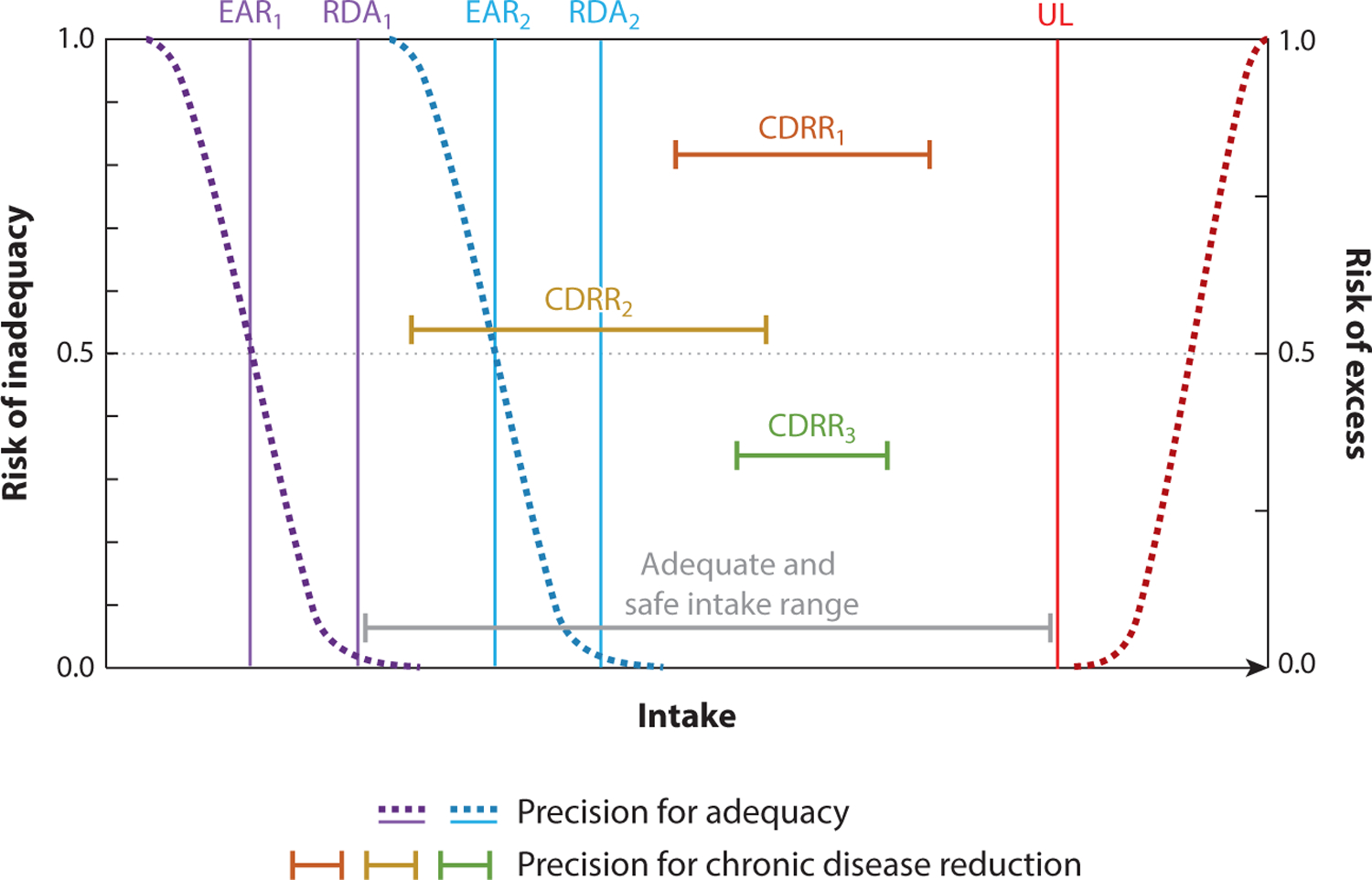
Figure 1
Figure 1
Dietary Reference Intakes (DRIs) taking population, precision, and personalized approaches. DRIs for nutrients and other food substances (NOFS) are established independently to maintain adequacy or risk of excess at the population and individual level [Estimated Average Requirement (EAR) and Recommended Daily Allowance (RDA)] and/or for Chronic Disease Risk Reduction (CDRR). Note that a CDRR can be lower than the RDA. The Adequate Intake (AI) does not have a consistent relationship like the EAR or the RDA and is therefore not presented in this figure; however, it is generally assumed that the AI value would be within the adequate and safe intake range (gray horizontal bar). The dashed curves indicate the level of risk (range between 0 and 1); dietary intakes that are within the range of the established RDA and the Tolerable Upper Intake Level (UL) are generally considered to be very low risk for most in a population group or at the individual level. Precision is introduced into the DRI process for essential nutrients when differences in requirements are identified currently within a subgroup on the basis of age, sex, or life stage (i.e., lactation and pregnancy), leading to separate recommendations for each subgroup group (RDA1, RDA2; EAR1, EAR2). DRIs set for chronic disease reduction for any given NOFS are expressed as ranges, unlike RDAs and EARs, which are discrete values. Precision is introduced into CDRRs (CDRR1, CDRR2, CDRR3) through identification of a population subgroup that is likely to respond similarity to a dietary exposure and by setting the end point for different or co-occurring disease states. Requirements that fall outside an adequate and safe intake level are very likely to require a more personalized approach than frameworks established to date. Some of this figure and caption language was adapted from Reference ; copyright 2000 National Academy of Sciences.
Figure 2
Figure 2
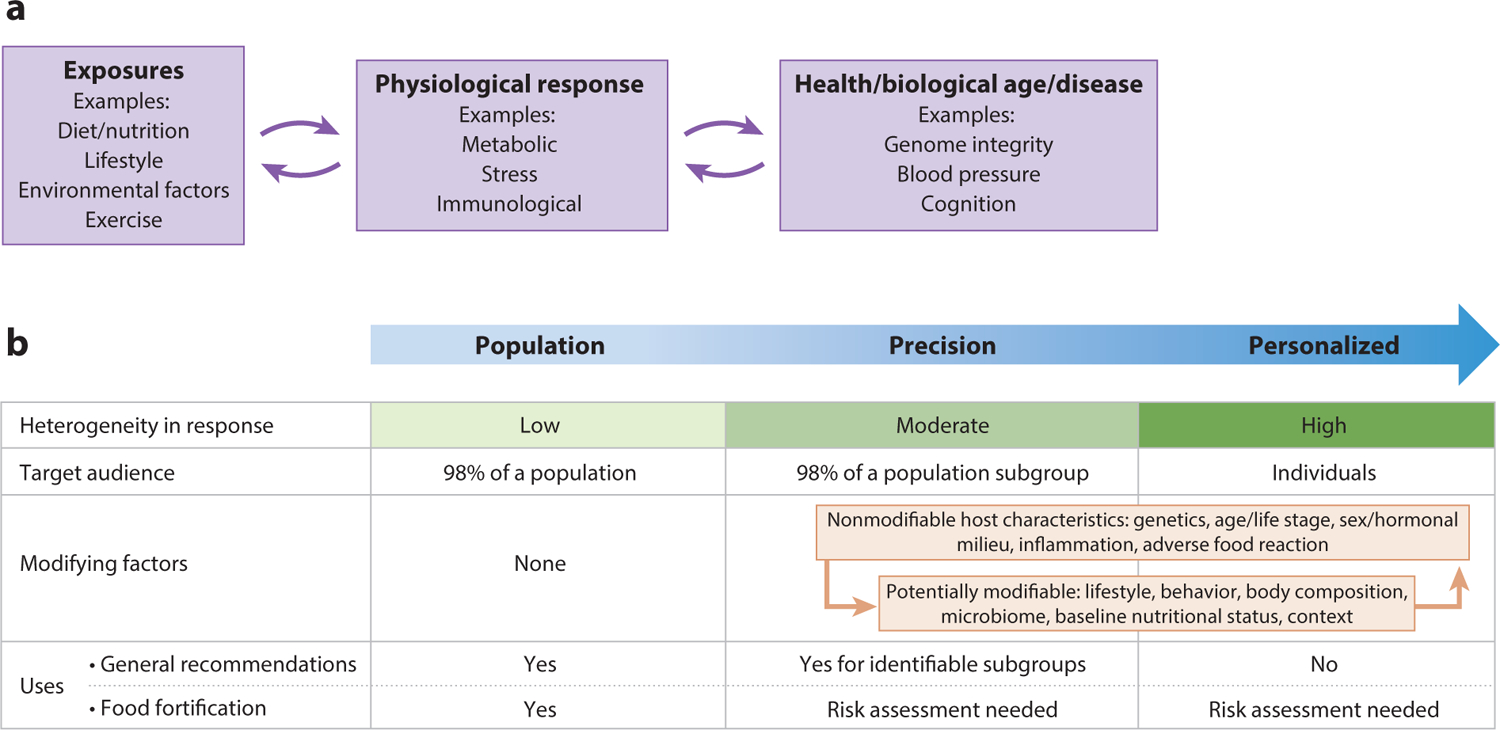
(a) Biomarkers linking exposures to disease. Implementing precision nutrition requires knowledge, tools, and measures (e.g., biomarkers) that quantify and connect exposures to physiological responses that influence health, disease, or validated surrogate markers. It is important to note that the connection between exposures and physiological response is reciprocal through feedback loops (e.g., diet can affect inflammation, which in turn affects dietary needs), and that physiological responses are reciprocal with health/disease/aging. (b) The relationships among and use of population, precision, and personalized nutrition approaches. Modifying factors that drive precision include those factors that are intrinsic to the host (e.g., genetics/ancestral history, age) and modifiable and dynamic factors that may change across the life course (e.g., physical activity, sleep, stress, microbiome). Precision nutrition is the classification of modifiable factors that alone or in combination with fixed factors may lead to a differential metabolic response to dietary exposures. Additionally, there are interactions between and among these factors, which add complexity to the precision nutrition lens and are much less predictable and quantifiable than each factor in isolation.
Figure 3
Figure 3
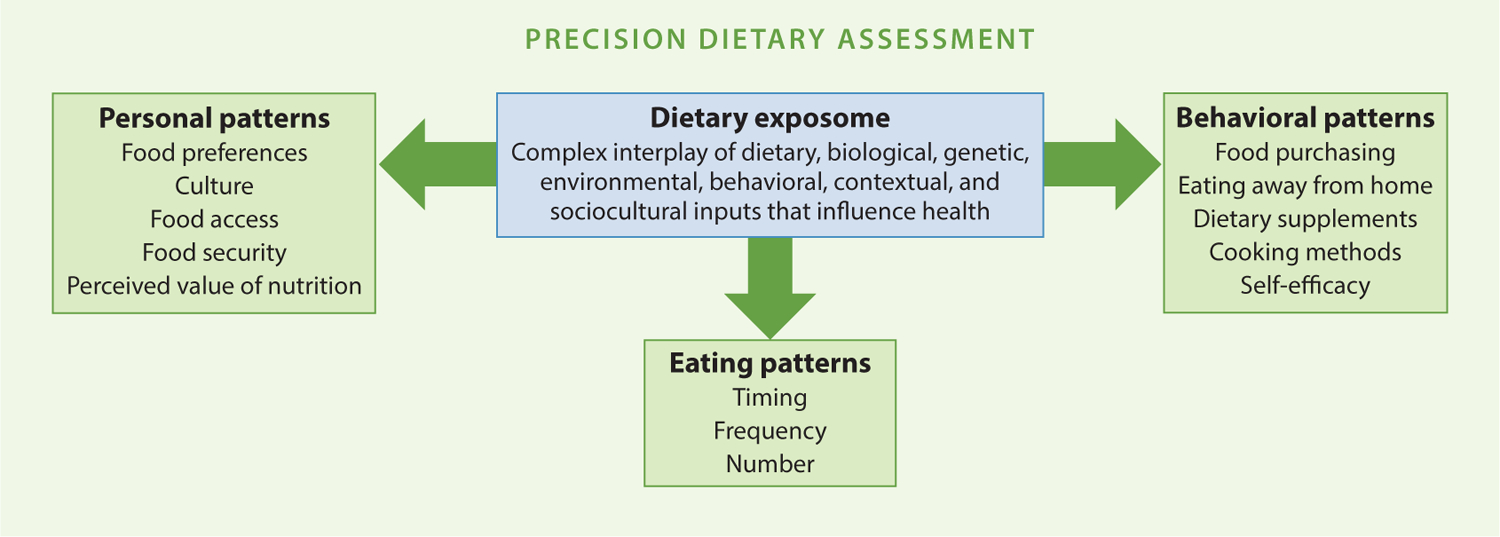
Defining the dietary exposome and additional factors that will need to be captured to improve precision nutrition guidance. Some of the many example factors (i.e., components of personal, eating, and behavioral patterns) of interest that are critical to capture or consider as part of improved dietary assessment methods are shown; please note that this example is not exhaustive of the multitude of factors that may be relevant for research and monitoring purposes.

References

    1. Appleton KM, Voyias PD, Sallis HM, Dawson S, Ness AR, et al. 2021. Omega-3 fatty acids for depression in adults. Cochrane Database Syst. Rev 11:CD004692. - PMC - PubMed
    1. Asbaghi O, Ashtary-Larky D, Bagheri R, Moosavian SP, Nazarian B, et al. 2021. Effects of folic acid supplementation on inflammatory markers: a grade-assessed systematic review and dose-response meta-analysis of randomized controlled trials. Nutrients 13:2327. - PMC - PubMed
    1. Axelrad JE, Lichtiger S, Yajnik V. 2016. Inflammatory bowel disease and cancer: the role of inflammation, immunosuppression, and cancer treatment. World J. Gastroenterol 22:4794–801 - PMC - PubMed
    1. Bailey RL, Ard JD, Davis TA, Naimi TS, Schneeman BO, et al. 2021. A proposed framework for identifying nutrients and food components of public health relevance in the Dietary Guidelines for Americans. J. Nutr 151:1197–1204 - PMC - PubMed
    1. Bailey RL, Gahche JJ, Lentino CV, Dwyer JT, Engel JS, et al. 2011. Dietary supplement use in the United States, 2003–2006. J. Nutr 141:261–66 - PMC - PubMed