


Assessment of patellar cartilage cross-sectional area in patients with lower grade chondromalacia patella
- PMID: 37603532
- PMCID: PMC10443766
- DOI: 10.1097/MD.0000000000034307
Assessment of patellar cartilage cross-sectional area in patients with lower grade chondromalacia patella
Abstract
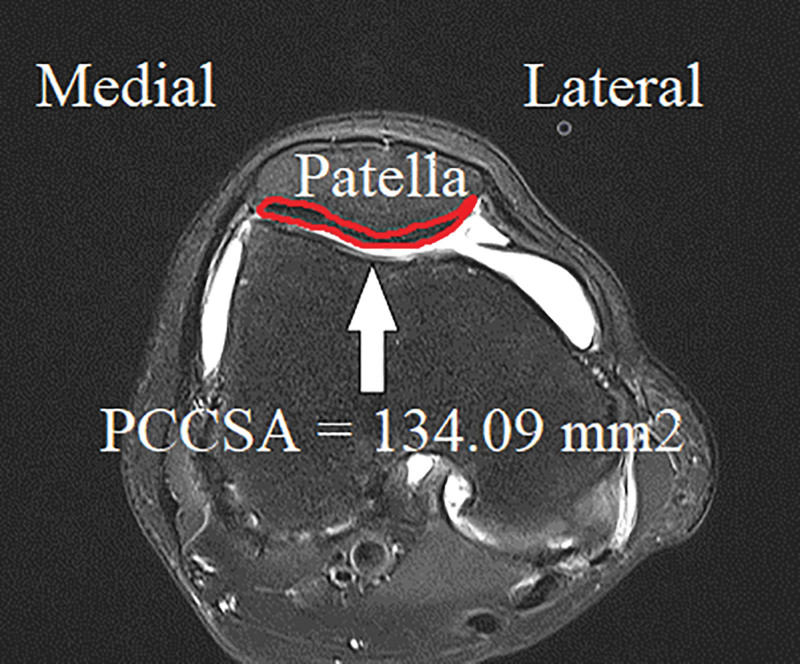
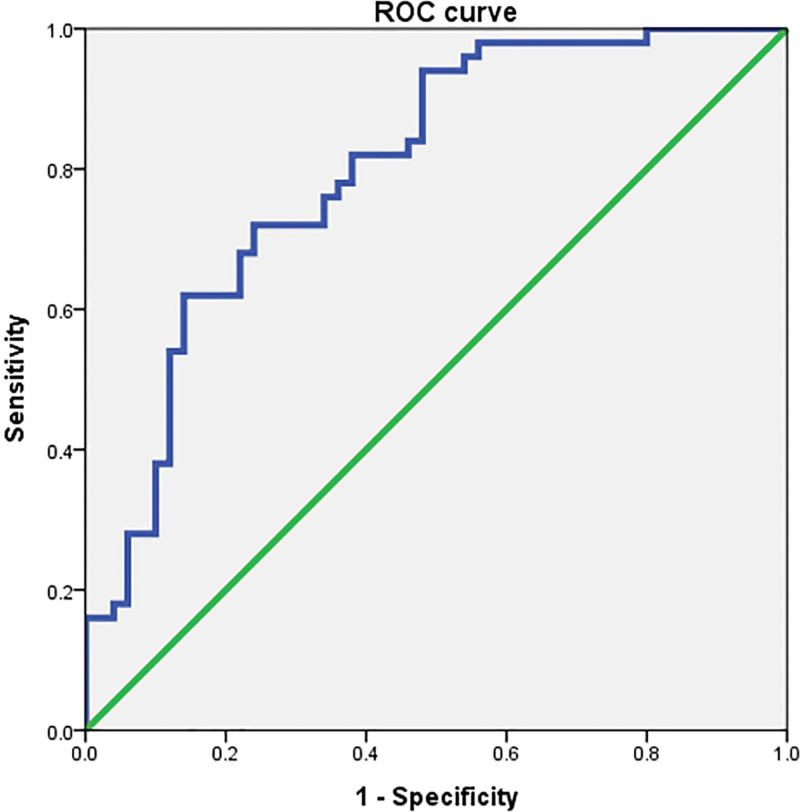
Chondromalacia patella (CMP) is abnormal softening of the cartilage of the underside the patella. It is a cause of anterior knee pain. Previous study has demonstrated that the patellar cartilage hypertrophy is correlated with early signs of CMP (Grade 1 or 2). However, no studies have investigated the clinical cutoff value of patella cartilage hypertrophy. Thus, we devised the patellar cartilage cross-sectional area (PCCSA) as a new predictive parameter for diagnosing the CMP. The purpose of this research was to compare MR measured PCCSA between CMP patients and gender matched healthy controls. The PCCSA samples were collected from 50 patients with CMP, and from 50 healthy controls who underwent knee MRI with no evidence of CMP. The T2-weighted turbo spin echo transverse MRI images were acquired. We measured the PCCSA on MRI using a PACS system. The PCCSA was measured on the axial angled sections through the whole images by drawing outlines. The average PCCSA was 104.28 ± 23.28 mm2 in the healthy controls and 134.09 ± 26.55 mm2 in the CMP group. CMP patients had significantly higher PCCSA (P < .001). Regarding the validity of PCCSA as predictors of CMP, Receiver Operating Characteristic curve analysis showed that the best cutoff point for the PCCSA was 116.24 mm2, with 72.0% sensitivity, 72.0% specificity, and the area under curve (AUC) of 0.79 (0.71-0.88). The PCCSA is a sensitive measurement parameter to predict low grade CMP. Thus, to evaluate CMP patients, the treating physician carefully inspect the PCCSA.
Copyright © 2023 the Author(s). Published by Wolters Kluwer Health, Inc.
Conflict of interest statement
The authors have no conflicts of interest to disclose.
Figures
References
-
- Duran S, Cavusoglu M, Kocadal O, et al. . Association between trochlear morphology and chondromalacia patella: an MRI study. Clin Imaging. 2017;41:7–10. - PubMed
-
- Tuna BK, Semiz-Oysu A, Pekar B, et al. . The association of patellofemoral joint morphology with chondromalacia patella: a quantitative MRI analysis. Clin Imaging. 2014;38:495–8. - PubMed
-
- Zha GC, Feng S, Chen XY, et al. . Does the grading of chondromalacia patellae influence anterior knee pain following total knee arthroplasty without patellar resurfacing? Int Orthop. 2018;42:513–8. - PubMed
MeSH terms
LinkOut - more resources
Full Text Sources
Medical
