. 2023 Aug 21;13(1):13556.
doi: 10.1038/s41598-023-40732-2.

Chemical cannibalistic cues make damselfly larvae hide rather than hunt

Affiliations

Chemical cannibalistic cues make damselfly larvae hide rather than hunt

Monika Sysiak et al. Sci Rep. .

Abstract

Adopting cannibalism substantially affects individual fitness, and recognizing the presence of other cannibals provides additional benefits such as the opportunity to prepare for hunting or defense. This recognition can be facilitated by perceiving conspecific chemical cues. Their role in cannibalistic interactions is less studied than in interspecific predation and it is unclear whether these cues inform individuals of danger or of food availability. Interpretation of these cues is crucial to balance the costs and benefits of anti-predator and feeding strategies, which can directly influence individual fitness. In this study we aimed to test whether damselfly larvae shift towards bolder and more exploratory (cannibalistic) behavior, or become more careful to avoid potential cannibals (as prey) in response to such cues. We conducted behavioral and respiratory experiments with Ischnura elegans larvae to investigate their response to chemical cues from older and larger conspecific larvae. We found that I. elegans larvae decrease their activity and shift their respiratory-related behavior, indicating activation of anti-predator defense mechanisms in response to conspecific chemical cues. Our findings indicate that individuals exposed to conspecific chemical cues balance catching prey with staying safe.


Conflict of interest statement

The authors declare no competing interests.

Figures
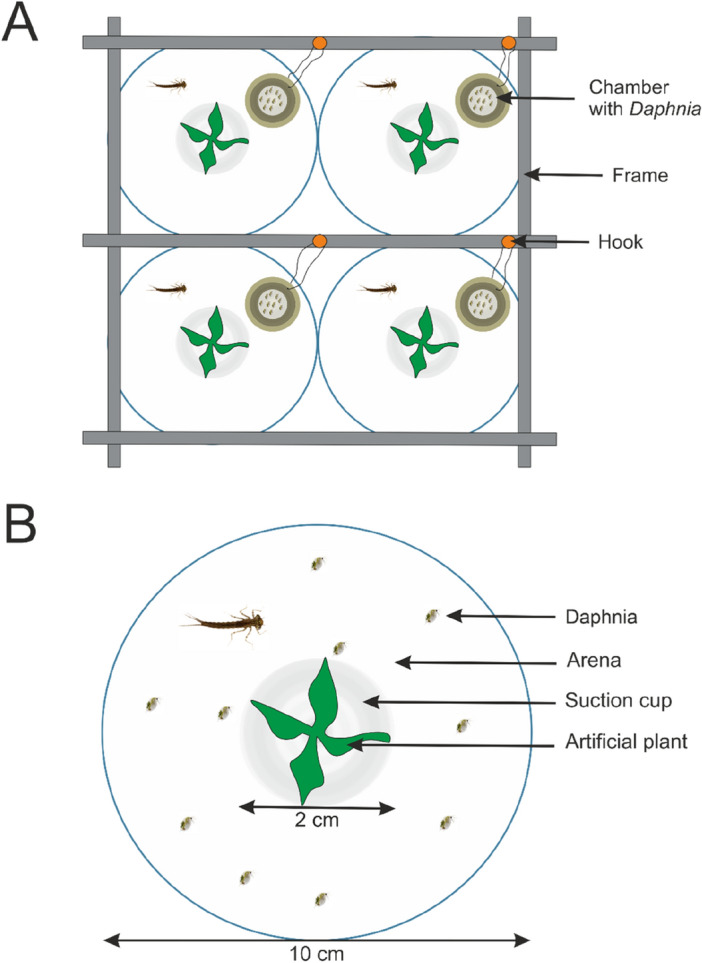
Figure 1
Figure 1
Experimental setup. (A) Feeding device with cylindrical bottomless chambers holding Daphnia while resting on the bottom of the experimental containers, four containers in sight. The chambers were tied to hooks on the rack (gray) and lifted during feeding, (B) An individual experimental container with arena zone and refuge zone (artificial plant on suction cup) with Daphnia released.
Figure 2
Figure 2
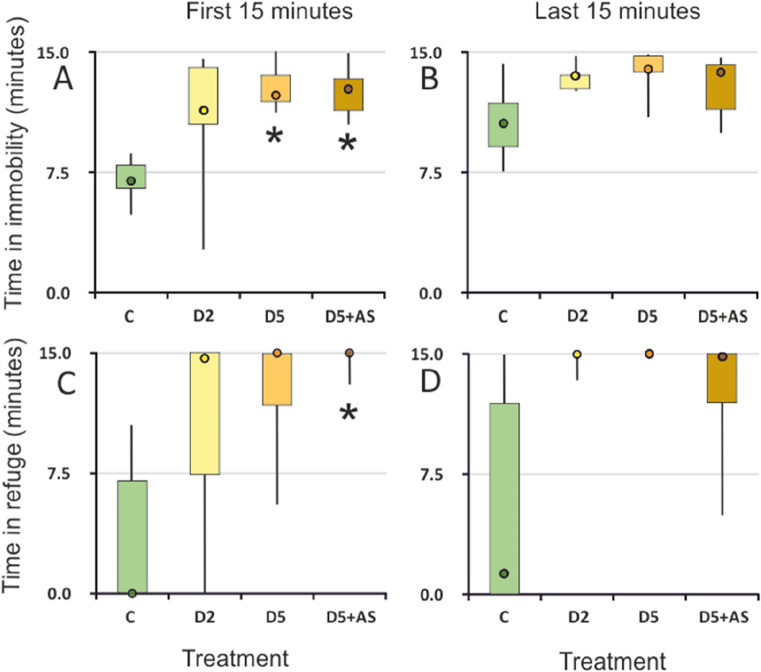
Time spent immobile (A, B) and time spent in refuge (C, D) by I. elegans exposed to different concentrations of kairomones (C, D2, D5) or kairomones with alarm signal (D5 + AS); Median (circle), 1st and 3rd quartiles (box), min/max (whiskers), *denotes treatments significantly different from the control treatment, C.
Figure 3
Figure 3
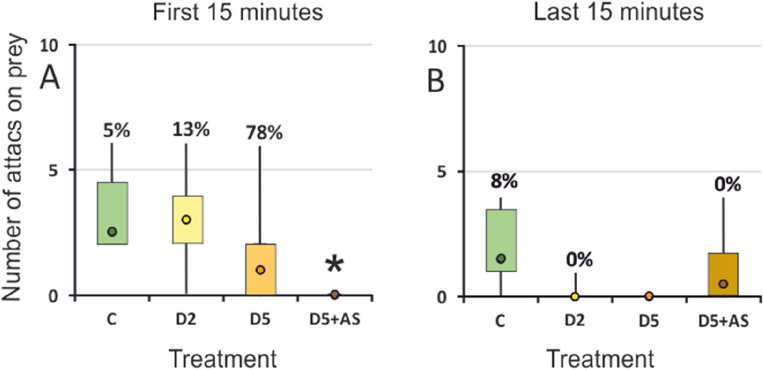
Total number of attacks on Daphnia by I. elegans exposed to different concentrations of kairomones (C, D2, D5) or kairomones with alarm signal (D5 + AS) in the first 15 min (A), and the last 15 min (B) of the experiment; Median (circle), 1st and 3rd quartiles (box), min/max (whiskers); Percentages of successful attacks are given over the whiskers; *denotes treatments significantly different from the control treatment (C).
Figure 4
Figure 4
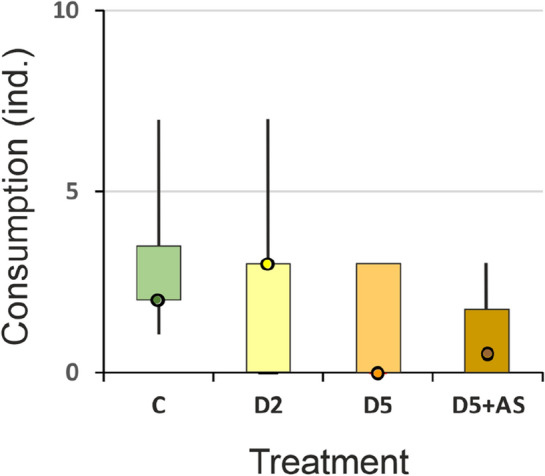
Number of Daphnia consumed by I. elegans exposed to different concentrations of kairomones (C, D2, D5) or kairomones with alarm signal (D5 + AS); Median (circle), 1st and 3rd quartiles (box), min/max (whiskers).
Figure 5
Figure 5
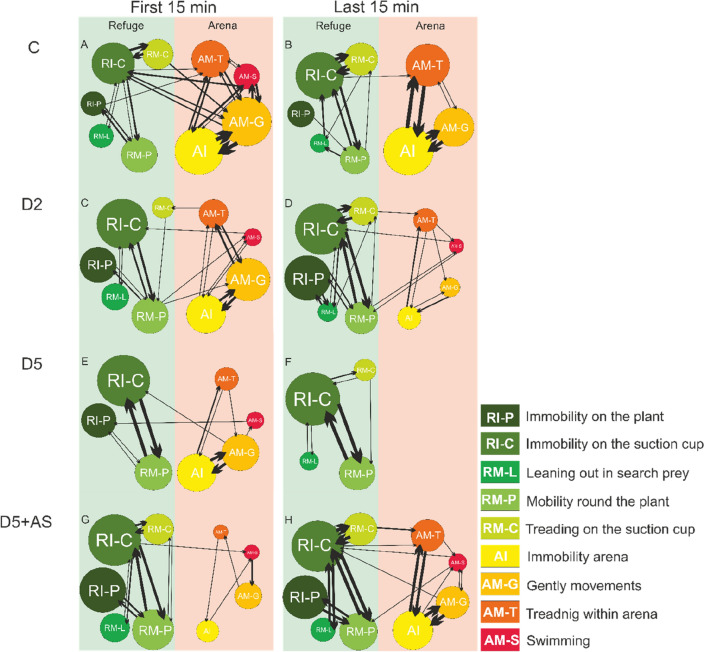
Behavioral patterns of experimental I. elegans larvae in each of the four treatments: C (A, B), D2 (C, D), D5 (E, F) and D5 + AS (G, H). The size of the bubble is proportional to the time spent on the behavior. The thickness of the arrow is proportional to the number of transitions between behaviors. Green colors indicate behaviors considered safe (in refuge), and red-yellow colors are for ones considered dangerous (in the open arena) for the odonates.
Figure 6
Figure 6
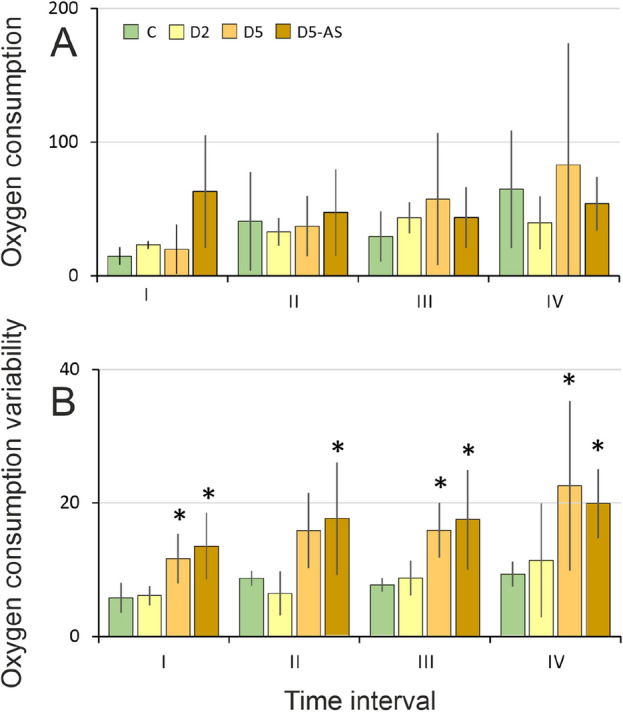
Mean oxygen consumption (O2 μmol/ individual mass (mg)) (A), and mean oxygen consumption variability (B) of I. elegans exposed to different concentrations of kairomones (C, D2, D5) or kairomones with alarm signal (D5 + AS). I–IV consecutive time intervals lasting three hours each. The bars indicate standard deviation. * denotes treatments significantly different from the control treatment (C) according to LSD (p < 0.05).

References

    1. Fox LR. Cannibalism in natural populations. Ann. Rev. Ecol. Syst. 1975;6:87–106.
    1. Claessen D, De Roos AM, Persson L. Population dynamic theory of size–dependent cannibalism. Proc. R. Soc. Lond. Ser. B Biol. Sci. 2004;271:333–340. - PMC - PubMed
    1. Bose AP. Parent–offspring cannibalism throughout the animal kingdom: a review of adaptive hypotheses. Biol. Rev. 2022;97:1868–1885. - PubMed
    1. Arvaniti K, Fantinou A, Perdikis D. Cannibalism among same-aged nymphs of the omnivorous predator Dicyphus errans (Hemiptera: Miridae) is affected by food availability and nymphal density. Eur. J. Entomol. 2019;116:302–308.
    1. Polis GA. The evolution and dynamics of intraspecific predation. Annu. Rev. Ecol. Syst. 1981;12:225–251.

Publication types