


Machine learning for the prediction of atherosclerotic cardiovascular disease during 3-year follow up in Chinese type 2 diabetes mellitus patients
- PMID: 37605871
- PMCID: PMC10583655
- DOI: 10.1111/jdi.14069
Machine learning for the prediction of atherosclerotic cardiovascular disease during 3-year follow up in Chinese type 2 diabetes mellitus patients
Abstract
Aims/introduction: Clinical guidelines for the management of individuals with type 2 diabetes mellitus endorse the systematic assessment of atherosclerotic cardiovascular disease risk for early interventions. In this study, we aimed to develop machine learning models to predict 3-year atherosclerotic cardiovascular disease risk in Chinese type 2 diabetes mellitus patients.
Materials and methods: Clinical records of 4,722 individuals with type 2 diabetes mellitus admitted to 94 hospitals were used. The features included demographic information, disease histories, laboratory tests and physical examinations. Logistic regression, support vector machine, gradient boosting decision tree, random forest and adaptive boosting were applied for model construction. The performance of these models was evaluated using the area under the receiver operating characteristic curve. Additionally, we applied SHapley Additive exPlanation values to explain the prediction model.
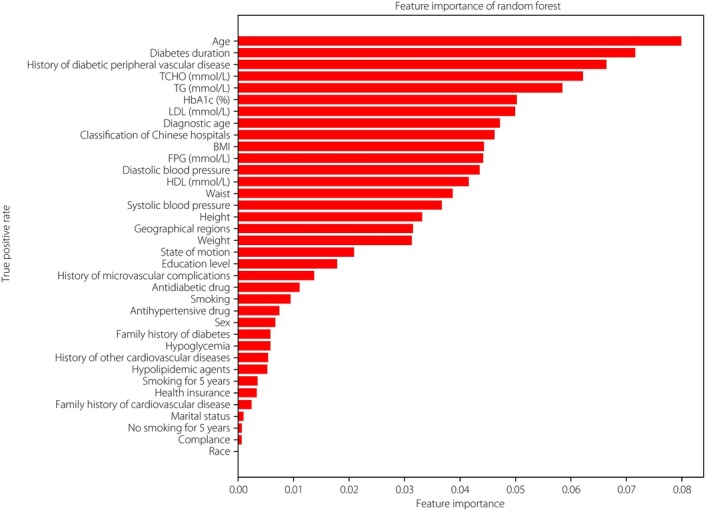
Results: All five models achieved good performance in both internal and external test sets (area under the receiver operating characteristic curve >0.8). Random forest showed the highest discrimination ability, with sensitivity and specificity being 0.838 and 0.814, respectively. The SHapley Additive exPlanation analyses showed that previous history of diabetic peripheral vascular disease, older populations and longer diabetes duration were the three most influential predictors.
Conclusions: The prediction models offer opportunities to personalize treatment and maximize the benefits of these medical interventions.
Keywords: Atherosclerotic cardiovascular disease; Machine learning; Type 2 diabetes mellitus.
© 2023 The Authors. Journal of Diabetes Investigation published by Asian Association for the Study of Diabetes (AASD) and John Wiley & Sons Australia, Ltd.
Conflict of interest statement
The authors declare no conflict of interest. Linong Ji is an Editorial Board member of
Approval of the research protocol: Protocol for the research project has been approved. Ethical approval was obtained by the ethics committees of Peking University People's Hospital and all participating hospitals, and it conforms to the provisions of the Declaration of Helsinki.
Informed consent: All patients signed the informed consent before data collection.
Registry and the registration no. of the study/trial: N/A.
Animal studies: N/A.
Figures




References
-
- Magliano D, Boyko EJ. IDF Diabetes Atlas. Brussels, Belgium: International Diabetes Federation, 2021. - PubMed
-
- Draznin B, Aroda VR, Bakris G, et al. 10. Cardiovascular disease and risk management: Standards of medical Care in Diabetes‐2022. Diabetes Care 2022; 45(Supplement_1): S144–S174. - PubMed
-
- Arnett DK, Blumenthal RS, Albert MA, et al. 2019 ACC/AHA guideline on the primary prevention of cardiovascular disease: Executive summary: A report of the American College of Cardiology/American Heart Association task force on clinical practice guidelines. Circulation 2019; 140: e563–e595. - PMC - PubMed
-
- Petruzzo M, Reia A, Maniscalco GT, et al. The Framingham cardiovascular risk score and 5‐year progression of multiple sclerosis. Eur J Neurol 2021; 28: 893–900. - PubMed
MeSH terms
LinkOut - more resources
Full Text Sources
Medical
