


Inflammatory Biomarker Profiles in Very Preterm Infants within the Context of Preeclampsia, Chorioamnionitis, and Clinically Diagnosed Postnatal Infection
- PMID: 37606448
- PMCID: PMC10443264
- DOI: 10.3390/pediatric15030044
Inflammatory Biomarker Profiles in Very Preterm Infants within the Context of Preeclampsia, Chorioamnionitis, and Clinically Diagnosed Postnatal Infection
Abstract
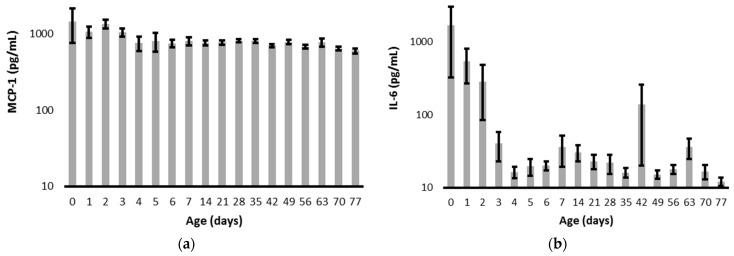
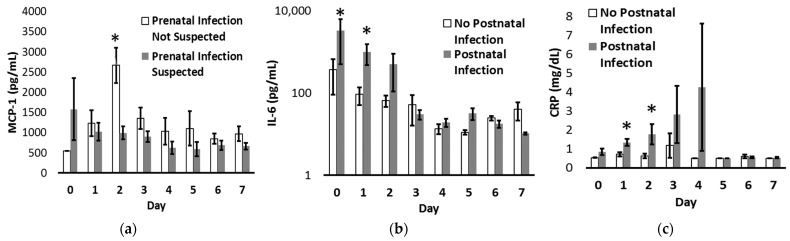
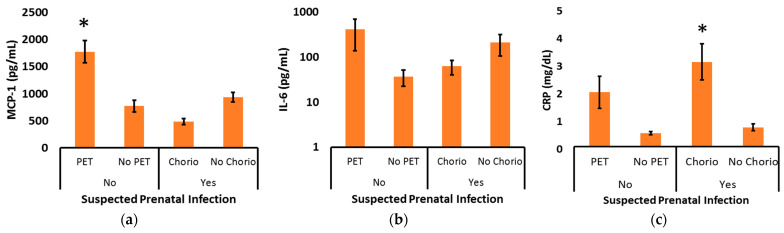
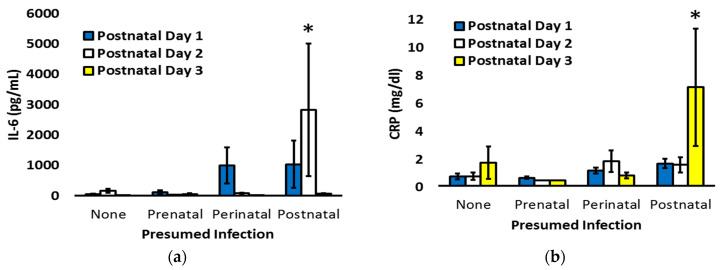
Preterm delivery can be precipitated by preeclampsia or infection, and preterm infants are at heightened risk of postnatal infection. Little is known about the ontogeny of inflammatory biomarkers in extremely preterm infants. We hypothesized that suspected prenatal infection (clinical chorioamnionitis or spontaneous preterm labor) and clinically diagnosed postnatal infection would be associated with unique biomarker signatures, and those patterns would be influenced by the degree of prematurity. Venous blood was collected daily for the first week and weekly for up to 14 additional weeks from 142 neonates born at 22-32 weeks gestation. A custom array was utilized to measure monocyte chemoattractant protein-1 (MCP-1) and interleukin-6 (IL-6). C-reactive protein (CRP) levels were obtained from the electronic medical record. Independent of gestational age, MCP-1 was significantly increased (p < 0.001) in association with maternal preeclampsia, but MCP-1 was decreased (p < 0.01), and CRP was increased (p < 0.01) in the presence of chorioamnionitis with funisitis. IL-6 and CRP were both increased in infants diagnosed with postnatal infection, with peak levels observed on days 2 and 3, respectively. In conclusion, suspected prenatal and postnatal infections and non-infectious complications of pregnancy are associated with unique biomarker profiles, independent of gestational age, including over a 2-fold increase in MCP-1 among newborns of mothers with preeclampsia. Further, in those clinically diagnosed with a postnatal infection in the absence of antenatal infection concerns, IL-6 increases before CRP, emphasizing a potential role for expanded biomarker screening if antibiotics are initially avoided in infants delivered for maternal indications.
Keywords: adipokine; chemokine (C-C motif) ligand 2; interleukin-6; leptin; neonatal; preeclampsia.
Conflict of interest statement
The authors declare no conflict of interest. The funders had no role in the design of the study; in the collection, analyses, or interpretation of data; in the writing of the manuscript; or in the decision to publish the results.
Figures
References
-
- Stoll B.J., Hansen N.I., Bell E.F., Walsh M.C., Carlo W.A., Shankaran S., Laptook A.R., Sánchez P.J., Van Meurs K.P., Wyckoff M., et al. Trends in care practices, morbidity, and mortality of extremely preterm neonates, 1993–2012. JAMA. 2015;314:1039–1051. doi: 10.1001/jama.2015.10244. - DOI - PMC - PubMed
-
- Schmatz M., Srinivasan L., Grundmeier R.W., Elci O.U., Weiss S.L., Masino A.J., Tremoglie M., Ostapenko S., Harris M.C. Surviving sepsis in a referral neonatal intensive care unit: Association between time to antibiotic administration and in-hospital outcomes. J. Pediatr. 2020;217:59–65. doi: 10.1016/j.jpeds.2019.08.023. - DOI - PubMed
Grants and funding
LinkOut - more resources
Full Text Sources
Research Materials
Miscellaneous
