Does humeral fixation technique affect long-term outcomes of total shoulder arthroplasty?
- PMID: 37607863
- PMCID: PMC10497929
- DOI: 10.5397/cise.2023.00199
Does humeral fixation technique affect long-term outcomes of total shoulder arthroplasty?
Abstract
Background: For anatomic total arthroscopic repair, cementless humeral fixation has recently gained popularity. However, few studies have compared clinical, radiographic, and patient-reported outcomes between cemented and press-fit humeral fixation, and none have performed follow-up for longer than 5 years. In this study, we compared long-term postoperative outcomes in patients receiving a cemented versus press-fit humeral stem anatomic arthroscopic repair.
Methods: This study retrospectively analyzed 169 shoulders that required primary anatomic total shoulder arthroplasty (aTSA). Shoulders were stratified by humeral stem fixation technique: cementation or press-fit. Data were collected pre- and postoperatively. Primary outcome measures included range of motion, patient reported outcomes, and radiographic measures.
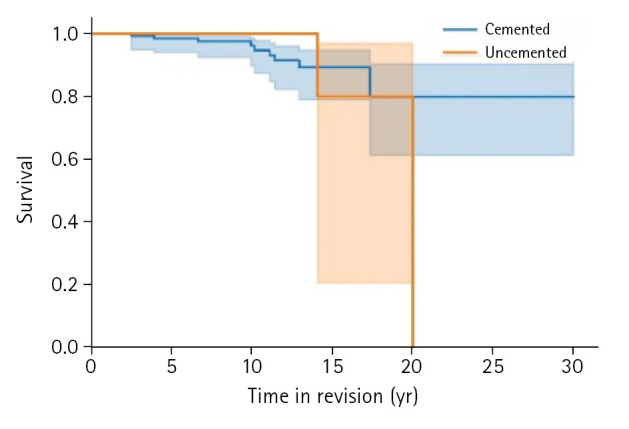
Results: One hundred thirty-eight cemented humeral stems and 31 press-fit stems were included. Significant improvements in range of motion were seen in all aTSA patients with no significant differences between final cemented and press-fit stems (forward elevation: P=0.12, external rotation: P=0.60, and internal rotation: P=0.77). Patient reported outcome metrics also exhibited sustained improvement through final follow-up. However, at final follow-up, the press-fit stem cohort had significantly better overall scores when compared to the cemented cohort (visual analog score: P=0.04, American Shoulder and Elbow Surgeon Score: P<0.01, Simple Shoulder Test score: P=0.03). Humeral radiolucency was noted in two cemented implants and one press-fit implant. No significant differences in implant survival were observed between the two cohorts (P=0.75).
Conclusions: In this series, we found that irrespective of humeral fixation technique, aTSA significantly improves shoulder function. However, within this cohort, press-fit stems provided significantly better outcomes than cemented stems in terms of patient reported outcome scores. Level of evidence: III.
Keywords: Cemented; Long-term outcomes; Press-fit; Shoulder; Replacement arthroplasty.
Conflict of interest statement
Dave Shukla is a consultant for Stryker, Tornier, and Wright Medical Technology; Bradford O. Parsons: consultant for Arthrex; Evan L. Flatow: Board and/or Committee Member of American Shoulder and Elbow Surgeons and Health Association of New York, and IP royalties from Innomed, Publishing royalties and financial and/or material support from Springer; Paul J. Cagle: consultant for Stryker, Johnson & Johnson, and Arthrex. No other potential conflicts of interest relevant to this article were reported.
Figures

References
-
- Neer CS., 2nd Replacement arthroplasty for glenohumeral osteoarthritis. J Bone Joint Surg Am. 1974;56:1–13. - PubMed
-
- Litchfield RB, McKee MD, Balyk R, et al. Cemented versus uncemented ixation of humeral components in total shoulder arthroplasty for osteoarthritis of the shoulder: a prospective, randomized, double-blind clinical trial-A JOINTs Canada Project. J Shoulder Elbow Surg. 2011;20:529–36. - PubMed
-
- Werthel JD, Lonjon G, Jo S, Cofield R, Sperling JW, Elhassan BT. Long-term outcomes of cemented versus cementless humeral components in arthroplasty of the shoulder: a propensity score-matched analysis. Bone Joint J. 2017;99:666–73. - PubMed
-
- Nagels J, Stokdijk M, Rozing PM. Stress shielding and bone resorption in shoulder arthroplasty. J Shoulder Elbow Surg. 2003;12:35–9. - PubMed
LinkOut - more resources
Full Text Sources