. 2023 Aug 22;13(1):13651.
doi: 10.1038/s41598-023-39943-4.

A novel index for measuring the impact of devices on hypertension

Affiliations

A novel index for measuring the impact of devices on hypertension

D B Kingsmore et al. Sci Rep. .

Abstract

A key limitation in assessing the therapeutic impact of non-pharmacological approaches to treating hypertension is the method of reporting outcomes. Reducing the medications required to achieve the same blood pressure may be reported separately to a reduction in the blood pressure without change in medication, and thus lessen the reported beneficial impact of treatment. This study aims to derive a novel scoring system to gauge the therapeutic impact of non-drug treatment of hypertension by utilising a combination of excessive blood pressure and the number of anti-hypertensives into a combined score-the hypertensive index (HTi). The hypertensive index was empirically derived based on the systolic blood pressure and number of antihypertensive drugs, and applied retrospectively to a cohort undergoing intervention for renovascular hypertension. Subgroup and receiver operating characteristic analyses were used to compare the HTi to traditional methods of reporting outcomes. Following intervention (99 patients), 46% had improvement in both medication load and blood pressure, 29% had benefit in blood pressure without reduction in medication load, 15% had reduction in medication load without significant change in blood pressure and 9% showed no benefit in either parameter. The HTi was superior in detecting benefit from intervention compared with measuring blood pressure or medication load alone (AUC 0.94 vs 0.85;0.84). The hypertensive index may be a more sensitive marker of treatment effect than assessing blood pressure measurements alone. The use of such scoring systems in future trial design may allow more accurate reporting of the effects of interventions for hypertension.


Conflict of interest statement

The authors declare no competing interests.

Figures
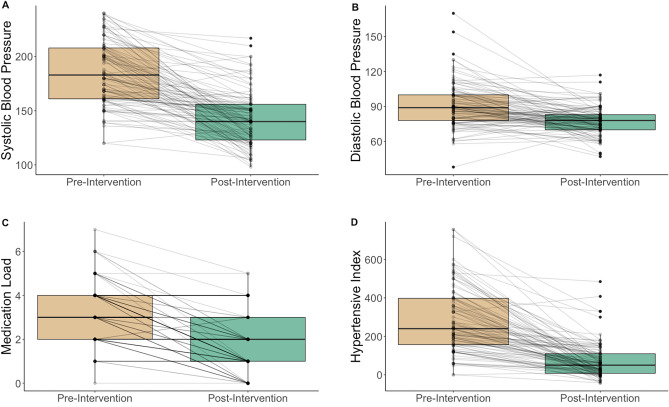
Figure 1
Figure 1
Boxplot and line graph of the response to renal artery intervention at discharge. Key: (A) systolic blood pressure (B) diastolic blood pressure (C) number of antihypertensive medications (D) hypertensive Index.
Figure 2
Figure 2
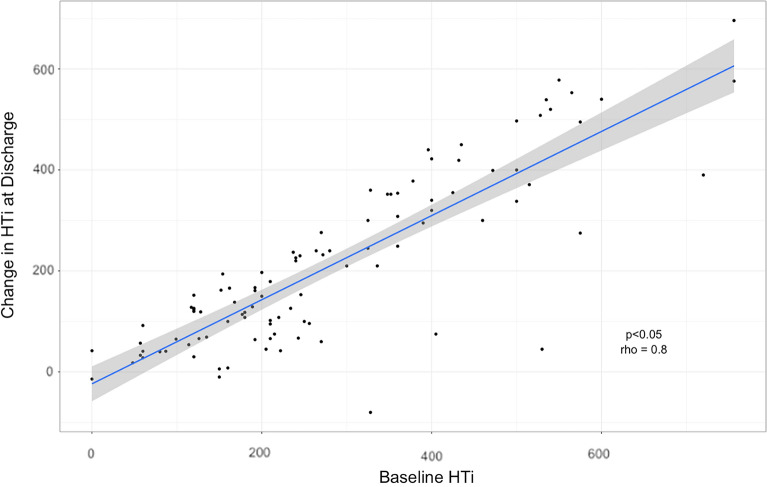
Scatter graph of pre-intervention hypertensive index and the magnitude of change following intervention. Key: HTi = Hypertensive Index. Spearman’s rank correlation coefficient (rho) = 0.8, p > 0.05.
Figure 3
Figure 3
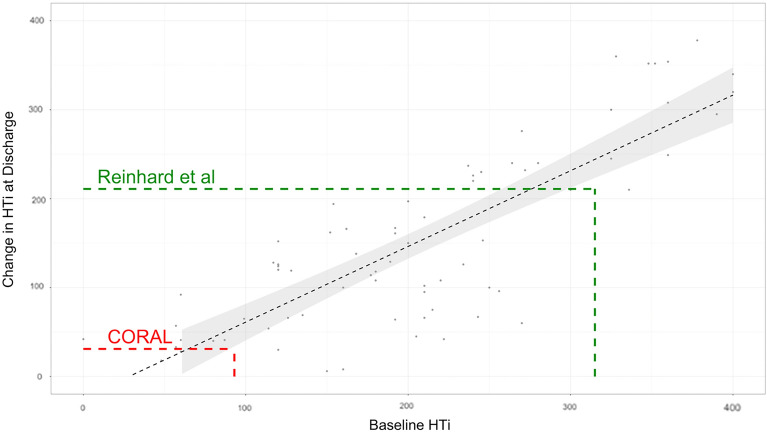
Comparing the baseline hypertension index with the impact of treatment in trials of renal artery stenting. HTi = Hypertensive Index.
Figure 4
Figure 4
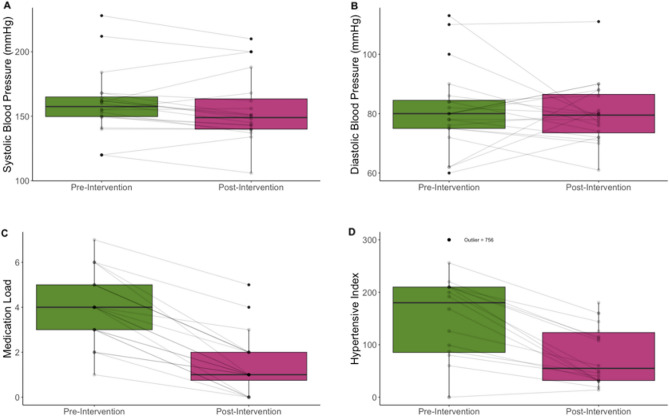
Changes in response to renal artery intervention at discharge in those without significant blood pressure reduction. Key: N = 15. (A) systolic blood pressure (B) diastolic blood pressure (C) number of antihypertensive medications (D) Hypertensive Index.
Figure 5
Figure 5
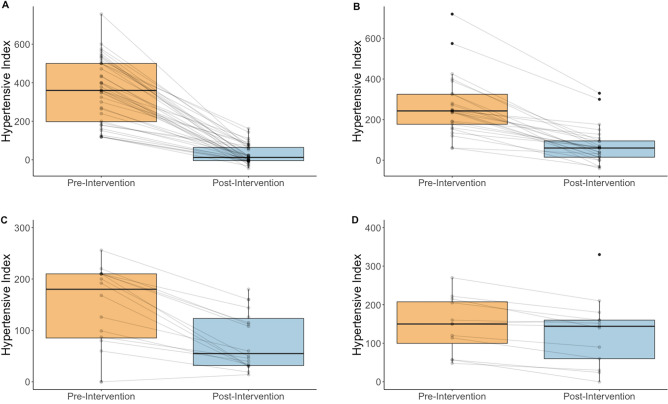
Changes in hypertensive index at discharge following renal artery intervention, by subgroup. Key: (A) Group 1 (B) Group 2 (C) Group 3 (D) Group 4.
Figure 6
Figure 6
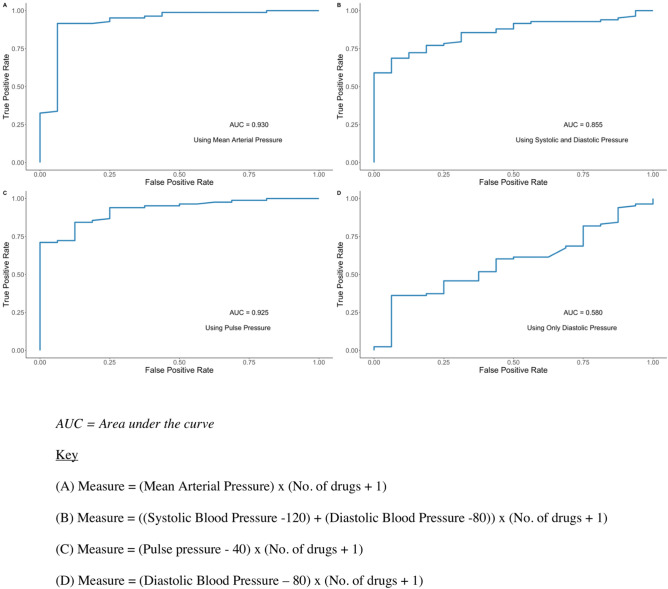
ROC analysis comparing the hypertensive index with other measures of success. AuC: area under the curve. Key: (A) Hypertensive Index (B) Systolic Blood Pressure (C) Diastolic Blood Pressure (D) Medication Load.
Figure 7
Figure 7
Alternative trialled methods of calculating a Hypertensive Index using measures other than systolic blood pressure alone.
Figure 8
Figure 8
Comparing the Hypertensive Index with the method used in the Genome-wide association study on blood pressure. Key: (A) Hypertensive Index (B) GWAS Study method.

References

    1. Forouzanfar MH, et al. Global burden of hypertension and systolic blood pressure of at least 110 to 115 mmHg, 1990–2015. JAMA. 2017;317:165–82. doi: 10.1001/jama.2016.19043. - DOI - PubMed
    1. Zhou D, Xi B, Zhao M, Wang L, Veeranki SP. Uncontrolled hypertension increases risk of all-cause and cardiovascular disease mortality in US adults: The NHANES III Linked Mortality Study. Sci. Rep. 2018;8:9418. doi: 10.1038/s41598-018-27377-2. - DOI - PMC - PubMed
    1. Schmieder RE. End organ damage in hypertension. Dtsch. Arztebl. Int. 2010;107:866–873. - PMC - PubMed
    1. Rahimi K, et al. Pharmacological blood pressure lowering for primary and secondary prevention of cardiovascular disease across different levels of blood pressure: An individual participant-level data meta-analysis. Lancet. 2021;397:1625–1636. doi: 10.1016/S0140-6736(21)00590-0. - DOI - PMC - PubMed
    1. Ng FL, Saxena M, Mahfoud F, Pathak A, Lobo MD. Device-based therapy for hypertension. Curr. Hypertens. Rep. 2016;18:61. doi: 10.1007/s11906-016-0670-5. - DOI - PMC - PubMed

Publication types

Substances