


Cyclical underreporting of seizures in patient-based seizure documentation
- PMID: 37608738
- PMCID: PMC10578895
- DOI: 10.1002/acn3.51880
Cyclical underreporting of seizures in patient-based seizure documentation
Abstract
Objective: Circadian and multidien cycles of seizure occurrence are increasingly discussed as to their biological underpinnings and in the context of seizure forecasting. This study analyzes if patient reported seizures provide valid data on such cyclical occurrence.
Methods: We retrospectively studied if circadian cycles derived from patient-based reporting reflect the objective seizure documentation in 2003 patients undergoing in-patient video-EEG monitoring.
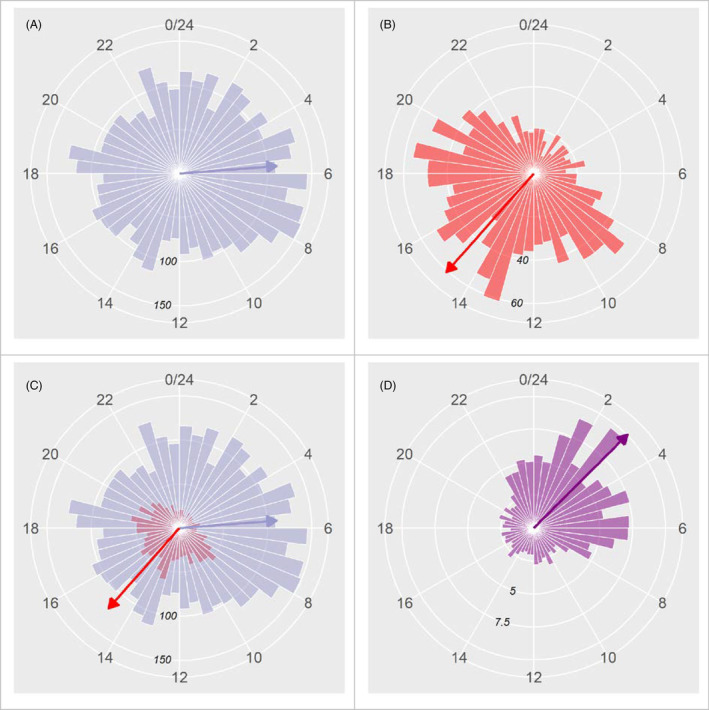
Results: Only 24.1% of more than 29000 seizures documented were accompanied by patient notifications. There was cyclical underreporting of seizures with a maximum during nighttime, leading to significant deviations in the circadian distribution of seizures. Significant cyclical deviations were found for focal epilepsies originating from both, frontal and temporal lobes, and for different seizure types (in particular, focal unaware and focal to bilateral tonic-clonic seizures).
Interpretation: Patient seizure diaries may reflect a cyclical reporting bias rather than the true circadian seizure distributions. Cyclical underreporting of seizures derived from patient-based reports alone may lead to suboptimal treatment schemes, to an underestimation of seizure-associated risks, and may pose problems for valid seizure forecasting. This finding strongly supports the use of objective measures to monitor cyclical distributions of seizures and for studies and treatment decisions based thereon.
© 2023 The Authors. Annals of Clinical and Translational Neurology published by Wiley Periodicals LLC on behalf of American Neurological Association.
Conflict of interest statement
ASB has received research funding from EU and American Epilepsy Foundation for the assessment of seizure occurrence using wearables and EEG recordings, and receives research funding from the company UNEEG for an ongoing clinical multicenter trial on subcutaneous ultralong‐term EEG recordings. MR has received research funding from EU and American Epilepsy Foundation for the assessment of seizure occurrence using wearables and EEG recordings. The other authors have nothing to report.
Figures


References
-
- Griffiths G, Fox JT. Rhythm in epilepsy. Lancet. 1938;232(5999):409‐416.
MeSH terms
LinkOut - more resources
Full Text Sources
Medical