[Preprint]. 2023 Aug 9:arXiv:2308.04988v1.

Desiderata for normative models of synaptic plasticity

Affiliations

Desiderata for normative models of synaptic plasticity

Colin Bredenberg et al. ArXiv. .

Update in

Abstract

Normative models of synaptic plasticity use a combination of mathematics and computational simulations to arrive at predictions of behavioral and network-level adaptive phenomena. In recent years, there has been an explosion of theoretical work on these models, but experimental confirmation is relatively limited. In this review, we organize work on normative plasticity models in terms of a set of desiderata which, when satisfied, are designed to guarantee that a model has a clear link between plasticity and adaptive behavior, consistency with known biological evidence about neural plasticity, and specific testable predictions. We then discuss how new models have begun to improve on these criteria and suggest avenues for further development. As prototypes, we provide detailed analyses of two specific models - REINFORCE and the Wake-Sleep algorithm. We provide a conceptual guide to help develop neural learning theories that are precise, powerful, and experimentally testable.

Keywords: computational neuroscience; learning; synaptic plasticity.


Figures
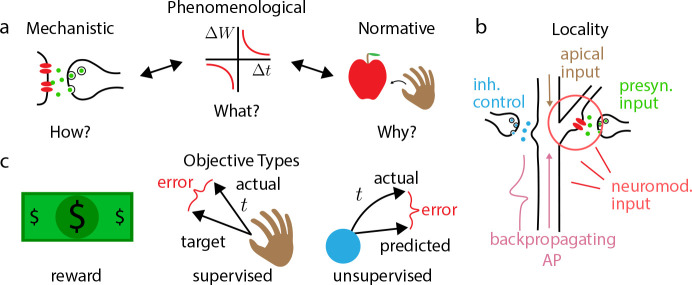
Figure 1:
Figure 1:. Defining normative modeling.
a. Spectrum of synaptic plasticity models. Mechanistic models show how detailed biophysical interactions produce observed plasticity, phenomenological models concisely describe what changes in experimental variables (e.g. post-pre relative spike timing Δt) affect plasticity (ΔW), and normative models explain why the observed plasticity implements capabilities that are useful to the organism. b. Schematic illustrating the range of local variables that may be available for synaptic plasticity. These include, but are not limited to: backpropagating action potentials from the soma, apical dendritic input, pre and postsynaptic activity, neuromodulatory signals, and potentially inhibitory input from local microcircuitry. c. Classes of objective function used in normative plasticity theories. Reward-based objectives involve only feedback about how well the organism or network performed, whereas supervised objectives provide explicit targets for network output. By contrast, unsupervised objectives do not require any form of explicit feedback to train the network.
Figure 2:
Figure 2:. Architecture and scalability considerations for normative plasticity models.
a. Features of realistic biological networks that normative plasticity theories should be able to account for: separation of excitatory and inhibitory neuron populations; stochastic and spiking input-output functions for individual neurons; and multilayer, recurrent connectivity. b. For actions in the past to be associated with delayed supervisory or reinforcement signals, plasticity algorithms require a mechanism of temporal association. One candidate is the ‘eligibility trace,’ which stores information about coactivity throughout time locally to a synapse, and subsequently modifies synaptic connections when paired with feedback information. Learning can occur offline, where some or all synaptic modification occurs in the absence of action or perception by the organism. Alternatively, it can occur online, where the organism acts and learns simultaneously. c. Stimuli (left) and task structure (right) can become complex in many ways. Different sensory features (e.g. visual, auditory, or spatial information) can all be made more naturalistic by training networks on stimuli organisms are exposed to and learn from in natural environments. Further, tasks can be made more naturalistic by increasing the number of action options (a) and sequential state (s) transitions required for a network to achieve its goals and by adding uncertainty into the task.
Figure 3:
Figure 3:. Testing normative theories.
a. Normative plasticity theories can be assessed through four different experimental lenses centered on individual neurons, circuits of collectively recorded neurons, the training signals delivered to a circuit, and the organism’s overall behavior over the course of learning. b. Different normative plasticity theories postulate different levels of detail for the feedback signals received by individual neurons.

References

    1. Ackley D. H., Hinton G. E., and Sejnowski T. J. (1985). A learning algorithm for Boltzmann machines. Cognitive science, 9(1):147–169.
    1. Akrout M., Wilson C., Humphreys P. C., Lillicrap T., and Tweed D. (2019). Using weight mirrors to improve feedback alignment. arXiv preprint arXiv:1904.05391.
    1. Alemi A., Machens C., Deneve S., and Slotine J.-J. (2018). Learning nonlinear dynamics in efficient, balanced spiking networks using local plasticity rules. In Proceedings of the AAAI Conference on Artificial Intelligence, volume 32.
    1. Amari S. I. S. i. and Nakahara H. (1999). Convergence of the wake-sleep algorithm. In Advances in Neural Information Processing Systems 11: Proceedings of the 1998 Conference, volume 11, page 239. MIT Press.
    1. Arjona-Medina J. A., Gillhofer M., Widrich M., Unterthiner T., Brandstetter J., and Hochreiter S. (2019). Rudder: Return decomposition for delayed rewards. Advances in Neural Information Processing Systems, 32.

Publication types

LinkOut - more resources