This is a preprint.
Increasing activity after stroke: a randomized controlled trial of highintensity walking and step activity intervention
- PMID: 37609269
- PMCID: PMC10441496
- DOI: 10.1101/2023.03.11.23287111
Increasing activity after stroke: a randomized controlled trial of highintensity walking and step activity intervention
Update in
-
Increasing Activity After Stroke: A Randomized Controlled Trial of High-Intensity Walking and Step Activity Intervention.Stroke. 2024 Jan;55(1):5-13. doi: 10.1161/STROKEAHA.123.044596. Epub 2023 Dec 22. Stroke. 2024. PMID: 38134254 Free PMC article. Clinical Trial.
Abstract
Background: Physical inactivity in people with chronic stroke profoundly affects daily function and increases recurrent stroke risk and mortality, making physical activity improvements an important target of intervention. We compared the effects of a highintensity walking intervention (FAST), a step activity monitoring behavioral intervention (SAM), or a combined intervention (FAST+SAM) on physical activity (i.e., steps per day). We hypothesized the combined intervention would yield the greatest increase in steps per day.
Methods: This assessor-blinded multi-site randomized controlled trial was conducted at four university/hospital-based laboratories. Participants were 21-85 years old, walking without physical assistance following a single, unilateral non-cerebellar stroke of ≥6 months duration, and randomly assigned to FAST, SAM, or FAST+SAM for 12 weeks (2-3 sessions/week). FAST training consisted of walking-related activities for 40 minutes/session at 70-80% heart rate reserve, while SAM received daily feedback and goal-setting of walking activity (steps per day). Assessors and study statistician were masked to group assignment.The a priori-determined primary outcome and primary endpoint was change in steps per day from pre- to post-intervention. Adverse events (AEs) were tracked after randomization. All randomized participants were included in the intent-to-treat analysis.This study is registered at ClinicalTrials.gov, NCT02835313.
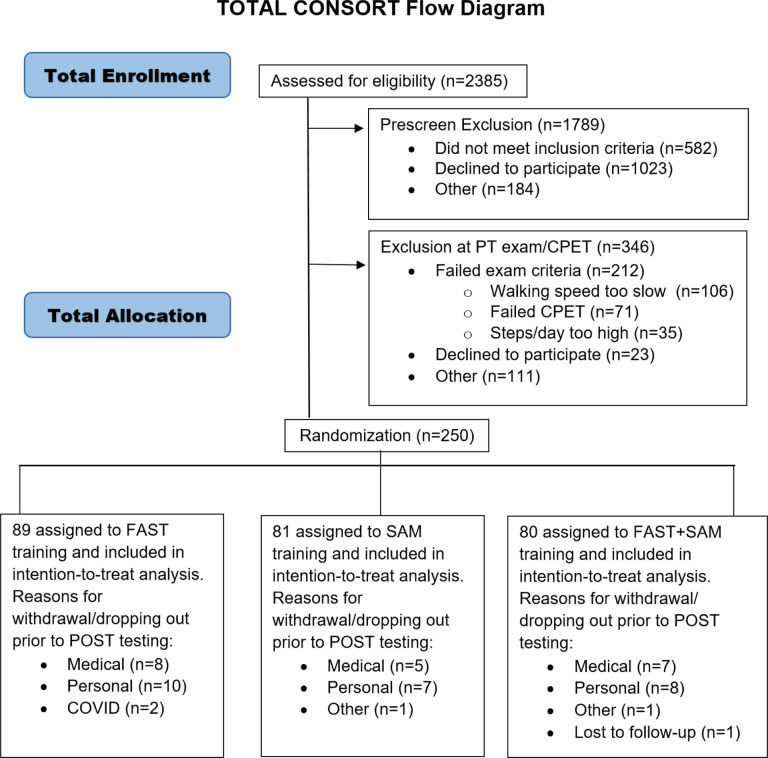
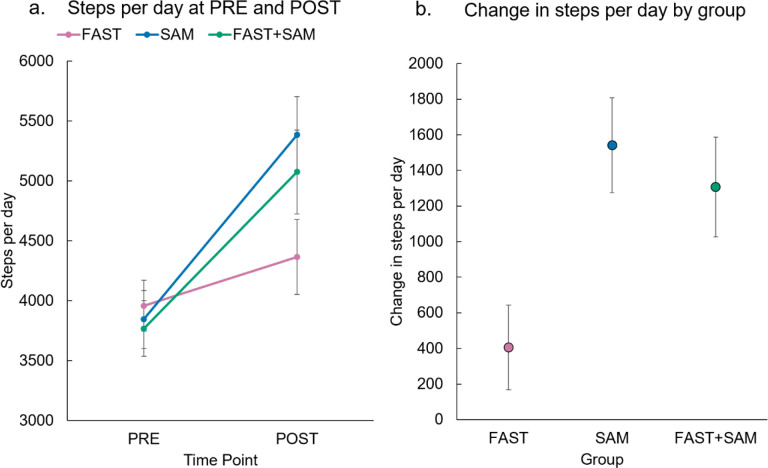
Findings: Participants were enrolled from July 18, 2016-November 16, 2021. Of 250 randomized participants (mean[SE] age 63[0.80], 116F/134M), 89 were assigned to FAST, 81 to SAM, and 80 to FAST+SAM. Steps per day significantly increased in both the SAM (mean[SE] 1542[267], 95%CI:1014-2069, p<0.001) and FAST+SAM groups (1307[280], 752-1861, p<0.001), but not in the FAST group (406[238], 63-876, p=0.09). There were no deaths or serious study-related AEs and all other minor AEs were similar between groups.
Interpretation: Only individuals with chronic stroke who completed a step activity monitoring behavioral intervention with skilled coaching and goal progression demonstrated improvements in physical activity (steps per day).
Keywords: high-intensity gait; step activity monitoring; stroke; treadmill; walking.
Conflict of interest statement
DISCLOSURES The authors state that they have no personal or financial relationships that could represent a conflict of interest, and declare no competing interests.
Figures
References
-
- Tsao CW, Aday AW, Almarzooq ZI, et al. Heart Disease and Stroke Statistics-2022 Update: A Report From the American Heart Association. Circulation 2022; 145(8): e153–e639. - PubMed
-
- Feigin VL, Brainin M, Norrving B, et al. World Stroke Organization (WSO): Global Stroke Fact Sheet 2022. Int J Stroke 2022; 17(1): 18–29. - PubMed
Publication types
Associated data
Grants and funding
LinkOut - more resources
Full Text Sources
Medical