High anteromedial insertion reduced anteroposterior and rotational knee laxity on mid-term follow-up after anatomic anterior cruciate ligament reconstruction
- PMID: 37609439
- PMCID: PMC10441525
- DOI: 10.7717/peerj.15898
High anteromedial insertion reduced anteroposterior and rotational knee laxity on mid-term follow-up after anatomic anterior cruciate ligament reconstruction
Abstract
Background: The position of the femoral insertion has a great influence on the laxity of the knee joint after ACLR, especially for rotational laxity.
Purpose: To compare the effects of different femoral tunnel positions on knee stability after arthroscopic anterior cruciate ligament reconstruction (ACLR).
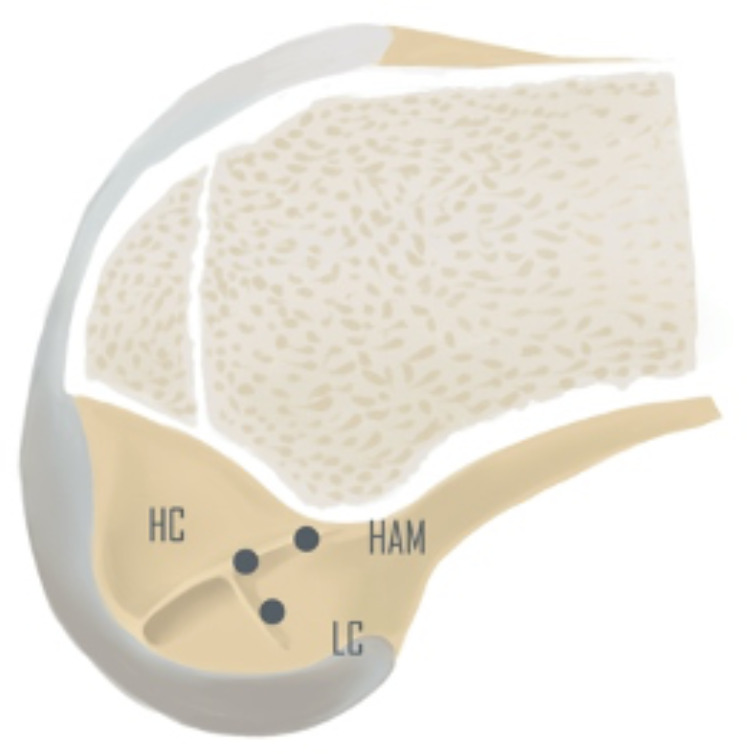
Methods: The clinical outcomes of 165 patients after autograft ACLR were analyzed retrospectively. The patients were separated into three groups according to the position of the femoral tunnel, as follows: low center (LC) group, 53 patients; high center (HC) group, 45 patients; and high anteromedial (HAM) group, 67 patients. The side-to-side differences (SSDs) in anteroposterior knee laxity measured using a KT-2000 arthrometer and the pivot shift test (PST) pre- and postoperatively were compared among the three groups and analyzed.
Results: After 5 years postoperatively, the SSD in the anteroposterior knee laxity in the three groups was significantly decreased postoperatively compared with preoperatively in knees; meanwhile, the negative PST rate was significantly increased in the three groups. The postoperative SSD in anteroposterior knee laxity was significantly increased in the HC group compared with the LC and HAM groups (1.5 ± 1.3 VS 1.0 ± 1.1 VS 1.0 ± 1.0, P<0.05). The negative postoperative PST rate was higher in both the LC and HAM groups than in the HC group (84.9% VS 91.0% VS 71.1%, P<0.05), and there was no significant difference in the negative PST rate between the LC and HAM groups (84.9% VS 91.0%, P>0.05). The negative postoperative PST rate was significantly higher in the HAM group than in the LC and HC groups for patients with a high degree of laxity preoperatively (31.3% VS 3.3% VS 14.4%, P>0.05).
Conclusion: Patients in HAM group showed better control over anteroposterior laxity, rotational laxity, and subjective knee function compared to other groups post operation. Therefore, the HAM point is the closest to the I.D.E.A.L point concept, and is recommended as the preferred location for the femoral tunnel in ACLR.
Keywords: Anatomic reconstruction; Anterior cruciate ligament; Femoral tunnel position; Laxity.
©2023 Zhang et al.
Conflict of interest statement
The authors declare there are no competing interests.
Figures
References
-
- Bernard M, Pappas E, Georgoulis A, Haschemi A, Scheffler S, Becker R. Risk of overconstraining femorotibial rotation after anatomical ACL reconstruction using bone patella tendon bone autograft. Archives of Orthopaedic and Trauma Surgery. 2020;140(12):2013–2020. doi: 10.1007/s00402-020-03616-y. - DOI - PubMed
-
- Cristiani R, Engström B, Edman G, Forssblad M, Stålman A. Revision anterior cruciate ligament reconstruction restores knee laxity but shows inferior functional knee outcome compared with primary reconstruction. Knee Surgery, Sports Traumatology, Arthroscopy. 2019;27(1):137–145. doi: 10.1007/s00167-018-5059-3. - DOI - PMC - PubMed
Publication types
MeSH terms
LinkOut - more resources
Full Text Sources
Medical