


Effect of apolipoprotein genotype and educational attainment on cognitive function in autosomal dominant Alzheimer's disease
- PMID: 37612284
- PMCID: PMC10447560
- DOI: 10.1038/s41467-023-40775-z
Effect of apolipoprotein genotype and educational attainment on cognitive function in autosomal dominant Alzheimer's disease
Abstract
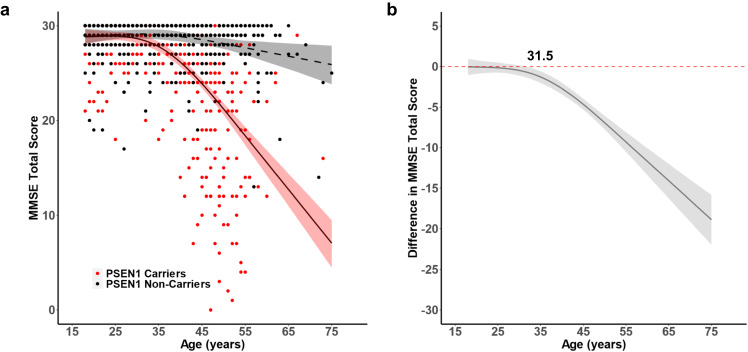
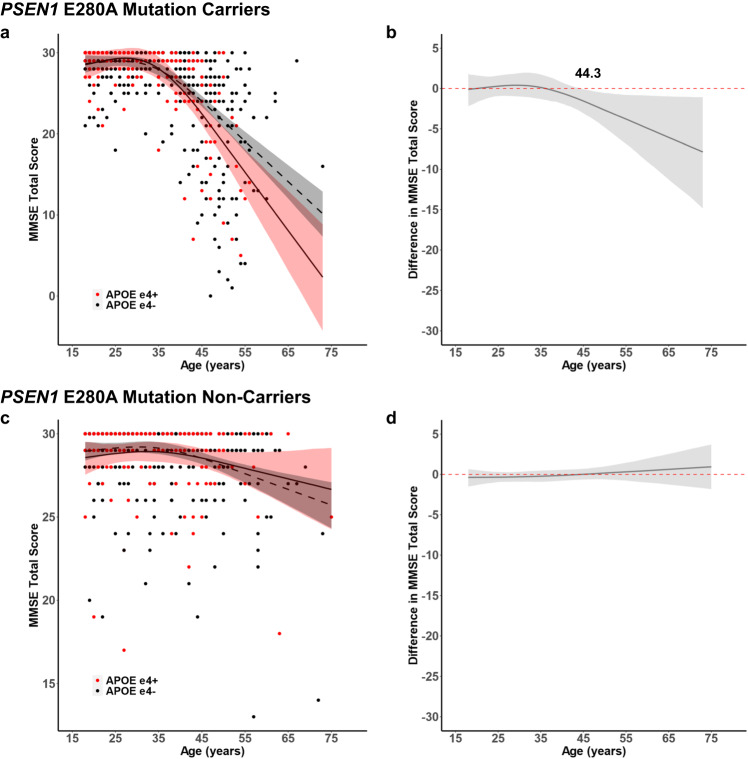
Autosomal dominant Alzheimer's disease (ADAD) is genetically determined, but variability in age of symptom onset suggests additional factors may influence cognitive trajectories. Although apolipoprotein E (APOE) genotype and educational attainment both influence dementia onset in sporadic AD, evidence for these effects in ADAD is limited. To investigate the effects of APOE and educational attainment on age-related cognitive trajectories in ADAD, we analyzed data from 675 Presenilin-1 E280A mutation carriers and 594 non-carriers. Here we show that age-related cognitive decline is accelerated in ADAD mutation carriers who also have an APOE e4 allele compared to those who do not and delayed in mutation carriers who also have an APOE e2 allele compared to those who do not. Educational attainment is protective and moderates the effect of APOE on cognition. Despite ADAD mutation carriers being genetically determined to develop dementia, age-related cognitive decline may be influenced by other genetic and environmental factors.
© 2023. Springer Nature Limited.
Conflict of interest statement
S.L. is supported by a grant from the Alzheimer’s Association (AARF-22-920754). Y.S. reports grants from The Alzheimer’s Association, The BrightFocus Foundation, NIH/NIA, State of Arizona, outside the submitted work. C.V.-C. reports grants from the Alzheimer’s Association (AARF 2019A005859) and the National Institute on Aging (K99AG073452). K.S.K. is on the Board of Directors for the Tau Consortium, receives funding from the NIA, the Alzheimer Association, and the Alzheimer’s Drug Discovery Foundation. H-S.Y. reports a grant from the National Institute of Aging (K23 AG062750). E.M.R. reports grants from National Institute on Aging (P30 AG072980, R01 AG069453, R01 AG055444), Banner Alzheimer’s Foundation and the NOMIS Foundation during the conduct of the study. E.M.R. is a compensated scientific advisor for Alzheon, Aural Analytics, Denali, Retromer Therapeutics, and Vaxxinity, an uncompensated scientific advisor for Lilly, and a cofounder, advisor and shareholder of AlzPATH, which is involved in the development of blood-based biomarkers for Alzheimer’s disease outside the scope of the submitted. In addition, E.M.R. is the inventor of a patent issued to Banner Health, which involves the use of biomarker endpoints in at-risk persons to accelerate the evaluation of Alzheimer’s disease prevention therapies and is outside the submitted work. F.L. was supported by an Anonymous Foundation, and the Administrative Department of Science, Technology and Innovation (Colciencias Colombia;111565741185). E.M.R. and F.L. are principal investigators of the Alzheimer’s Prevention Initiative (API) Autosomal Dominant AD Trial, which is supported by NIA, philanthropy, Genentech, and Roche. Y.T.Q. was supported by grants from the National Institute on Aging (R01 AG054671, RF1AG077627), the Alzheimer’s Association, and Massachusetts General Hospital ECOR. Y.T.Q. serves as consultant for Biogen. The remaining authors declare no competing interests.
Figures

References
-
- Roses AD. Apolipoprotein E alleles as risk factors in Alzheimer’s disease. Annu. Rev. Med. 1996;47:387–400. - PubMed
-
- Corder EH, et al. Gene dose of apolipoprotein E type 4 allele and the risk of Alzheimer’s disease in late onset families. Science. 1993;261:921–923. - PubMed
-
- Acosta-Baena N, et al. Pre-dementia clinical stages in presenilin 1 E280A familial early-onset Alzheimer’s disease: a retrospective cohort study. Lancet Neurol. 2011;10:213–220. - PubMed
-
- Pastor P, et al. Apolipoprotein Eε4 modifies Alzheimer’s disease onset in an E280A PS1 kindred. Ann. Neurol. 2003;54:163–169. - PubMed
Publication types
MeSH terms
Substances
Grants and funding
LinkOut - more resources
Full Text Sources
Medical
Miscellaneous
