. 2022 Aug 5;69(4):401-408.
doi: 10.1093/cz/zoac058. eCollection 2023 Aug.

The combined role of visual and olfactory cues in foraging by Cataglyphis ants in laboratory mazes

Affiliations

The combined role of visual and olfactory cues in foraging by Cataglyphis ants in laboratory mazes

Tomer Gilad et al. Curr Zool. .

Abstract

Foragers use several senses to locate food, and many animals rely on vision and smell. It is beneficial not to rely on a single sense, which might fail under certain conditions. We examined the contribution of vision and smell to foraging and maze exploration under laboratory conditions using Cataglyphis desert ants as a model. Foraging intensity, measured as the number of workers entering the maze and arriving at the target as well as target arrival time, were greater when food, blue light, or both were offered or presented in contrast to a control. Workers trained to forage for a combined food and light cue elevated their foraging intensity with experience. However, foraging intensity was not higher when using both cues simultaneously than in either one of the two alone. Following training, we split between the two cues and moved either the food or the blue light to the opposite maze corner. This manipulation impaired foraging success by either leading to fewer workers arriving at the target cell (when the light stayed and the food was moved) or to more workers arriving at the opposite target cell, empty of food (when the food stayed and the light was moved). This result indicates that ant workers use both senses when foraging for food and readily associate light with food.

Keywords: binary-tree maze; desert ants; diet choice; foraging; sensual modality; spatial learning.


Conflict of interest statement

We declare no conflict of interest. No permissions were required to conduct this study.

Figures

Figure 1
Figure 1
Schemes of the nest and experimental arena. (A) The nest (N) and the maze, where the experiment itself took place, were connected by a corridor with holes (circles) enabling the workers to move through. The maze comprises three levels. The cells in the two first levels split into two cells in the next level (a binary tree maze). The target (food, blue light, or both; T) was placed on the extreme right or left. The opposite-target cell (OT) is at the other extreme corner. (B) In experiment 1, we allowed access only to the first two levels of the maze. (C) C. niger workers attending pupae under semi-natural conditions.
Figure 2
Figure 2
Experiment 1: The number of workers entering the cell, which contained the food or blue light (Treatment) vs. an empty dish or white light (Control). Whereas more workers entered the cell containing food than the control, there was no attraction to blue light in this experiment. Medians, quartiles, the range, and all data points are presented.
Figure 3
Figure 3
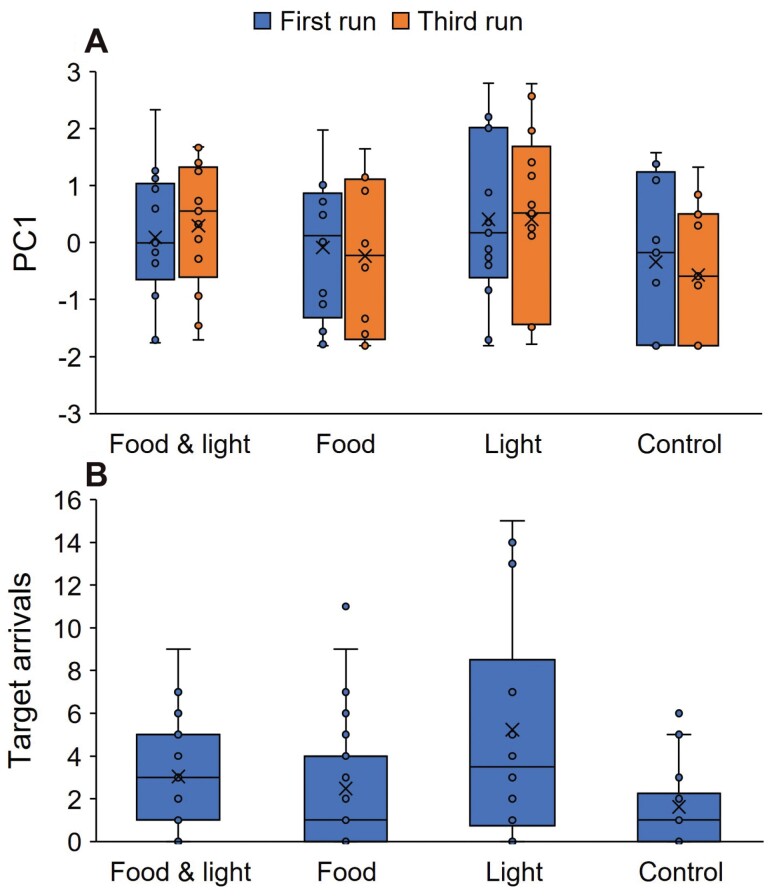
Experiment 2: (A) PC1, which stands for foraging intensity (higher values indicate more workers entering the maze and arriving at the target cell and doing so faster). There was no difference between the first and third runs. Foraging intensity on food and light was greater than the control (empty dish). (B) The number of worker arrivals at the target cell in the four different treatments (both runs are lumped together). Medians, quartiles, the range, and all datapoints are presented.
Figure 4
Figure 4
Experiment 3: (A) PC1 (higher values indicate more workers entering the maze and arriving at the target cell and doing so faster) was higher in the third run than in the first run, indicating an intensifying level of foraging. (B) The same pattern, presented by worker arrivals at the target cell. (C) The effect of moving either the food or the blue light from the target cell to the opposite target cell in the fourth run. When the blue light was moved, more workers arrived at the opposite target cell, whereas when food was moved fewer workers arrived at the target cell. Medians, quartiles, the range, and all data points are presented. In three of the four treatments in (C) the median of the opposite-target arrivals is zero (and hence the orange column is absent).

References

    1. Alpert GF, Hein G, Tsai N, Naumer MJ, Knight RT, 2008. Temporal characteristics of audiovisual information processing. J Neurosci 28:5344–5349. - PMC - PubMed
    1. Banschbach VS, 1994. Colour association influences honey bee choice between sucrose concentrations. J Comp Physiol A 175:107–114.
    1. Barragán-Fonseca KY, Van Loon JJ, Dicke M, Lucas-Barbosa D, 2020. Use of visual and olfactory cues of flowers of two brassicaceous species by insect pollinators. Ecol Entomol 45:45–55.
    1. Bega D, Samocha Y, Yitzhak N, Saar M, Subach Aet al. , 2020. Non-spatial information on the presence of food elevates search intensity in ant workers, leading to faster maze solving in a process parallel to spatial learning. PLoS One 15:e0229709. - PMC - PubMed
    1. Bernadou A, Heinze J, 2013. Mating-associated changes in the behaviour of Leptothorax gredleri ant queens. Ethology 119:634–643.