Prevalence of psychosocial issues among pregnant women who do and do not use illicit substances
- PMID: 37616097
- PMCID: PMC10891299
- DOI: 10.1037/adb0000952
Prevalence of psychosocial issues among pregnant women who do and do not use illicit substances
Abstract
Objective: The American College of Obstetricians and Gynecologists (ACOG) recommends providers screen their prenatal patients for 11 psychosocial issues because they affect patient mental and physical well-being. The prevalence and co-occurrence of these issues have rarely been compared among pregnant women who do and do not report recent illicit substance use.
Method: Seven psychosocial issues identified by ACOG were operationalized using National Survey on Drug Use and Health variables. We report weighted prevalence and adjusted risk ratios (ARR) for these issues in pregnant women who did versus did not report past-month illicit substance use.
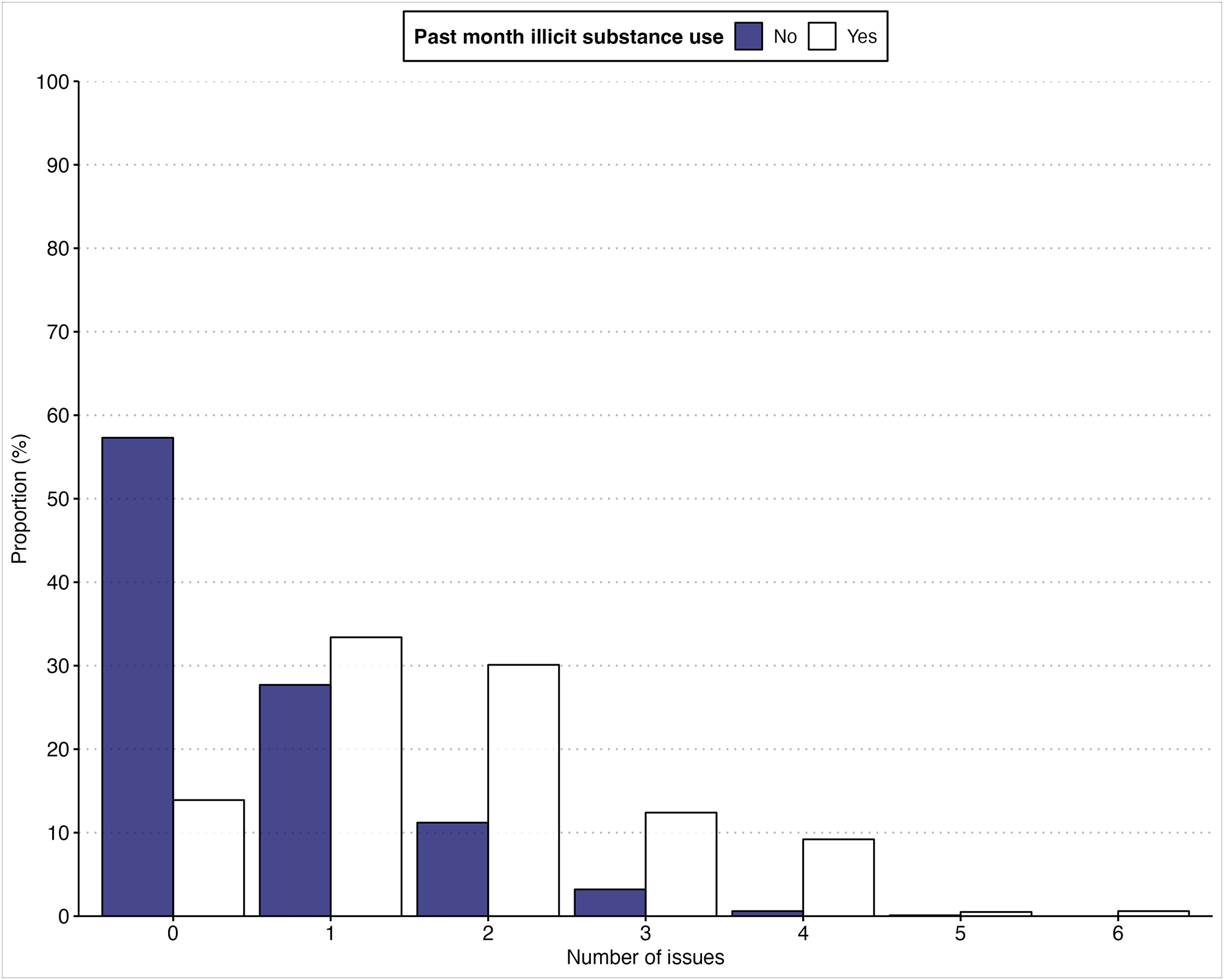
Results: Pregnant women (n = 3,657) who reported past-month illicit substance use (6.3%; 95% CI [5.4-7.3]) had significantly higher prevalence of almost all psychosocial issues examined, including past-month cigarette smoking (44.9% versus 9.5%; ARR = 2.84, 95% CI [2.21-3.65]); past-month alcohol use, 36.1% versus 7.9%; ARR = 4.71 (3.59-6.18); serious past-month distress, 23.0% versus 5.0%; ARR = 3.51 (2.39-5.15); no health insurance, 11.7% versus 6.2%; ARR = 1.71 (1.07-2.74); and receipt of food stamps, 45.0% versus 24.0%; ARR = 1.40 (1.18-1.67). Moving 3 + times in the past year followed a similar pattern, but results were compatible with there being no difference, 10.6% versus 5.5%; ARR = 1.39 (0.86-2.25). The majority of pregnant women reporting illicit substance use endorsed experiencing ≥ 2 psychosocial issues while the majority of those who did not report illicit substance use did not endorse any.
Conclusions: Pregnant women who use illicit substances experience higher prevalence and greater co-occurrence of psychosocial issues compared to those who do not, reinforcing recommendations for multidisciplinary approaches to care. (PsycInfo Database Record (c) 2024 APA, all rights reserved).
Figures
Update of
-
Prevalence of Psychosocial Issues Among Pregnant Women Who Do and Do Not Use Illicit Substances.Res Sq [Preprint]. 2023 Apr 24:rs.3.rs-2845911. doi: 10.21203/rs.3.rs-2845911/v1. Res Sq. 2023. Update in: Psychol Addict Behav. 2024 Mar;38(2):205-210. doi: 10.1037/adb0000952. PMID: 37163000 Free PMC article. Updated. Preprint.
References
-
- American College of Pediatrics and American College of Obstetrics and Gynecologists. (2017). Guidelines for Perinatal Care (Kilpatrick S & Papile L-A, Eds.; 8th ed.). https://www.acog.org/clinical-information/physician-faqs/-/media/3a22e15...
-
- Grant RL (2014). Converting an odds ratio to a range of plausible relative risks for better communication of research findings. Bmj, 348. - PubMed
-
- Kessler RC, Andrews G, Colpe LJ, Hiripi E, Mroczek DK, Normand S-L, Walters EE, & Zaslavsky AM (2002). Short screening scales to monitor population prevalences and trends in non-specific psychological distress. Psychological Medicine, 32(6), 959–976. - PubMed
-
- Kessler RC, Green JG, Gruber MJ, Sampson NA, Bromet E, Cuitan M, Furukawa TA, Gureje O, Hinkov H, & Hu C (2010). Screening for serious mental illness in the general population with the K6 screening scale: results from the WHO World Mental Health (WMH) survey initiative. International Journal of Methods in Psychiatric Research, 19(S1), 4–22. - PMC - PubMed
MeSH terms
Grants and funding
LinkOut - more resources
Full Text Sources
Medical
Miscellaneous