


Promoting appetitive learning of consensual, empowered vulnerability: a contextual behavioral conceptualization of intimacy
- PMID: 37621928
- PMCID: PMC10445171
- DOI: 10.3389/fpsyg.2023.1200452
Promoting appetitive learning of consensual, empowered vulnerability: a contextual behavioral conceptualization of intimacy
Abstract
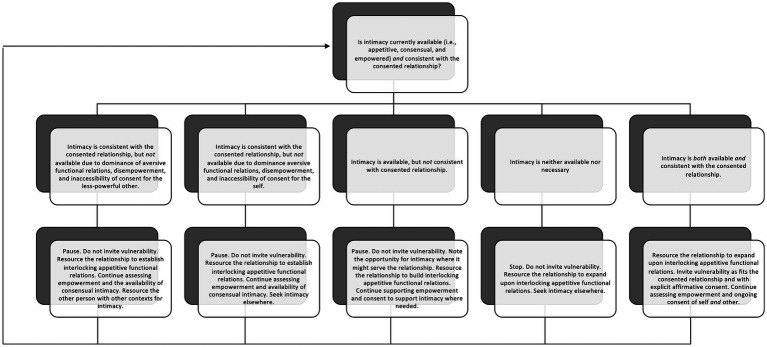
Vulnerability is emphasized in a number of theoretical models of intimacy (e.g., Intimacy Process Model), including from behavioral and contextual behavioral perspectives. Vulnerability is generally defined as susceptibility to harm and involves behaviors that have been historically met with aversive social consequences. From these perspectives, intimacy is fostered when vulnerable behavior is met with reinforcement. For example, interventions have trained intimacy by building skills in emotional expression and responsiveness with promising results. Vulnerability has divergent functions, however, depending on the interpersonal context in which it occurs. Functional intimacy is explored through the lens of functional relations, which play a key role in interpersonal processes of power, privilege, and consent. This conceptualization suggests that vulnerability must be under appetitive functional relations, consensual, and empowered for safe intimacy to emerge. The responsibility to promote appetitive learning of consensual, empowered vulnerability to foster intimacy falls to the person with more power in a particular interaction and relationship. Recommendations are offered for guiding this process.
Keywords: appetitive; behavioral; consent; context; intimacy; power; vulnerability; well-being.
Copyright © 2023 Louisiana Contextual Science Research Group.
Conflict of interest statement
The authors declare that the research was conducted in the absence of any commercial or financial relationships that could be construed as a potential conflict of interest.
Figures
References
-
- Accapadi M. M. (2007). When white women cry: how white women's tears oppress women of color. Coll. Stud. Aff. J. 26, 208–215.
-
- Allen A. (2005). “Feminist perspectives on power” in The Stanford encyclopedia of philosophy Available at: http://plato.stanford.edu/entries/feminist-power/ (accessed July 31, 2023).
-
- Aron A., Melinat E., Aron E. N., Vallone R. D., Bator R. J. (1997). The Experimental Generation of Interpersonal Closeness: A Procedure and Some Preliminary Findings. Pers. Soc. Psychol. Bull. 23, 363–377. doi: 10.1177/0146167297234003 - DOI
-
- Bardeen J. R., Tull M. T., Stevens E. N., Gratz K. L. (2015). Further investigation of the association between anxiety sensitivity and posttraumatic stress disorder: Examining the influence of emotional avoidance. J. Context. Behav. Sci. 4, 163–169. doi: 10.1016/j.jcbs.2015.05.002 - DOI - PMC - PubMed
-
- Baum W. (2005). “Relationships, management, and government,” in Understanding behaviorism: Behavior, culture, and evolution (2nd ed.). (Malden, MA: Blackwell Publishing), 213–236.
Publication types
LinkOut - more resources
Full Text Sources
Miscellaneous
