


HLA-G 14 bp Ins/Del (rs66554220) Variant Is Not Associated with Breast Cancer in Women from Western Mexico
- PMID: 37623251
- PMCID: PMC10453716
- DOI: 10.3390/cimb45080432
HLA-G 14 bp Ins/Del (rs66554220) Variant Is Not Associated with Breast Cancer in Women from Western Mexico
Abstract
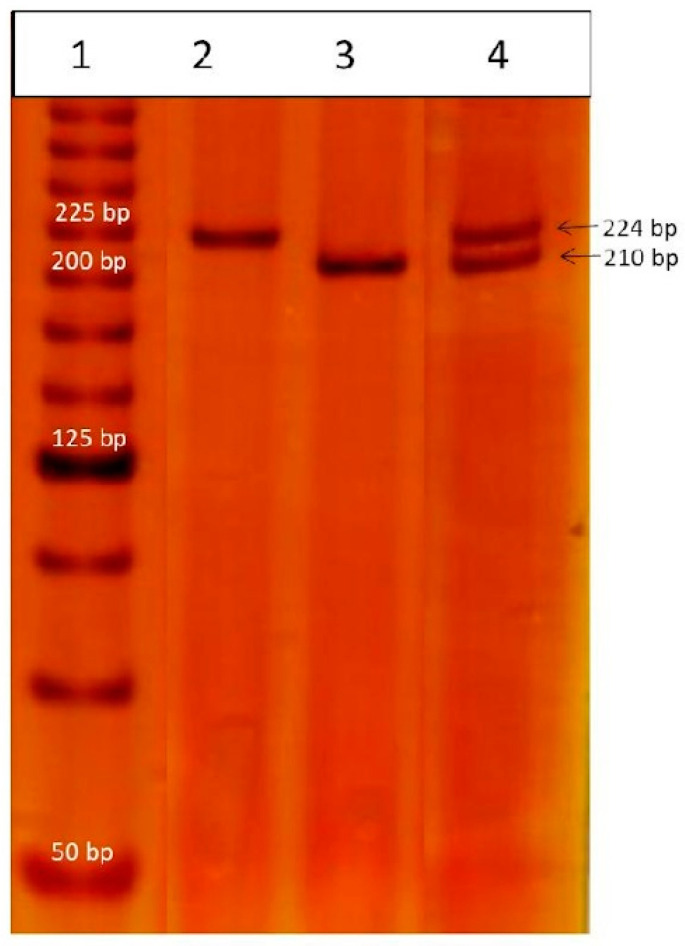
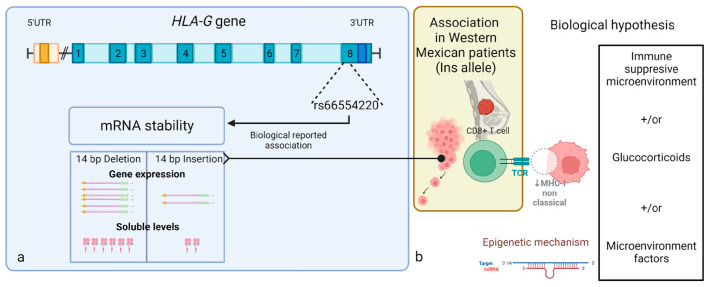
HLA-G is a physiology and pathologic immunomodulator detrimentally related to cancer. Its gene is heavily transcriptionally and post-transcriptionally regulated by variants located in regulator regions like 3'UTR, being the most studied Ins/Del of 14-bp (rs66554220), which is known to influence the effects of endogen cell factors; nevertheless, the reports are discrepant and controversial. Herein, the relationship of the 14-bp Ins/Del variant (rs66554220) with breast cancer (BC) and its clinical characteristics were analyzed in 182 women with non-familial BC and 221 disease-free women as a reference group. Both groups from western Mexico and sex-age-matched (sm-RG). The rs66554220 variant was amplified by SSP-PCR and the fragments were visualized in polyacrylamide gel electrophoresis. The variant rs66554220 was not associated with BC in our population. However, we suggest the Ins allele as a possible risk factor for developing BC at clinical stage IV (OR = 3.05, 95% CI = 1.16-7.96, p = 0.01); nevertheless, given the small stratified sample size (n = 11, statistical power = 41%), this is inconclusive. In conclusion, the 14-bp Ins/Del (rs66554220) variant of HLA-G is not associated with BC in the Mexican population, but might be related to advanced breast tumors. Further studies are required.
Keywords: 14-bp Ins/Del; HLA-G; Mexican population; breast cancer; clinical; rs66554220; stage IV; western Mexico.
Conflict of interest statement
The authors declare no conflict of interest.
Figures
References
-
- Ferlay J., Ervik M., Lam F., Colombet M., Mery L., Piñeros M. Global Cancer Observatory. International Agency for Research on Cancer; Lyon, France: 2020. [(accessed on 7 December 2022)]. Available online: https://gco.iarc.fr/today.
-
- Anna F., Bole-Richard E., LeMaoult J., Escande M., Lecomte M., Certoux J.-M., Souque P., Garnache F., Adotevi O., Langlade-Demoyen P., et al. First immunotherapeutic CAR-T cells against the immune checkpoint protein HLA-G. J. Immunother. Cancer. 2021;9:e001998. doi: 10.1136/jitc-2020-001998. - DOI - PMC - PubMed
-
- Carosella E.D., Rouas-Freiss N., Tronik-Le Roux D., Moreau P., LeMaoult J. HLA-G: An Immune Checkpoint Molecule. Adv. Immunol. 2015;127:33–144. - PubMed
Grants and funding
LinkOut - more resources
Full Text Sources
Research Materials
