


SGLT2 Inhibitors vs. GLP-1 Agonists to Treat the Heart, the Kidneys and the Brain
- PMID: 37623335
- PMCID: PMC10455499
- DOI: 10.3390/jcdd10080322
SGLT2 Inhibitors vs. GLP-1 Agonists to Treat the Heart, the Kidneys and the Brain
Abstract
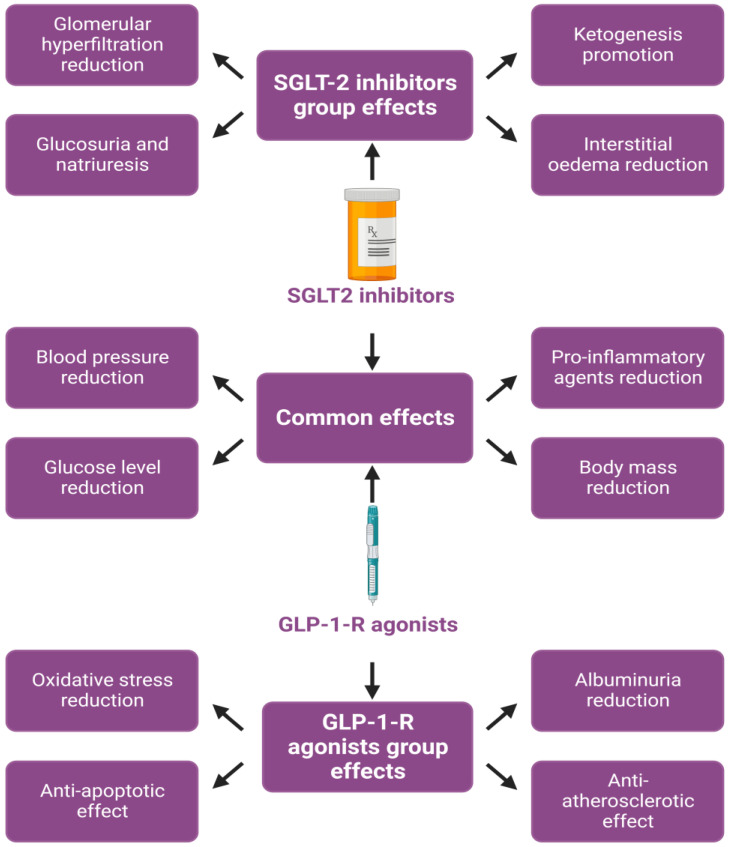
Sodium glucose cotransporter 2 (SGLT2) inhibitors and glucagon-like-peptide-1 receptor (GLP-1-R) agonists are novel therapeutic agents used for the management of type 2 diabetes mellitus (T2DM). Recently, large-scale randomized clinical trials have been conducted to assess the cardiovascular safety of these medications. The findings of these trials have revealed that both SGLT2 inhibitors and GLP-1-R agonists exhibit favorable cardioprotective effects, including reduction in cardiovascular and all-cause mortality, a decreased risk of chronic kidney disease progression, a decrease in hospitalization for heart failure (HF), an effect shown by SGLT2 inhibitors, and stroke prevention, an effect shown by GLP-1-R agonists. Based on the results from above studies, the European and American Diabetes Associations have issued new recommendations strongly endorsing the use of SGLT2 inhibitors and GLP-1-R agonists in combination with metformin for patients with T2DM who have additional cardiovascular (CV) comorbidities or risk factors. The primary aim of this combined therapy is to prevent CV events. Although both medication groups offer beneficial effects, they demonstrate slightly different profiles. SGLT2 inhibitors have exhibited better effects regarding a reduced incidence of HF, whereas GLP-1-R agonists have shown a reduced risk of CV events, particularly stroke. Moreover, recent European Society of Cardiology as well as American College of Cardiology and American Heart Association guidelines of HF treatment stressed the importance of SGLT2 inhibitor administration in patients with HF regardless of T2DM. In this context, we present and discuss the outcomes of the most recent trials investigating the impact of SGLT2 inhibitors and GLP-1-R agonists on renal and cardiovascular outcomes in patients, both with and without T2DM. Additionally, we explore the synergistic effects of combining SGLT2 inhibitors and GLP-1-R agonists in patients with cardiovascular disease.
Keywords: GLP-1-R agonists; SGLT2 inhibitors; cardiovascular outcomes; chronic kidney disease; combination therapy; heart failure.
Conflict of interest statement
The authors declare no conflict of interest.
Figures
References
-
- Sun H., Saeedi P., Karuranga S., Pinkepank M., Ogurtsova K., Duncan B.B., Stein C., Basit A., Chan J.C.N., Mbanya J.C., et al. IDF Diabetes Atlas: Global, Regional and Country-Level Diabetes Prevalence Estimates for 2021 and Projections for 2045. Diabetes Res. Clin. Pract. 2022;183:109119. doi: 10.1016/j.diabres.2021.109119. - DOI - PMC - PubMed
-
- Severino P., D’Amato A., Netti L., Pucci M., Infusino F., Maestrini V., Mancone M., Fedele F. Myocardial Ischemia and Diabetes Mellitus: Role of Oxidative Stress in the Connection between Cardiac Metabolism and Coronary Blood Flow. J. Diabetes Res. 2019;2019:9489826. doi: 10.1155/2019/9489826. - DOI - PMC - PubMed
-
- Palmer S.C., Tendal B., Mustafa R.A., Vandvik P.O., Li S., Hao Q., Tunnicliffe D., Ruospo M., Natale P., Saglimbene V., et al. Sodium-Glucose Cotransporter Protein-2 (SGLT-2) Inhibitors and Glucagon-like Peptide-1 (GLP-1) Receptor Agonists for Type 2 Diabetes: Systematic Review and Network Meta-Analysis of Randomised Controlled Trials. BMJ. 2021;372:m4573. doi: 10.1136/bmj.m4573. - DOI - PMC - PubMed
Publication types
LinkOut - more resources
Full Text Sources
Research Materials
Miscellaneous
