. 2023 Aug 1;14(8):681.
doi: 10.3390/insects14080681.

Using Gamma Irradiation to Predict Sperm Competition Mechanism in Bagrada hilaris (Burmeister) (Hemiptera: Pentatomidae): Insights for a Future Management Strategy

Affiliations

Using Gamma Irradiation to Predict Sperm Competition Mechanism in Bagrada hilaris (Burmeister) (Hemiptera: Pentatomidae): Insights for a Future Management Strategy

Chiara Elvira Mainardi et al. Insects. .

Abstract

The stink bug, Bagrada hilaris, is a pest of mainly Brassicaceae crops. It is native to Africa and Asia and was recently reported as invasive in the southwestern part of the USA and in South America. There are no mitigation programs in place that do not involve pesticides. Therefore, much attention has recently been paid to the study of this species in order to identify sustainable and effective control strategies, such as the Sterile Insect Technique (SIT). In order to evaluate the suitability of the SIT on this pest, the mechanism of post-copulatory sperm competition was investigated. This is a polyandrous species, and it is thus important to understand whether irradiated males are able to compete with wild, e.g., non-irradiated, males for sperm competition after matings. Sperm competition was studied by sequentially mating a healthy virgin female first with a non-irradiated male, and then with a γ-irradiated (Co-60) one, and again in the opposite order. Males were irradiated at three different doses: 60, 80, and 100 Gy. The fecundity and fertility of the females, in the two orders of mating, were scored in order to perform an initial assessment of the success of sperm competition with a P2 index. Sperm from the non-irradiated male were utilized at the lowest irradiation doses (60 and 80 Gy), whereas the irradiated sperm were preferentially utilized at the highest dose (100 Gy). Bagrada hilaris exhibited high variability in P2 indexes, indicating a sperm-mixing mechanism.

Keywords: biological control; insect pest; irradiation; sperm mixing; sperm precedence; sterile insect technique; stink bug.


Conflict of interest statement

The authors declare no conflict of interest.

Figures
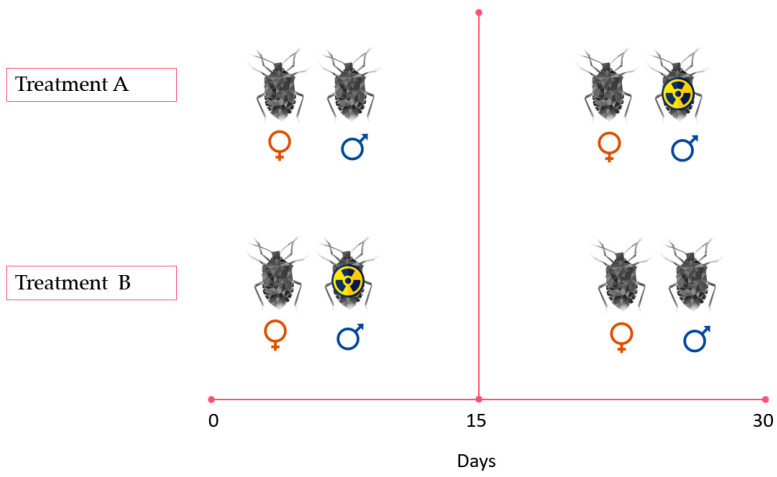
Figure A1
Figure A1
Experimental design of the experiment using Bagrada hilaris males and females, either irradiated (at 60, 80 and 100 Gy) or not, during a 30-day period. In treatment A, the female was confined with a non-irradiated male for 15 days. At the end of these, the non-irradiated male was removed and an irradiated male was inserted. In treatment B, the same procedure was performed, but in the reverse order i.e., non-irradiated-irradiated.
Figure A2
Figure A2
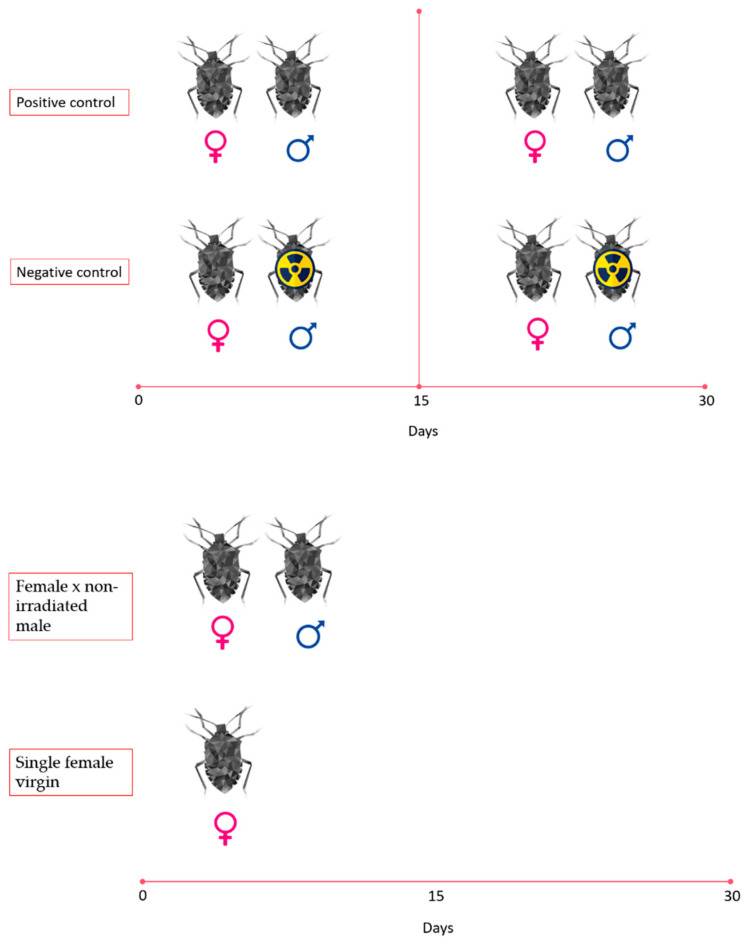
Experiment design of the controls used in the experiment. In the positive control, the female was confined with two non-irradiated males while in the negative control with two irradiated males. In addition, a female was confined with a non-irradiated male, without replacement. Finally, a non-irradiated virgin female was confined alone.
Figure 1
Figure 1
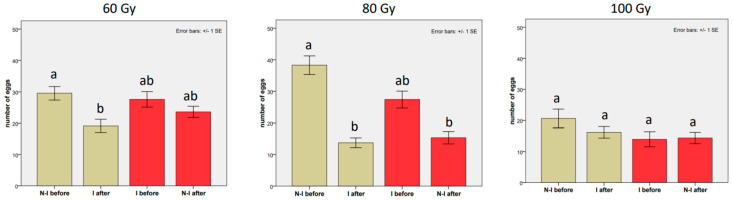
From left to right: Effects of the last male of Bagrada hilaris on the number of laid eggs at 60, 80, and 100 Gy. Grey histograms: a non-irradiated male was replaced with an irradiated male (treatment A). Red histograms: an irradiated male was replaced with a non-irradiated male (treatment B). “NI−I” refers to the non-irradiated male; “I” refers to the irradiated male. Bars with no common letters are significantly different at p < 0.05.
Figure 2
Figure 2
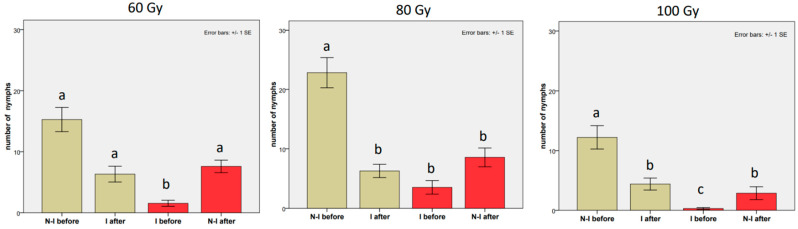
From left to right: Effects of the last male of Bagrada hilaris on the number of offspring at 60, 80, and 100 Gy. Grey histograms: a non-irradiated male was replaced with an irradiated male (treatment A). Red histograms: an irradiated male was replaced with a non-irradiated male (treatment B). “N−I” refers to the non-irradiated male; “I” refers to the irradiated male. Bars with no common letters are significantly different at p < 0.05.
Figure 3
Figure 3
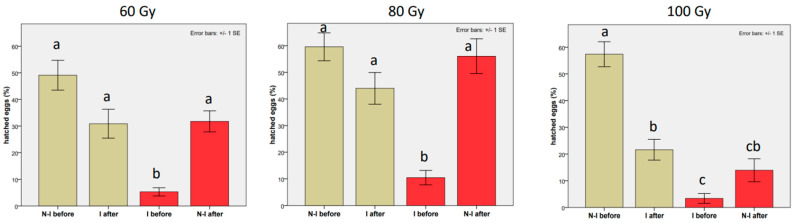
From left to right: Effects of the last male of Bagrada hilaris on the percentage of hatched eggs at 60, 80, and 100 Gy. Grey histograms: a non−irradiated male was replaced with an irradiated male (treatment A). Red histograms: an irradiated male was replaced with a non−irradiated male (treatment B). “N−I” refers to the non-irradiated male; “I” refers to the irradiated male. Bars with no common letters are significantly different at p < 0.05.
Figure 4
Figure 4
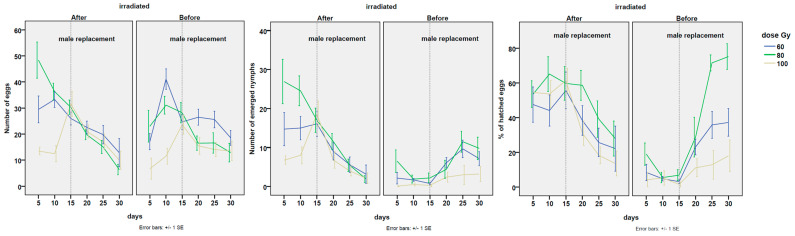
From left to right. Trends in the number of eggs, number of emerged nymphs, and percentage of eggs hatching of Bagrada hilaris during the experiment on sperm selection at the 3 tested doses of 60, 80, and 100 Gy. After 15 days, the male was replaced. In the panel on the left, the non−irradiated male was replaced with the irradiated one (treatment after). In the panel on the right, the irradiated male was replaced with the non−irradiated one (treatment before).
Figure 5
Figure 5
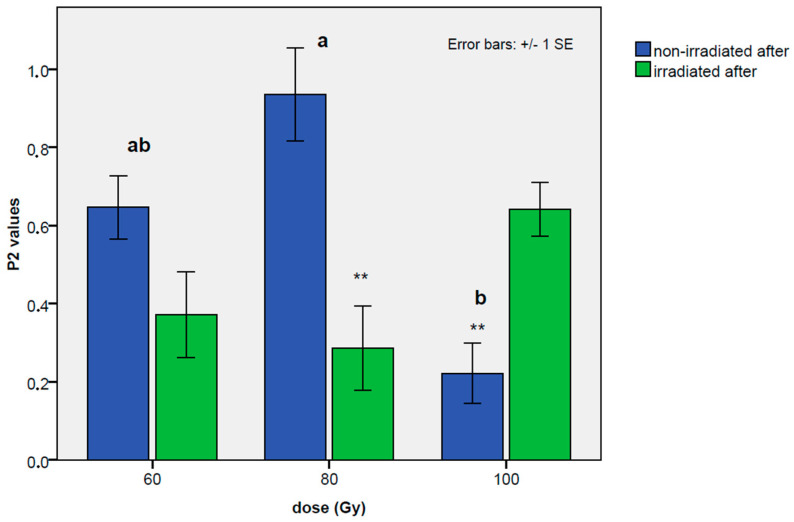
P2 values for the second mating with the non-irradiated male (blue histograms, treatment B) or with the irradiated males (green histograms, treatment A) at the tested doses of 60, 80, and 100 Gy. Bars with no common letters indicate a statistically significant difference at p = 0.05, according to the Tukey’s test for mean separation among the different doses for the type of treatment (non-irradiated after or irradiated after). The asterisks indicate a statistically significant difference between the second mating with a non-irradiated male and the second mating with an irradiated male within each dose treatment. No letters or asterisks indicate no statistically significant differences.

References

    1. Howard C.W. The Entomological Section: The Bagrada Bug (Bagrada hilaris) Transvaal Agric. J. 1906;5:168–176.
    1. Bundy C.S., Grasswitz T.R., Sutherland C. First Report of the Invasive Stink Bug Bagrada hilaris (Burmeister) (Heteroptera: Pentatomidae) from New Mexico, with Notes on Its Biology. Southwest. Entomol. 2012;37:411–414. doi: 10.3958/059.037.0317. - DOI
    1. Matsunaga J.N. Bagrada Bug Bagrada hilaris (Burmeister) State Hawaii Dep. Agric. New Pests Advis. 2014;14:2.
    1. Faúndez E.I. From Agricultural to Household Pest: The Case of the Painted Bug Bagrada hilaris (Burmeister) (Heteroptera: Pentatomidae) in Chile. J. Med. Entomol. 2018;55:1365–1368. doi: 10.1093/jme/tjy091. - DOI - PubMed
    1. Carpintero D.L., Quiroga V.N., Celentano E. Primer Registro De Bagrada hilaris (Burmeister, 1835) (Hemiptera: Pentatomidae) Para La República Argentina. Hist. Nat. 2021;11:179–184.

LinkOut - more resources