


Review of Marine Cyanobacteria and the Aspects Related to Their Roles: Chemical, Biological Properties, Nitrogen Fixation and Climate Change
- PMID: 37623720
- PMCID: PMC10456358
- DOI: 10.3390/md21080439
Review of Marine Cyanobacteria and the Aspects Related to Their Roles: Chemical, Biological Properties, Nitrogen Fixation and Climate Change
Abstract
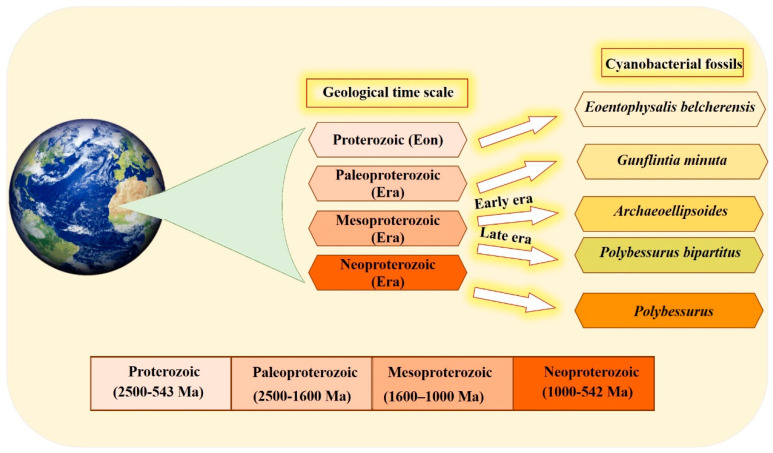
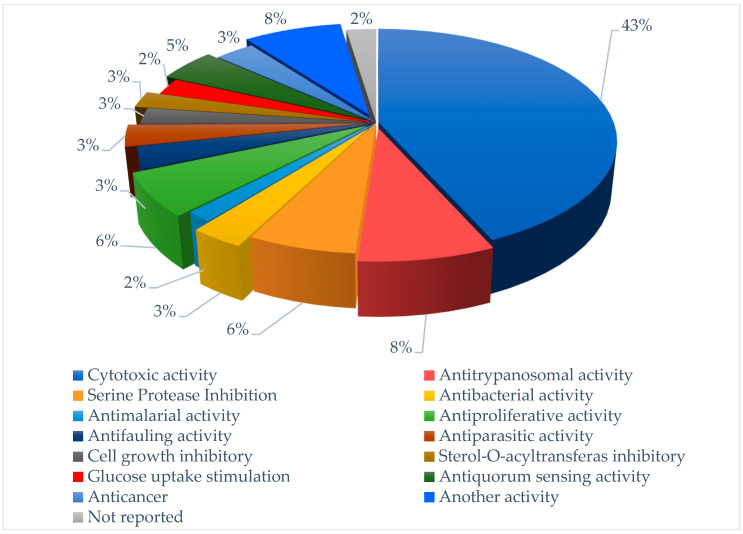
Marine cyanobacteria are an ancient group of photosynthetic microbes dating back to 3.5 million years ago. They are prolific producers of bioactive secondary metabolites. Over millions of years, natural selection has optimized their metabolites to possess activities impacting various biological targets. This paper discusses the historical and existential records of cyanobacteria, and their role in understanding the evolution of marine cyanobacteria through the ages. Recent advancements have focused on isolating and screening bioactive compounds and their respective medicinal properties, and we also discuss chemical property space and clinical trials, where compounds with potential pharmacological effects, such as cytotoxicity, anticancer, and antiparasitic properties, are highlighted. The data have shown that about 43% of the compounds investigated have cytotoxic effects, and around 8% have anti-trypanosome activity. We discussed the role of different marine cyanobacteria groups in fixing nitrogen percentages on Earth and their outcomes in fish productivity by entering food webs and enhancing productivity in different agricultural and ecological fields. The role of marine cyanobacteria in the carbon cycle and their outcomes in improving the efficiency of photosynthetic CO2 fixation in the chloroplasts of crop plants, thus enhancing the crop plant's yield, was highlighted. Ultimately, climate changes have a significant impact on marine cyanobacteria where the temperature rises, and CO2 improves the cyanobacterial nitrogen fixation.
Keywords: climate change; clinical trials; historical record; marine cyanobacteria; nitrogen fixation; secondary metabolites.
Conflict of interest statement
The authors declare no conflict of interest.
Figures
References
-
- Azeez R., Dhanalakshmi P.K., Surenirakumar K., Nallamuthu T. Growth and biochemical parameters of selective cultured cyanobacteria and exploiting antibacterial potency against human bacterial pathogens. Elixer. Appl. Bot. 2014;72:25537–25543.
-
- Altermann W., Kazmierczak J., Oren A., Wright D.T. Cyanobacterial calcification and its rock-building potential during 3.5 billion years of Earth history. Geobiology. 2006;4:147–166. doi: 10.1111/j.1472-4669.2006.00076.x. - DOI
-
- Jirí K., Kastovský J. Coincidences of structural and molecular characters in evolutionary lines of cyanobacteria. Algol. Stud. 2003;109:305–325. doi: 10.1127/1864-1318/2003/0109-0305. - DOI
Publication types
MeSH terms
Substances
LinkOut - more resources
Full Text Sources
Medical
