


Proteomic and Transcriptomic Analyses to Decipher the Chitinolytic Response of Jeongeupia spp
- PMID: 37623729
- PMCID: PMC10455584
- DOI: 10.3390/md21080448
Proteomic and Transcriptomic Analyses to Decipher the Chitinolytic Response of Jeongeupia spp
Abstract
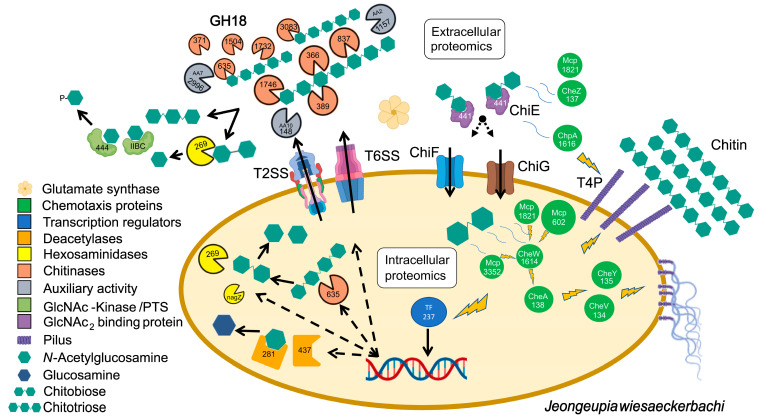
In nature, chitin, the most abundant marine biopolymer, does not accumulate due to the action of chitinolytic organisms, whose saccharification systems provide instructional blueprints for effective chitin conversion. Therefore, discovery and deconstruction of chitinolytic machineries and associated enzyme systems are essential for the advancement of biotechnological chitin valorization. Through combined investigation of the chitin-induced secretome with differential proteomic and transcriptomic analyses, a holistic system biology approach has been applied to unravel the chitin response mechanisms in the Gram-negative Jeongeupia wiesaeckerbachi. Hereby, the majority of the genome-encoded chitinolytic machinery, consisting of various glycoside hydrolases and a lytic polysaccharide monooxygenase, could be detected extracellularly. Intracellular proteomics revealed a distinct translation pattern with significant upregulation of glucosamine transport, metabolism, and chemotaxis-associated proteins. While the differential transcriptomic results suggested the overall recruitment of more genes during chitin metabolism compared to that of glucose, the detected protein-mRNA correlation was low. As one of the first studies of its kind, the involvement of over 350 unique enzymes and 570 unique genes in the catabolic chitin response of a Gram-negative bacterium could be identified through a three-way systems biology approach. Based on the cumulative data, a holistic model for the chitinolytic machinery of Jeongeupia spp. is proposed.
Keywords: chitin; chitinase; chitinolytic; glycosidic hydrolase family 18; lytic polysaccharide monooxygenase; omics; proteomics; transcriptomics.
Conflict of interest statement
The authors declare no conflict of interest. The funders had no role in the design of the study; in the collection, analyses, or interpretation of data; in the writing of the manuscript; or in the decision to publish the results.
Figures
References
-
- Gooday G.W. In: The Ecology of Chitin Degradation BT-Advances in Microbial Ecology. Marshall K.C., editor. Springer; Boston, MA, USA: 1990. pp. 387–430.
-
- Rinaudo M. Chitin and Chitosan: Properties and Applications. Prog. Polym. Sci. 2006;31:603–632. doi: 10.1016/j.progpolymsci.2006.06.001. - DOI
-
- FAO . The State of World Fisheries and Aquaculture 2022. Food & Agriculture Organization; Rome, Italy: 2022.
MeSH terms
Substances
Grants and funding
LinkOut - more resources
Full Text Sources
Research Materials
Miscellaneous
