


Antimicrobial Resistant Staphylococcus Species Colonization in Dogs, Their Owners, and Veterinary Staff of the Veterinary Teaching Hospital of Naples, Italy
- PMID: 37623976
- PMCID: PMC10457731
- DOI: 10.3390/pathogens12081016
Antimicrobial Resistant Staphylococcus Species Colonization in Dogs, Their Owners, and Veterinary Staff of the Veterinary Teaching Hospital of Naples, Italy
Abstract
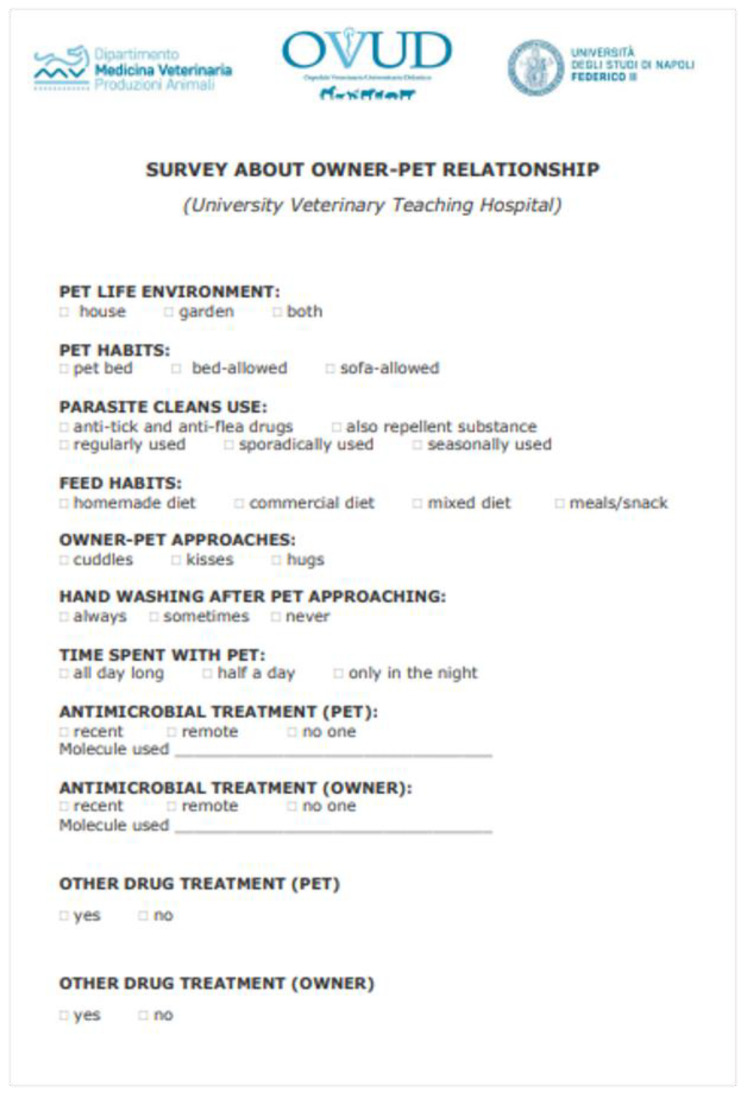
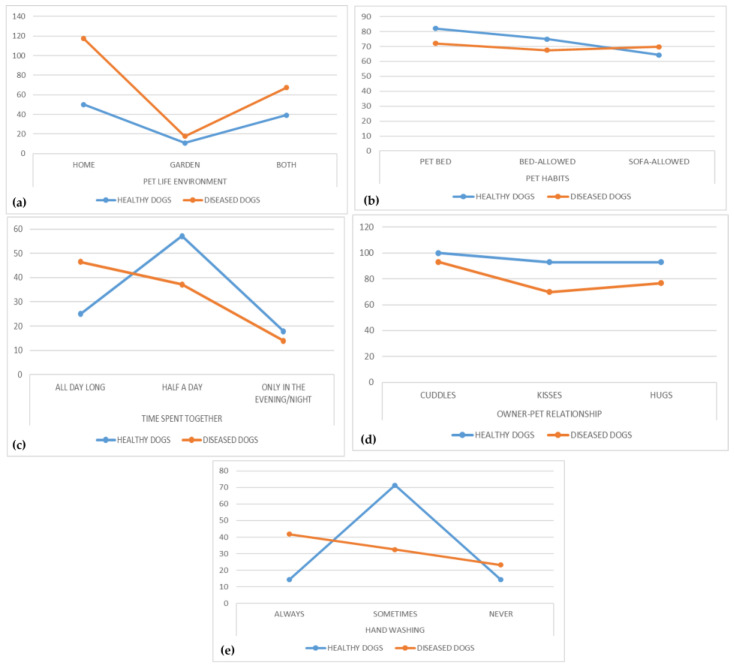
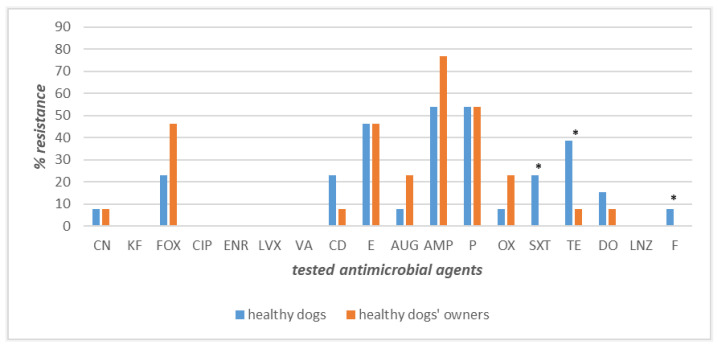
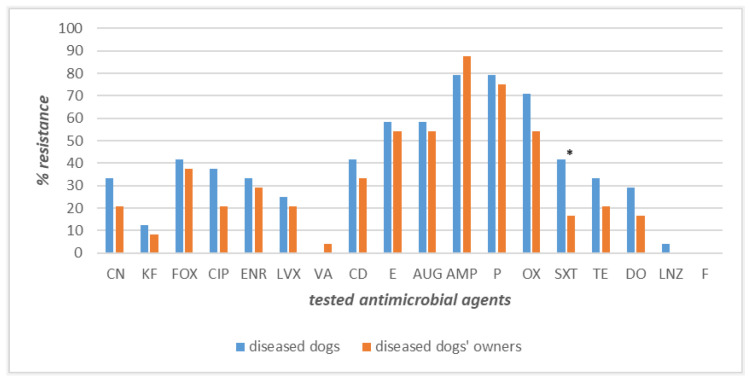
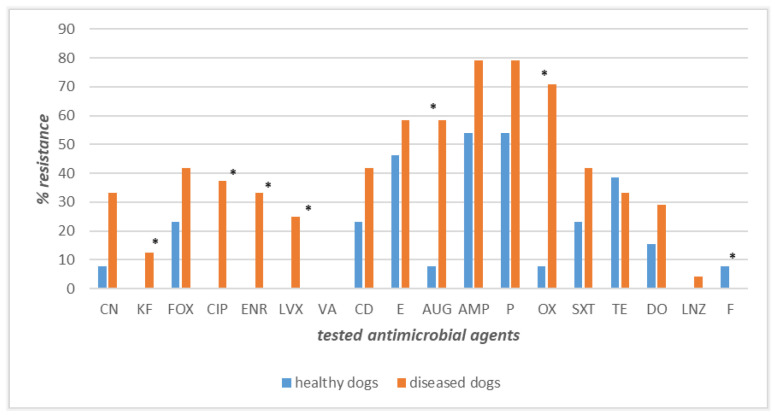
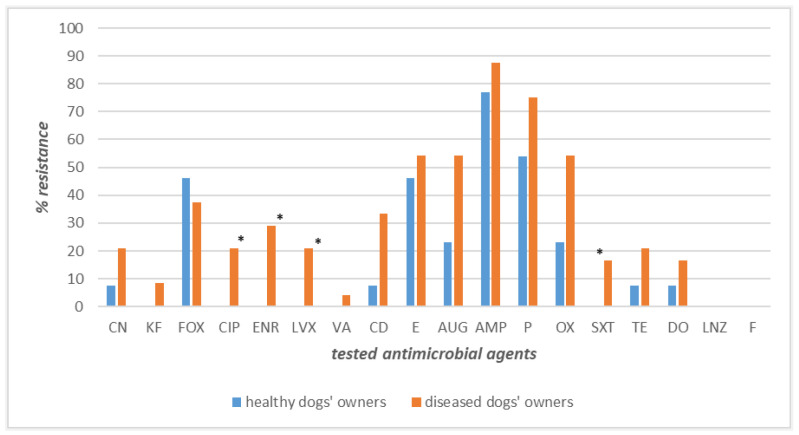
This study aimed to identify Staphylococcus species isolated from nasal swabs of both healthy and diseased dogs, and those of human origin, obtained from nasal swabs of both owners and veterinary staff. Firstly, pet owners were requested to complete a questionnaire relating to the care and relationship with their pets, whose results mainly showed a statistically significant higher frequency of hand washing in diseased dogs' owners than in healthy dogs' owners. Canine nasal swabs were obtained from 43 diseased dogs and 28 healthy dogs, while human nasal swabs were collected from the respective dogs' owners (71 samples) and veterinary staff (34 samples). The isolation and identification of Staphylococcus spp. were followed by disk diffusion method to define the antimicrobial resistance profiles against 18 different molecules. Staphylococcus pseudintermedius was the most frequent isolated strain in both diseased (33.3%) and healthy (46.1%) dogs. Staphylococcus epidermidis was the most frequent isolated bacterium in diseased dogs' owners (66.6%), while in nasal samples of healthy dogs' owners, the same frequency of isolation (38.4%) was observed for both Staphylococcus epidermidis and Staphylococcus aureus. All the isolated strains showed good susceptibility levels to the tested antimicrobials; however, the carriage of oxacillin-resistant strains was significantly higher in diseased dogs than in healthy ones (71% and 7.7%, respectively). Only in three cases the presence of the same bacterial species with similar antimicrobial resistance profiles in dogs and their owners was detected, suggesting the potential bacterial transmission. In conclusion, this study suggests potential transmission risk of staphylococci from dogs to humans or vice versa, and highlights that the clinical relevance of Staphylococcus pseudintermedius transmission from dog to human should not be underestimated, as well as the role of Staphylococcus aureus from human to dog transmission.
Keywords: Staphylococcus spp.; antimicrobial resistance; dogs; pet owners; transmission; veterinary staff.
Conflict of interest statement
The authors declare no conflict of interest.
Figures
References
-
- Misic A.M., Davis M.F., Tyldsley A.S., Hodkinson B.P., Tolomeo P., Hu B., Nachamkin I., Lautenbach E., Morris D.O., Grice E.A. The shared microbiota of humans and companion animals as evaluated from Staphylococcus carriage sites. Microbiome. 2015;3:2. doi: 10.1186/s40168-014-0052-7. - DOI - PMC - PubMed
-
- Cuny C., Layer-Nicolaou F., Weber R., Köck R., Witte W. Colonization of dogs and their owners with Staphylococcus aureus and Staphylococcus pseudintermedius in households, veterinary practices, and healthcare facilities. Microorganisms. 2022;10:677. doi: 10.3390/microorganisms10040677. - DOI - PMC - PubMed
LinkOut - more resources
Full Text Sources
Miscellaneous
