


Epidemiological Differences in Hajj-Acquired Airborne Infections in Pilgrims Arriving from Low and Middle-Income versus High-Income Countries: A Systematised Review
- PMID: 37624356
- PMCID: PMC10459586
- DOI: 10.3390/tropicalmed8080418
Epidemiological Differences in Hajj-Acquired Airborne Infections in Pilgrims Arriving from Low and Middle-Income versus High-Income Countries: A Systematised Review
Abstract
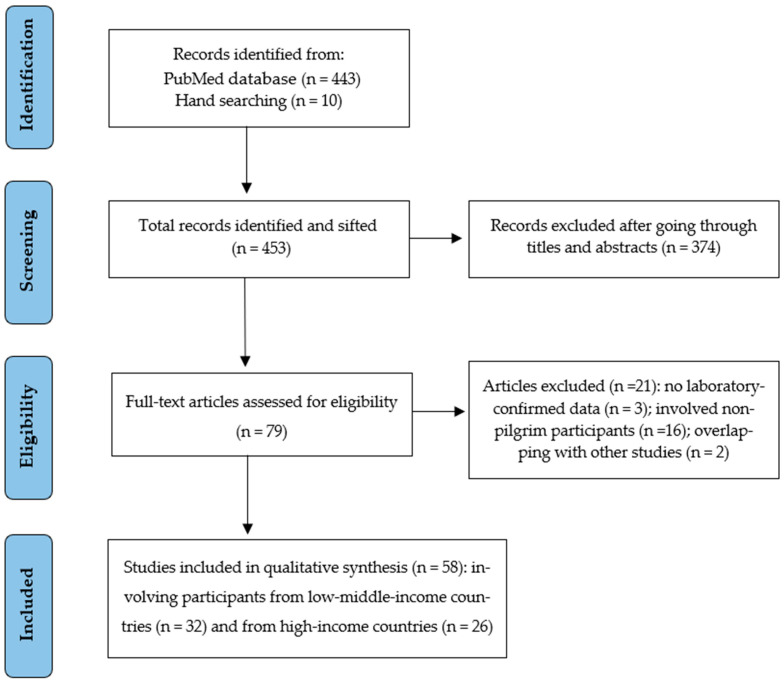
This systematised review aims to compare the epidemiological patterns of Hajj-acquired airborne infections among pilgrims from low and middle-income countries (LMIC) versus those from high-income countries (HIC). A PubMed search was carried out for all published articles before February 2023, using a combination of MeSH terms and text words. The Newcastle-Ottawa Scale (NOS) was used to assess data quality. From a total of 453 titles identified, 58 studies were included in the review (LMIC = 32, and HIC = 26). In the pooled sample, there were 27,799 pilgrims aged 2 days to 105 years (male: female = 1.3:1) from LMIC and 70,865 pilgrims aged 2 months to 95 years (male: female = 1:1) from HIC. Pilgrims from both HIC and LMIC had viral and bacterial infections, but pilgrims from HIC tended to have higher attack rates of viral infections than their LMIC counterparts. However, the attack rates of bacterial infections were variable: for instance, pilgrims from LMIC seemed to have higher rates of meningococcal infections (0.015-82% in LMIC vs. 0.002-40% in HIC) based on the study population, but not Mycobacterium tuberculosis (0.7-20.3% in LMIC vs. 38% in HIC). Targeted measures are needed to prevent the spread of airborne infections at Hajj.
Keywords: Hajj; airborne infections; high-income countries; low and middle-income countries; pilgrims.
Conflict of interest statement
The authors declare no conflict of interest.
Figures
Similar articles
-
Meningococcal serogroup A, C, W, and Y serum bactericidal antibody profiles in Hajj pilgrims.Int J Infect Dis. 2014 Nov;28:171-5. doi: 10.1016/j.ijid.2014.09.005. Epub 2014 Oct 12. Int J Infect Dis. 2014. PMID: 25307887
-
Effectiveness of interventions for children and adolescents with autism spectrum disorder in high-income vs. lower middle-income countries: An overview of systematic reviews and research papers from LMIC.Front Psychiatry. 2022 Aug 4;13:834783. doi: 10.3389/fpsyt.2022.834783. eCollection 2022. Front Psychiatry. 2022. PMID: 35990045 Free PMC article.
-
Meningococcal carriage in Umra pilgrims returning from Saudi Arabia.J Travel Med. 2003 May-Jun;10(3):147-9. doi: 10.2310/7060.2003.35751. J Travel Med. 2003. PMID: 12757687
-
High prevalence of common respiratory viruses and no evidence of Middle East respiratory syndrome coronavirus in Hajj pilgrims returning to Ghana, 2013.Trop Med Int Health. 2015 Jun;20(6):807-12. doi: 10.1111/tmi.12482. Epub 2015 Mar 3. Trop Med Int Health. 2015. PMID: 25688471 Free PMC article.
-
Global Problem of Physician Dual Practices: A Literature Review.Iran J Public Health. 2022 Jul;51(7):1444-1460. doi: 10.18502/ijph.v51i7.10079. Iran J Public Health. 2022. PMID: 36248302 Free PMC article. Review.
References
-
- Alqahtani A.S., Alshahrani A.M., Rashid H. Health Issues of Mass Gatherings in the Middle East. In: Laher I., editor. Handbook of Healthcare in the Arab World. Springer International Publishing; Cham, Switzerland: 2021. pp. 1183–1198.
Publication types
LinkOut - more resources
Full Text Sources
