


MAIT cells in bacterial infectious diseases: heroes, villains, or both?
- PMID: 37624404
- PMCID: PMC10714195
- DOI: 10.1093/cei/uxad102
MAIT cells in bacterial infectious diseases: heroes, villains, or both?
Abstract
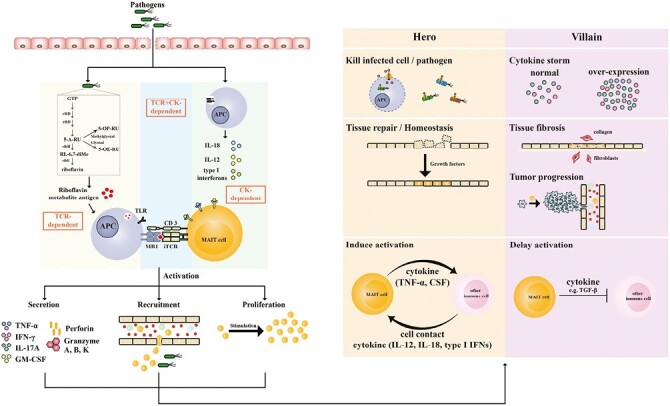
Due to the aggravation of bacterial drug resistance and the lag in the development of new antibiotics, it is crucial to develop novel therapeutic regimens for bacterial infectious diseases. Currently, immunotherapy is a promising regimen for the treatment of infectious diseases. Mucosal-associated invariant T (MAIT) cells, a subpopulation of innate-like T cells, are abundant in humans and can mount a rapid immune response to pathogens, thus becoming a potential target of immunotherapy for infectious diseases. At the site of infection, activated MAIT cells perform complex biological functions by secreting a variety of cytokines and cytotoxic substances. Many studies have shown that MAIT cells have immunoprotective effects because they can bridge innate and adaptive immune responses, leading to bacterial clearance, tissue repair, and homeostasis maintenance. MAIT cells also participate in cytokine storm generation, tissue fibrosis, and cancer progression, indicating that they play a role in immunopathology. In this article, we review recent studies of MAIT cells, discuss their dual roles in bacterial infectious diseases and provide some promising MAIT cell-targeting strategies for the treatment of bacterial infectious diseases.
Keywords: MAIT cells; bacterial infectious disease; immunopathology; immunoprotection; immunotherapy.
© The Author(s) 2023. Published by Oxford University Press on behalf of the British Society for Immunology. All rights reserved. For permissions, please e-mail: journals.permissions@oup.com.
Conflict of interest statement
The authors declare no conflicts of interest.
Figures
References
-
- Collaborators GDaIIaP. Global, regional, and national incidence, prevalence, and years lived with disability for 354 diseases and injuries for 195 countries and territories, 1990-2017: a systematic analysis for the Global Burden of Disease Study 2017. Lancet 2018, 392, 1789–858. doi: 10.1016/S0140-6736(18)32279-7 - DOI - PMC - PubMed
Publication types
MeSH terms
Substances
Grants and funding
LinkOut - more resources
Full Text Sources
Medical
