


Early and repeated screening detects children with persistent attention-deficit/hyperactivity disorder
- PMID: 37624573
- PMCID: PMC11211128
- DOI: 10.1007/s00787-023-02284-8
Early and repeated screening detects children with persistent attention-deficit/hyperactivity disorder
Abstract
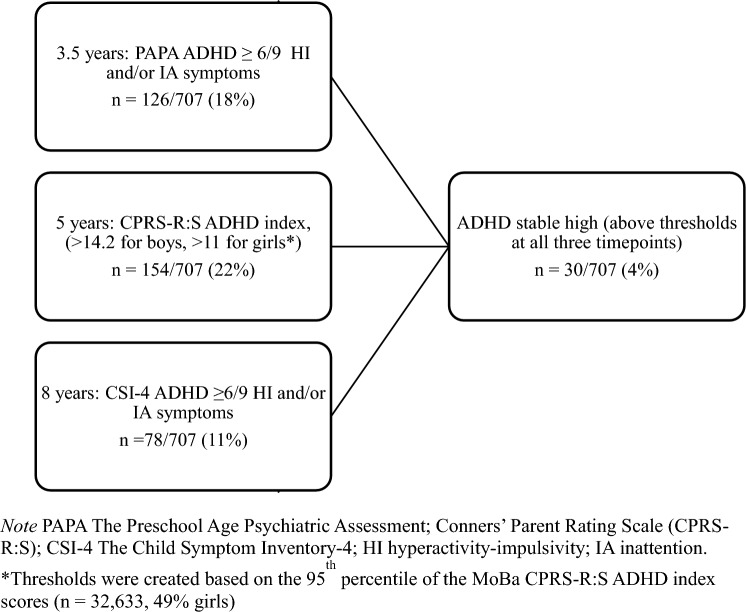
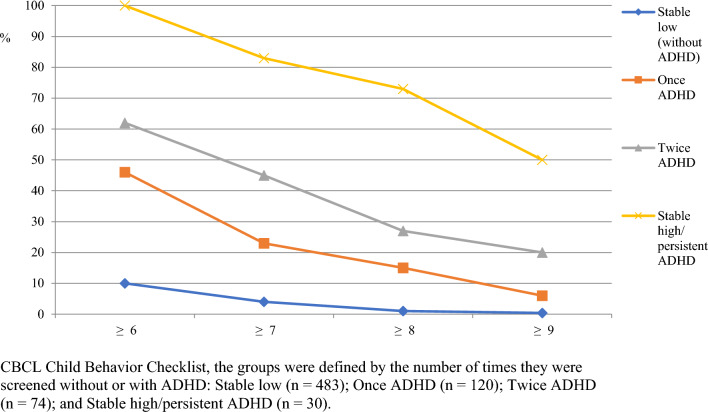
Preschool screening of attention-deficit/hyperactivity disorder (ADHD) has been found too inaccurate to be clinically useful. This may be due to the known instability of ADHD symptoms from preschool onwards, and the use of a single screening only. We hypothesized that by identifying a group of children with persistent ADHD from preschool to school age and repeating the screening, the clinical usefulness of screening would increase. This study is part of the prospective longitudinal, population-based Norwegian Mother, Father and Child Cohort Study, with a diagnostic parent interview at 3.5 years and follow-up with parent questionnaires at ages 5 and 8 years (n = 707). We identified a group classified with ADHD at all three time points (persistent ADHD). We then used the Child Behavior Checklist ADHD DSM-oriented scale at ages 3.5 and 5 years to investigate the accuracies of single- and two-stage screening at different thresholds to identify children with persistent ADHD. About 30% of the children were classified with ADHD at least once across time (at ages 3.5, 5, and/or 8 years), but only 4% (n = 30) had persistent ADHD. At all thresholds, the two-stage screening identified children with persistent ADHD more accurately than single screening, mainly due to a substantial reduction in false positives. Only a small group of children were classified with persistent ADHD from preschool to school age, underlining that future screening studies should distinguish this group from those with fluctuating symptoms when estimating screening accuracies. We recommend a two-stage screening process to reduce false positives.
Keywords: ADHD; Children; Longitudinal; Persistent; Preschool.
© 2023. The Author(s).
Conflict of interest statement
Dr. Polanczyk has served as a consultant/speaker to Abbott, Aché, Medice, Novo Nordisk, and Takeda, and has received royalties from Editora Manole. He receives research support from Fundação de Amparo à Pesquisa do Estado de São Paulo (FAPESP) (Grant No. 16/22455–8). All other authors have no conflicts of interest to disclose.
Figures

References
-
- Coghill D, Banaschewski T, Cortese S, Asherson P, Brandeis D, Buitelaar J, et al. The management of ADHD in children and adolescents: bringing evidence to the clinic: perspective from the European ADHD Guidelines Group (EAGG) Eur Child Adolesc Psychiatry. 2023;32:1337–1361. doi: 10.1007/s00787-021-01871-x. - DOI - PMC - PubMed
-
- Sampaio F, Feldman I, Lavelle TA, Skokauskas N. The cost-effectiveness of treatments for attention deficit-hyperactivity disorder and autism spectrum disorder in children and adolescents: a systematic review. Eur Child Adolesc Psychiatry. 2022;31:1655–1670. doi: 10.1007/s00787-021-01748-z. - DOI - PMC - PubMed
-
- Shephard E, Zuccolo PF, Idrees I, Godoy PBG, Salomone E, Ferrante C, et al. Systematic review and meta-analysis: the science of early-life precursors and interventions for attention-deficit/hyperactivity disorder. J Am Acad Child Adolesc Psychiatry. 2022;61:187–226. doi: 10.1016/j.jaac.2021.03.016. - DOI - PubMed
MeSH terms
LinkOut - more resources
Full Text Sources
Medical
