. 2023 Sep:95:104764.
doi: 10.1016/j.ebiom.2023.104764. Epub 2023 Aug 23.

Long-acting lenacapavir protects macaques against intravenous challenge with simian-tropic HIV

Affiliations

Long-acting lenacapavir protects macaques against intravenous challenge with simian-tropic HIV

Adrienne E Swanstrom et al. EBioMedicine. 2023 Sep.

Abstract

Background: Long-acting subcutaneous lenacapavir (LEN), a first-in-class HIV capsid inhibitor approved by the US FDA for the treatment of multidrug-resistant HIV-1 with twice yearly dosing, is under investigation for HIV-1 pre-exposure prophylaxis (PrEP). We previously derived a simian-tropic HIV-1 clone (stHIV-A19) that encodes an HIV-1 capsid and replicates to high titres in pigtail macaques (PTM), resulting in a nonhuman primate model well-suited for evaluating LEN PrEP in vivo.

Methods: Lenacapavir potency against stHIV-A19 in PTM peripheral blood mononuclear cells in vitro was determined and subcutaneous LEN pharmacokinetics were evaluated in naïve PTMs in vivo. To evaluate the protective efficacy of LEN PrEP, naïve PTMs received either a single subcutaneous injection of LEN (25 mg/kg, N = 3) or vehicle (N = 4) 30 days before a high-dose intravenous challenge with stHIV-A19, or 7 daily subcutaneous injections of a 3-drug control PrEP regimen starting 3 days before stHIV-A19 challenge (N = 3).

Findings: In vitro, LEN showed potent antiviral activity against stHIV-A19, comparable to its potency against HIV-1. In vivo, subcutaneous LEN displayed sustained plasma drug exposures in PTMs. Following stHIV-A19 challenge, while all vehicle control animals became productively infected, all LEN and 3-drug control PrEP animals were protected from infection.

Interpretation: These findings highlight the utility of the stHIV-A19/PTM model and support the clinical development of long-acting LEN for PrEP in humans.

Funding: Gilead Sciences as part of a Cooperative Research and Development Agreement between Gilead Sciences and Frederick National Lab; federal funds from the National Cancer Institute, National Institutes of Health, under Contract No. 75N91019D00024/HHSN261201500003I; NIH grant R01AI078788.

Keywords: Capsid; HIV; Macaque; Nonhuman primate; PrEP; Pre-exposure prophylaxis.


Conflict of interest statement

Declaration of interests BL, KW, WR, JZ, WB, and SRY are or were employees of Gilead Sciences, Inc., and received salary and stock ownership as compensation for their employment. WB, JZ, and SRY are inventors on patent application US20210188815A1 covering the use of capsid inhibitors for the prevention of HIV. JDL has served as a compensated advisor to Gilead Sciences, Inc., and JDL, GQD, and AES have received research support from Gilead Sciences, Inc., for studies unrelated to the work described here through separate collaborative research and development agreements with Leidos Biomedical Research, Inc. TH has received royalties from Wiley for textbook authorship, NIH honoraria for grant review panel participation, and registration fee reimbursement from Gordon conference for participating as an invited speaker. PDB receives salary support from the Howard Hughes Medical Institute and owns Gilead stock. The authors declare no other financial or competing interests exist.

Figures
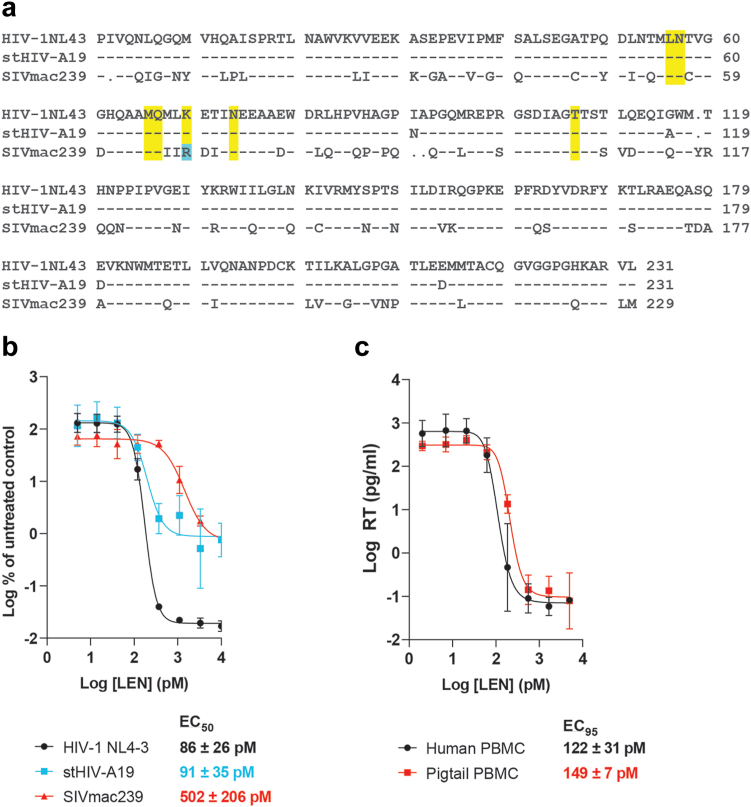
Fig. 1
Fig. 1
Sensitivity of stHIV-A19 to LEN. (a) Alignment of capsid protein (CA) amino acid sequences for HIV-1 NL4-3, stHIV-A19, and SIVmac239. Locations of known amino acid substitutions conferring LEN resistance are highlighted in yellow. An amino acid difference in the SIVmac239 CA sequence associated with reduced LEN sensitivity for HIV-1 is highlighted in blue. (b) In vitro antiviral dose response curves for LEN against HIV-1 NL4-3, stHIV-A19, or SIVmac239 in multi-round viral replication assays in SupT1-CCR5 cells. Viral RNA content in culture supernatants collected at 7 days post-infection was quantified and expressed as a percentage of vRNA content in no-drug control cultures. Lenacapavir mean EC50 values ± SD determined against each virus are shown. (c) In vitro antiviral dose response curves for LEN against stHIV-A19 in multi-round viral replication assays in primary human and pigtail macaque PBMCs from three independent donors. Viral reverse transcriptase (RT) protein was quantified in culture supernatants collected 7 days post-infection. Calculated EC95 values for LEN against stHIV-A19 in each cell type are shown. Data in (b) and (c) represent means ± SD values from three independent experiments each performed in triplicate.
Fig. 2
Fig. 2
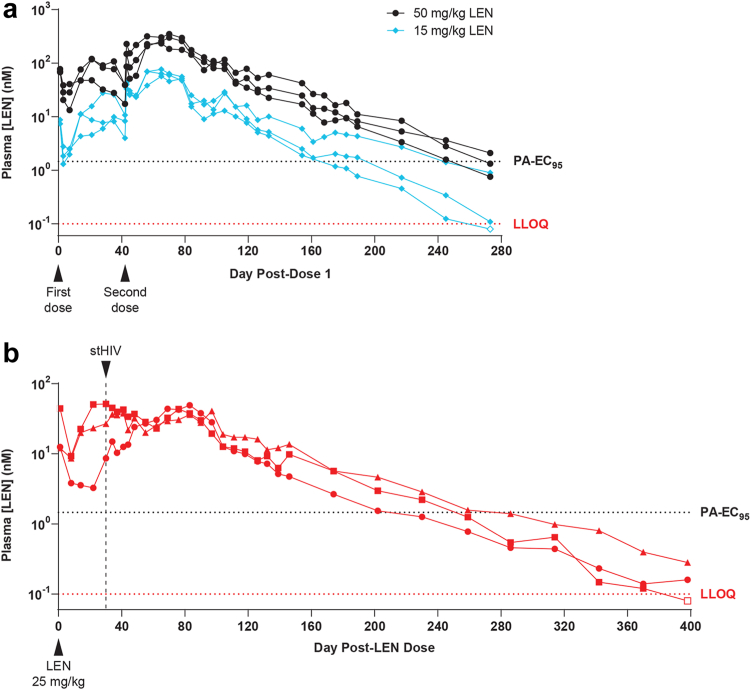
Pharmacokinetics of subcutaneous LEN in pigtail macaques. Longitudinal plasma LEN concentrations measured by liquid chromatography mass spectrometry (LC-MS) in (a) naïve pigtail macaques that received two doses of LEN at 15 mg/kg (N = 3; blue diamonds) or 50 mg/kg (N = 3; black circles) 6 weeks apart and in (b) three pigtail macaques in the LEN PrEP study group that each received a single subcutaneous injection of LEN at 25 mg/kg and were intravenously challenged with stHIV-A19 30 days later. In each plot, the bottom horizontal red dashed line represents the assay lower limit of quantification (LLOQ; 0.1 nM) and the top horizontal black dashed line represents the plasma protein binding-adjusted EC95 (PA-EC95; 1.46 nM) for LEN against stHIV-A19 in pigtail macaque peripheral blood mononuclear cells.
Fig. 3
Fig. 3
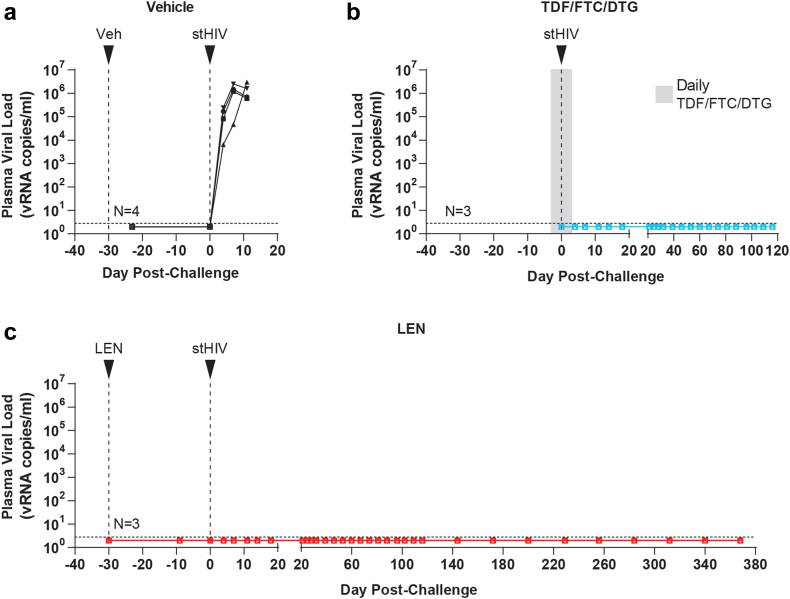
Plasma viral loads following stHIV-A19 challenge. Longitudinal plasma viral loads for (a) vehicle control, (b) TDF/FTC/DTG control PrEP, and (c) LEN PrEP group animals prior to and following intravenous stHIV-A19 challenge. The timing of vehicle, LEN, and stHIV-A19 injections are indicated by arrows. The grey shaded region in (b) indicates a 7-day period of daily TDF/FTC/DTG administration, beginning three days prior to stHIV-A19 challenge. Horizontal dashed lines indicate the assay quantification limit (2.8 vRNA copies/ml plasma). Plot symbols below the quantification limit represent specimens in which no viral RNA was detected.
Fig. 4
Fig. 4
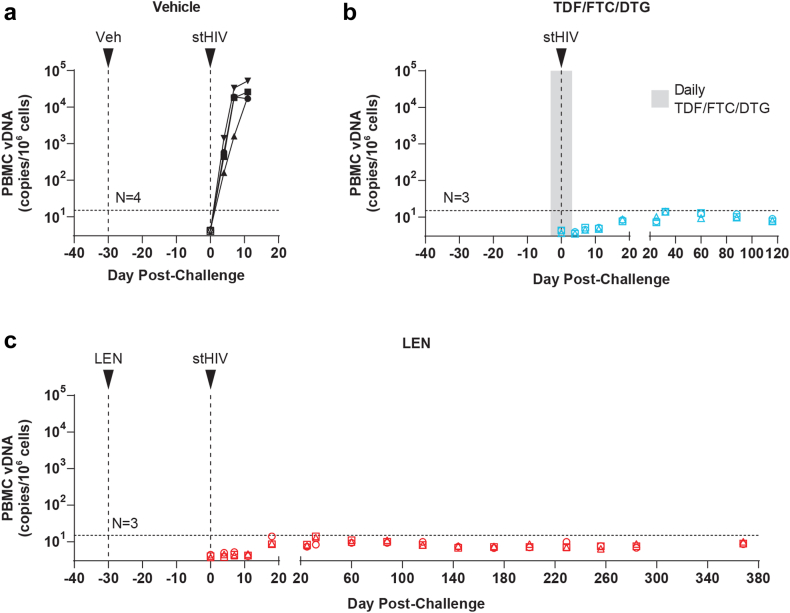
Cell-associated viral DNA following stHIV-A19 challenge. Cell-associated viral DNA (CA-vDNA) levels in PBMC for (a) vehicle control, (b) TDF/FTC/DTG control PrEP, and (c) LEN PrEP group animals prior to and following intravenous stHIV-A19 challenge. The timing of vehicle, LEN, and stHIV-A19 injections are indicated by arrows. The grey shaded region in (b) indicates a 7-day period of daily TDF/FTC/DTG administration, beginning three days prior to stHIV-A19 challenge. Determined vDNA levels were normalized based on input diploid genome cell equivalents assayed for each sample determined by the duplex quantification of the copy number of a host cell gene within the same sample extraction. Symbols are plotted at the threshold sensitivity limit for that sample based on the number of cell equivalents assayed. Horizontal dashed lines indicate the highest threshold assay quantification limit (based on the lowest cell input for the assay) across all analysed samples (15 vDNA copies/106 cell equivalents). Plot symbols below the quantification limit represent specimens in which no vDNA were detected.
Fig. 5
Fig. 5
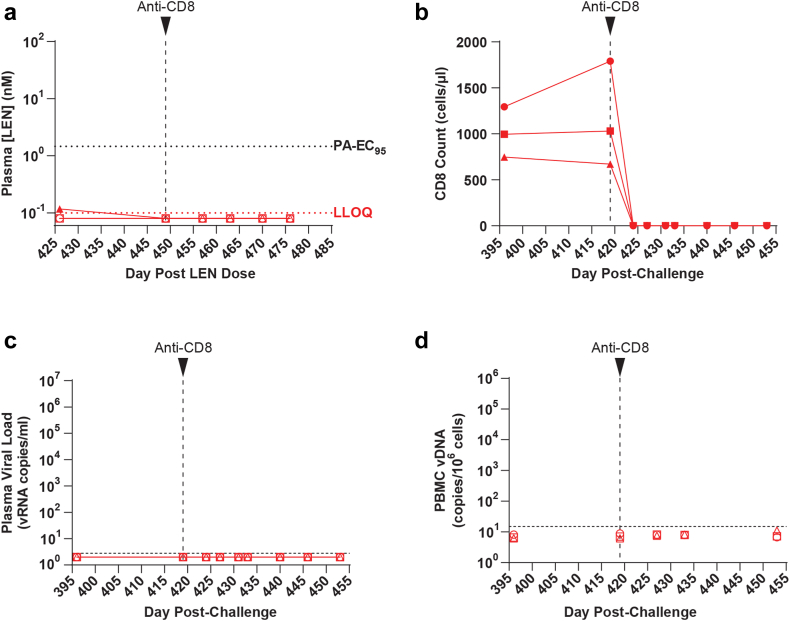
Experimental depletion of CD8+ cells in LEN PrEP animals. Animals in the LEN PrEP group received a single subcutaneous injection of the rhesusized anti-CD8 antibody MT807R1 (50 mg/kg) at the indicated time point, after LEN plasma concentrations declined below the lower limit of quantitation (LLOQ) in each of the three animals. (a) Longitudinal plasma LEN concentrations measured by LC-MS. The bottom horizontal red dashed line represents the assay LLOQ for LEN (0.1 nM). The top horizontal dashed black line represents the PA-EC95 (1.46 nM) for LEN against stHIV-A19 in pigtail macaque cells. (b) Longitudinal absolute CD8+ T cell counts in whole blood determined by flow cytometry. (c) Longitudinal plasma viral loads. The horizontal dashed line denotes the assay quantification limit (2.8 vRNA copies/ml plasma). Plot symbols below the quantification limit represent specimens in which no viral RNA was detected. (d) Longitudinal cell-associated viral DNA (CA-vDNA) levels in PBMC. Determined vDNA levels were normalized based on input diploid genome cell equivalents assayed for each sample determined by the duplex quantification of the copy number of a host cell gene within the same sample extraction. The horizontal dashed line indicates the maximum quantification limit across all analysed samples (15 vDNA copies/106 cell equivalents). Plot symbols below the quantification limit represent specimens in which no vDNA was detected. Symbols are plotted at the threshold sensitivity limit for that individual sample based on the number of cell equivalents assayed.
Supplementary Figure S1
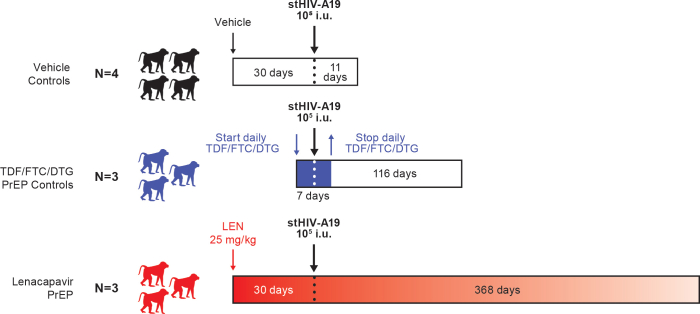
Intravenous challenge study schema. Study design, including relative timing of vehicle injection, lenacapavir (LEN) injection, initiation (blue downward arrow) and discontinuation (blue upward arrow) of daily oral TDF/FTC/DTG administration, and intravenous stHIV-A19 challenge. Following stHIV-A19 challenge, each group was monitored for the indicated duration. Animals in the vehicle control and TDF/FTC/DTG control groups were followed for a shorter duration than the LEN groups following stHIV-A19 challenge because they were repurposed for other studies to conserve animal resources. I.U., infectious units.
Supplementary Figure S2
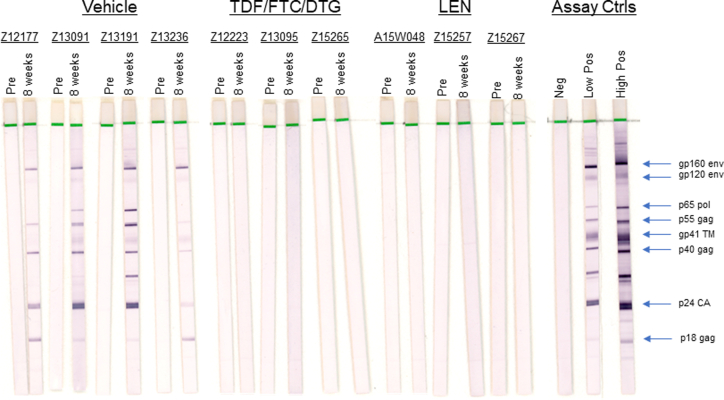
Challenge study animal seroreactivity with HIV-1 Proteins. Plasma samples collected prior to (“Pre”) or 8 weeks after intravenous stHIV-A19 challenge for all 10 challenge study animals were evaluated for the presence of antibodies specific for HIV-1 proteins by Western blot analysis.

References

    1. UNAIDS . 2021. Global HIV & AIDS statistics - 2021 fact sheet.http://wwwunaidsorg/en/resources/fact-sheet
    1. Grant R.M., Lama J.R., Anderson P.L., et al. Preexposure chemoprophylaxis for HIV prevention in men who have sex with men. N Engl J Med. 2010;363(27):2587–2599. - PMC - PubMed
    1. Baeten J.M., Donnell D., Ndase P., et al. Antiretroviral prophylaxis for HIV prevention in heterosexual men and women. N Engl J Med. 2012;367(5):399–410. - PMC - PubMed
    1. Liu A.Y., Cohen S.E., Vittinghoff E., et al. Preexposure prophylaxis for HIV infection integrated with municipal- and community-based sexual health services. JAMA Intern Med. 2016;176(1):75–84. - PMC - PubMed
    1. Marcus J.L., Hurley L.B., Hare C.B., et al. Preexposure prophylaxis for HIV prevention in a large integrated health care system: adherence, renal safety, and discontinuation. J Acquir Immune Defic Syndr. 2016;73(5):540–546. - PMC - PubMed