


Investigating two mobile just-in-time adaptive interventions to foster psychological resilience: research protocol of the DynaM-INT study
- PMID: 37626397
- PMCID: PMC10464364
- DOI: 10.1186/s40359-023-01249-5
Investigating two mobile just-in-time adaptive interventions to foster psychological resilience: research protocol of the DynaM-INT study
Abstract
Background: Stress-related disorders such as anxiety and depression are highly prevalent and cause a tremendous burden for affected individuals and society. In order to improve prevention strategies, knowledge regarding resilience mechanisms and ways to boost them is highly needed. In the Dynamic Modelling of Resilience - interventional multicenter study (DynaM-INT), we will conduct a large-scale feasibility and preliminary efficacy test for two mobile- and wearable-based just-in-time adaptive interventions (JITAIs), designed to target putative resilience mechanisms. Deep participant phenotyping at baseline serves to identify individual predictors for intervention success in terms of target engagement and stress resilience.
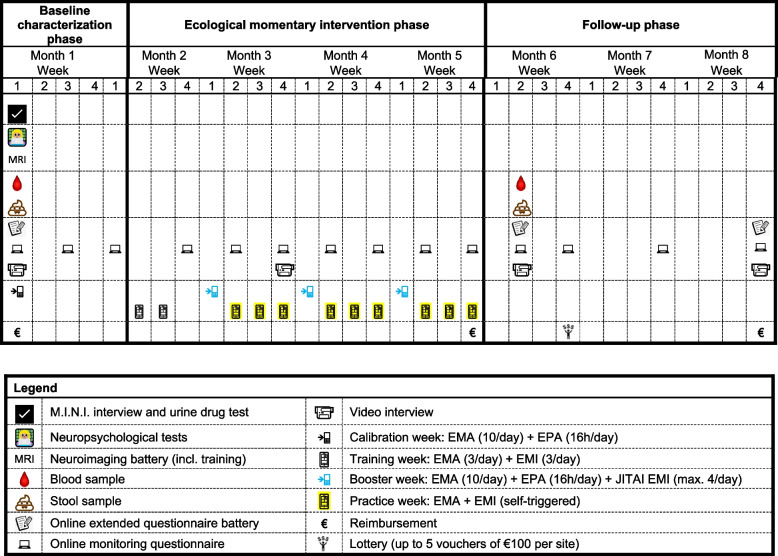
Methods: DynaM-INT aims to recruit N = 250 healthy but vulnerable young adults in the transition phase between adolescence and adulthood (18-27 years) across five research sites (Berlin, Mainz, Nijmegen, Tel Aviv, and Warsaw). Participants are included if they report at least three negative burdensome past life events and show increased levels of internalizing symptoms while not being affected by any major mental disorder. Participants are characterized in a multimodal baseline phase, which includes neuropsychological tests, neuroimaging, bio-samples, sociodemographic and psychological questionnaires, a video-recorded interview, as well as ecological momentary assessments (EMA) and ecological physiological assessments (EPA). Subsequently, participants are randomly assigned to one of two ecological momentary interventions (EMIs), targeting either positive cognitive reappraisal or reward sensitivity. During the following intervention phase, participants' stress responses are tracked using EMA and EPA, and JITAIs are triggered if an individually calibrated stress threshold is crossed. In a three-month-long follow-up phase, parts of the baseline characterization phase are repeated. Throughout the entire study, stressor exposure and mental health are regularly monitored to calculate stressor reactivity as a proxy for outcome resilience. The online monitoring questionnaires and the repetition of the baseline questionnaires also serve to assess target engagement.
Discussion: The DynaM-INT study intends to advance the field of resilience research by feasibility-testing two new mechanistically targeted JITAIs that aim at increasing individual stress resilience and identifying predictors for successful intervention response. Determining these predictors is an important step toward future randomized controlled trials to establish the efficacy of these interventions.
Keywords: Ecological momentary assessment; Ecological momentary intervention; Longitudinal; Mental health; Mental imagery; Prospective; Reappraisal; Resilience; Resilience factors; Stress.
© 2023. BioMed Central Ltd., part of Springer Nature.
Conflict of interest statement
The authors declare that they have no competing interests. RK has received advisory honoraria from JoyVentures, Herzlia, Israel.
Figures
References
-
- James SL, Abate D, Abate KH, Abay SM, Abbafati C, Abbasi N, et al. Global, regional, and national incidence, prevalence, and years lived with disability for 354 diseases and injuries for 195 countries and territories, 1990–2017: a systematic analysis for the Global Burden of Disease Study 2017. Lancet. 2018;392:1789–1858. doi: 10.1016/S0140-6736(18)32279-7. - DOI - PMC - PubMed
MeSH terms
Grants and funding
- 777084/European Union's Horizon 2020 research and innovation program
- 777084/European Union's Horizon 2020 research and innovation program
- 777084/European Union's Horizon 2020 research and innovation program
- 777084/European Union's Horizon 2020 research and innovation program
- 777084/European Union's Horizon 2020 research and innovation program
- 777084/European Union's Horizon 2020 research and innovation program
- 777084/European Union's Horizon 2020 research and innovation program
- 777084/European Union's Horizon 2020 research and innovation program
- 777084/European Union's Horizon 2020 research and innovation program
- 777084/European Union's Horizon 2020 research and innovation program
- 777084/European Union's Horizon 2020 research and innovation program
- 777084/European Union's Horizon 2020 research and innovation program
- 777084/European Union's Horizon 2020 research and innovation program
- 777084/European Union's Horizon 2020 research and innovation program
- 777084/European Union's Horizon 2020 research and innovation program
- 777084/European Union's Horizon 2020 research and innovation program
- DFG Grant CRC 1193, subprojects B01, C01, C04, Z03/Deutsche Forschungsgemeinschaft
- DFG Grant CRC 1193, subprojects B01, C01, C04, Z03/Deutsche Forschungsgemeinschaft
- 01KX2021/German Federal Ministry for Education and Research (BMBF) as part of the Network for University Medicine
- MARP program, DRZ program, Leibniz Institute for Resilience Research/State of Rhineland-Palatinate, Germany
- MARP program, DRZ program, Leibniz Institute for Resilience Research/State of Rhineland-Palatinate, Germany
LinkOut - more resources
Full Text Sources
Research Materials
Miscellaneous
