


Using the RE-AIM framework to evaluate the implementation and effectiveness of a WHO HEARTS-based intervention to integrate the management of hypertension into HIV care in Uganda: a process evaluation
- PMID: 37626415
- PMCID: PMC10463385
- DOI: 10.1186/s43058-023-00488-2
Using the RE-AIM framework to evaluate the implementation and effectiveness of a WHO HEARTS-based intervention to integrate the management of hypertension into HIV care in Uganda: a process evaluation
Abstract
Background: World Health Organization (WHO) HEARTS packages are increasingly used to control hypertension. However, their feasibility in persons living with HIV (PLHIV) is unknown. We studied the effectiveness and implementation of a WHO HEARTS intervention to integrate the management of hypertension into HIV care.
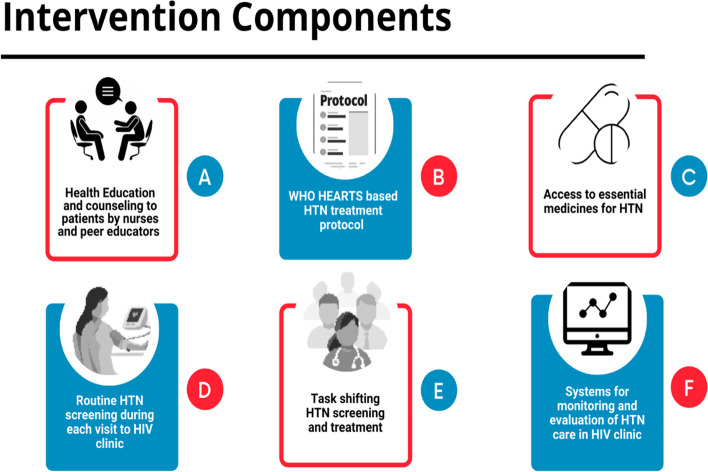
Methods: This was a mixed methods study at Uganda's largest HIV clinic. Components of the adapted WHO HEARTS intervention were lifestyle counseling, free hypertension medications, hypertension treatment protocol, task shifting, and monitoring tools. We determined the effectiveness of the intervention among PLHIV by comparing hypertension and HIV outcomes at baseline and 21 months. The RE-AIM framework was used to evaluate the implementation outcomes of the intervention at 21 months. We conducted four focus group discussions with PLHIV (n = 42), in-depth interviews with PLHIV (n = 9), healthcare providers (n = 15), and Ministry of Health (MoH) policymakers (n = 2).
Results: Reach: Among the 15,953 adult PLHIV in the clinic, of whom 3892 (24%) had been diagnosed with hypertension, 1133(29%) initiated integrated hypertension-HIV treatment compared to 39 (1%) at baseline. Among the enrolled patients, the mean age was 51.5 ± 9.7 years and 679 (62.6%) were female.
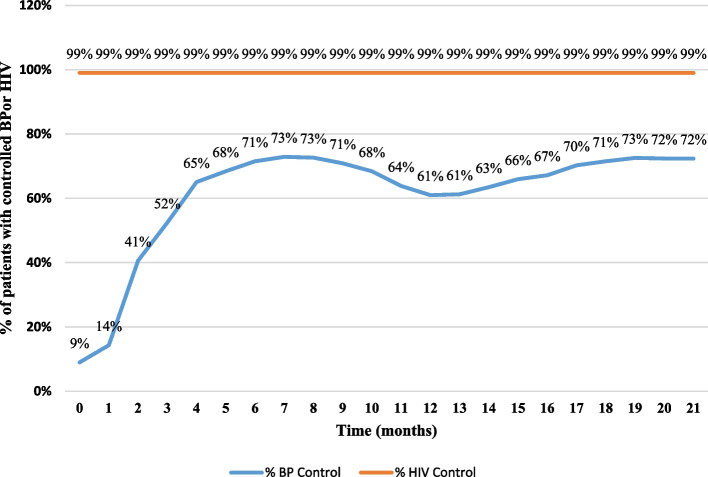
Effectiveness: Among the treated patients, hypertension control improved from 9 to 72% (p < 0.001), mean systolic blood pressure (BP) from 153.2 ± 21.4 to 129.2 ± 15.2 mmHg (p < 0.001), and mean diastolic BP from 98.5 ± 13.5 to 85.1 ± 9.7 mmHg (p < 0.001). Overall, 1087 (95.9%) of patients were retained by month 21. HIV viral suppression remained high, 99.3 to 99.5% (p = 0.694). Patients who received integrated hypertension-HIV care felt healthy and saved more money. Adoption: All 48 (100%) healthcare providers in the clinic were trained and adopted the intervention. Training healthcare providers on WHO HEARTS, task shifting, and synchronizing clinic appointments for hypertension and HIV promoted adoption.
Implementation: WHO HEARTS intervention was feasible and implemented with fidelity. Maintenance: Leveraging HIV program resources and adopting WHO HEARTS protocols into national guidelines will promote sustainability.
Conclusions: The WHO HEARTS intervention promoted the integration of hypertension management into HIV care in the real-world setting. It was acceptable, feasible, and effective in controlling hypertension and maintaining optimal viral suppression among PLHIV. Integrating this intervention into national guidelines will promote sustainability.
Keywords: Process evaluation of integrated hypertension-HIV management.
© 2023. BioMed Central Ltd.
Conflict of interest statement
The authors declare that they have no competing interests.
Figures
References
-
- World Health Organization. HEARTS: technical package for cardiovascular disease management in primary health care. 2020.
-
- Muddu M, Ssinabulya I, Kigozi SP, Ssennyonjo R, Ayebare F, Katwesigye R, et al. Hypertension care cascade at a large urban HIV clinic in Uganda: a mixed methods study using the Capability, Opportunity, Motivation for Behavior change (COM-B) model. Implement Sci Commun. 2021;2(1):1–16. doi: 10.1186/s43058-021-00223-9. - DOI - PMC - PubMed
Publication types
Grants and funding
LinkOut - more resources
Full Text Sources
