. 2023 Jul 26;12(8):1049.
doi: 10.3390/biology12081049.

The Importance of the "Time Factor" for the Evaluation of Inhibition Mechanisms: The Case of Selected HDAC6 Inhibitors

Affiliations

The Importance of the "Time Factor" for the Evaluation of Inhibition Mechanisms: The Case of Selected HDAC6 Inhibitors

Edoardo Cellupica et al. Biology (Basel). .

Abstract

Histone deacetylases (HDACs) participate with histone acetyltransferases in the modulation of the biological activity of a broad array of proteins, besides histones. Histone deacetylase 6 is unique among HDAC as it contains two catalytic domains, an N-terminal microtubule binding region and a C-terminal ubiquitin binding domain. Most of its known biological roles are related to its protein lysine deacetylase activity in the cytoplasm. The design of specific inhibitors is the focus of a large number of medicinal chemistry programs in the academy and industry because lowering HDAC6 activity has been demonstrated to be beneficial for the treatment of several diseases, including cancer, and neurological and immunological disorders. Here, we show how re-evaluation of the mechanism of action of selected HDAC6 inhibitors, by monitoring the time-dependence of the onset and relief of the inhibition, revealed instances of slow-binding/slow-release inhibition. The same approach, in conjunction with X-ray crystallography, in silico modeling and mass spectrometry, helped to propose a model of inhibition of HDAC6 by a novel difluoromethyloxadiazole-based compound that was found to be a slow-binding substrate analog of HDAC6, giving rise to a tightly bound, long-lived inhibitory derivative.

Keywords: cancer; difluoromethyloxadiazoles; histone deacetylase; histone deacetylase 6; hydroxamates; immunomodulation; inhibition; kinetics; medicinal chemistry; neurodegeneration.


Conflict of interest statement

The authors have declared that no competing interest exists. Edoardo Cellupica, Gianluca Caprini, Gianluca Fossati, Paola Cordella, Mattia Marchini, Ilaria Rocchio, Giovanni Sandrone, Andrea Stevenazzi, Barbara Vergani, and Christian Steinkühler are employees of Italfarmaco SpA. The work in the laboratory of Maria Antonietta Vanoni was carried out with funds from Italfarmaco SpA that supported the training fellowship of Doris Mirdita.

Figures
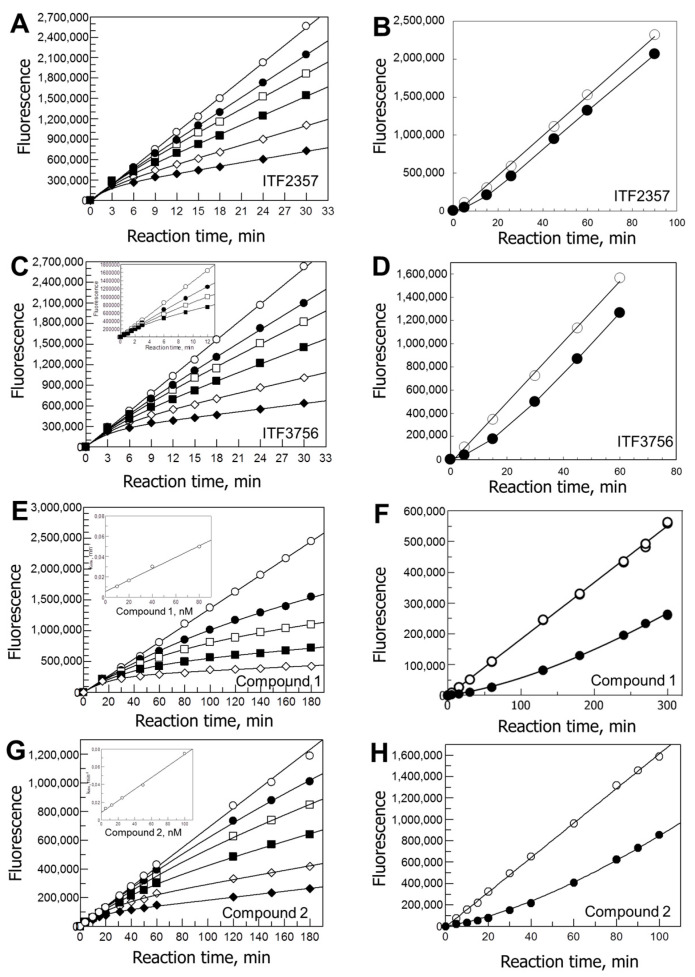
Figure 1
Figure 1
Kinetics of onset and relief of inhibition of HDAC6 by hydroxamic and non-hydroxamic compounds. Panels (A,C,E,G): kinetics of onset of inhibition. The reactions were started by the addition of GST-HDAC (typically 150 µL) to solutions (150 µL) containing varying inhibitors concentrations in 25 mM Tris/HCl pH 8, 130 mM NaCl, 0.05% Tween-20, 10% glycerol, 1% DMSO, and 4 μM Fluor de Lys Green. Aliquots of reactions were stopped at different times with TSA and subsequently developed, as described in detailed methods in Supplementary information. Panel (A): 0 (◯), 2 (●), 4 (□), 8 (■), 16 (⋄) and 32 (◆) nM ITF2357; 116 pg/μL GST-HDAC. Panel (C): 0 (◯), 1 (●), 2 (□), 4 (■) 8 (⋄) and 16 (◆) nM ITF3756; 116 pg/μL GST-HDAC; the inset shows a similar experiment done to study the early reaction times; here, withdrawn aliquots were added to the stop/developing solution. Panel (E): 0 (◯), 10 (●), 20 (□), 40 (■) and 80 (⋄) nM Compound 1; 14.5 pg/μL GST-HDAC. Panel (G): 0 (◯), 5 (●), 12.5 (□), 25 (■), 50 (⋄) and 100 (◆) nM Compound 2; 11.6 pg/μL GST-HDAC; reactions were terminated at different times by mixing with the stop/developing solution. The data were fitted to Equation (2) to determine the steady-state velocity values (vs), which were used to calculate IC50 and kobs (Table 1). The initial velocity was set to the value measured in the absence of the inhibitor. The kobs values showed in all cases a linear dependence upon inhibitor concentration (see insets of panels (E) and (G)). They were used to determine the mechanism of slow-binding inhibition, and estimates of kon, koff and Ki (Table 1). Panels (B,D,F,H): kinetics of relief of inhibition in jump-dilution assays. GST-HDAC (2.9 ng/µL) was pre-incubated in the absence (◯) or presence (●) of ITF2357 (80 nM, Panel B) or ITF3756 (50 nM, Panel (D)) in a final volume of 10 µL in 25 mM Tris/HCl pH 8, 130 mM NaCl, 0.05% Tween-20, 10% glycerol, 0.5 mM TCEP, 1 mg/mL BSA and 0.3% DMSO). After 15 min at 25 °C, a solution (990 µL) containing 2 µM Fluor de Lys Green (approximately the Km value) that had been equilibrated at 25 °C was added. Compound 1 (100 nM, Panel F) and Compound 2 (100 nM, Panel (H)) were pre-incubated with the enzyme (1.16 ng/µL, Panel F; 0.58 ng/µL, Panel H) for 120 min. A solution (990 µL) containing saturating Fluor de Lys Green (25 µM) was added to start the reaction. Reaction aliquots were withdrawn and stopped at the indicated times in the stop/developing solution. The data were fitted to Equation (2) to obtain estimates of the koff value (Table 1). The parallel control (no inhibitor) samples demonstrated the stability of the enzyme during the experiment, and the linearity of the time-course of product formation during the reaction in the absence of inhibitor.
Figure 2
Figure 2
Steady-state kinetic analysis of the inhibition of HDAC6 by ITF3756 and Compound 2. Panels (A,B). HDAC6 was added to solutions containing varying Fluor de Lys Green concentrations and constant levels of ITF3756 [0 (◯), 1 (●), 5 (□), 10 (■), 20 (⋄) and 50 nM (◆)]. Final assay composition was 25 mM Tris/HCl, pH 8, 130 mM NaCl, 0.05% Tween-20, 10% glycerol, 0.5 mM TCEP, 1 mg/mL BSA, 0.5% DMSO, varying substrate and inhibitor concentration. The time-course of the reaction was monitored by withdrawing aliquots at different times and adding them to an equal volume of the stop/developing solution as already described. The steady-state velocity values were calculated from the slope of the straight line interpolating the points in the linear part of the progress curves (20–60 min) and are expressed as v/E in min−1. v/E values were globally fitted to the equation for competitive inhibition (Equation (6)) (panel (A)) after inspection of double reciprocal plots (Panel (B)). The replots of the slope (open circles) and intercept (×10, closed circles) values obtained from independently fitting to straight lines; the data in the double reciprocal form shown in the inset of Panels (BD) show the corresponding experiment with Compound 2 held at constant levels [ 0 (◯), 5 (●), 20 (□) and 100 nM (■)]. Here, the reactions were monitored for up to 3 h, and the steady-state velocities were calculated by fitting the progress curves to Equation (2).
Figure 3
Figure 3
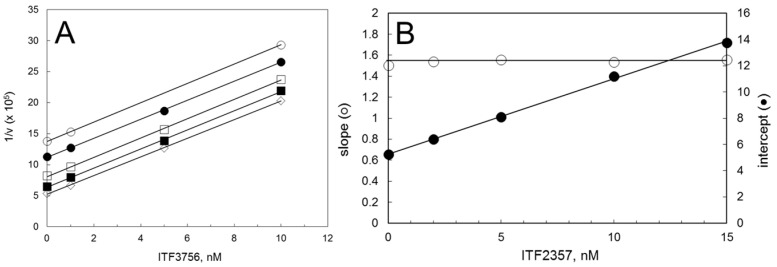
Yonetani–Theorell analysis of the binding of ITF2357 and ITF3756 to HDAC6. Panel (A): The reactions were started by adding aliquots of the enzyme solution (150 µL, 11.6 pg/μL final concentration) to an equal volume of solutions containing varying ITF3756 concentrations (0–10 nM, final concentrations) at fixed levels of ITF2357 [final concentrations: 0 (⋄), 2 (■), 5 (□), 10 (●) and 15 nM (◯)], and a fixed Fluor de Lys Green concentration (2 µM) in 25 mM Tris/HCl pH 8, 130 mM NaCl, 0.05% Tween-20, 10% glycerol, 0.5 mM TCEP, 1 mg/mL BSA, 0.5% DMSO. The time-course of reactions was monitored to calculate the steady-state velocity from the linear part of the curve. The reciprocal of the calculated velocity values (expressed as ΔF/min−1 × 105) were plotted as a function of ITF3756 concentration. The series of assays was independently fitted with straight lines. Panel (B): Secondary plot of the slopes and intercept of the lines of Panel A as a function of ITF2357 concentration. The line through the slope values is the average value of the slopes (1.54 ± 0.02); the intercept values were fitted with a straight line of the type y = 0.57 * [ITF2357] + 5.27. vo, KI and KJ values were calculated according to Equations (9) and (10) (Table 1).
Figure 4
Figure 4
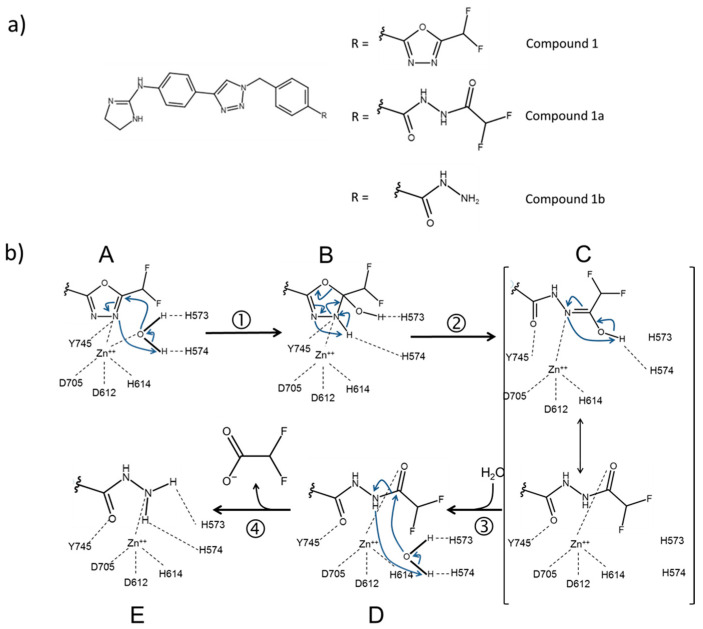
Proposed mechanism of hydrolysis of Compound 1 in HDAC6 active site. Panel (a) Chemical structures of Compound 1 and its stable ring opened (Compound 1a) and hydrazide derivatives (Compound 1b) deriving from two subsequent hydrolysis reactions. Panel (b) Schematic representation of: (A) Compound 1 bound to the active site of HDAC6 where a water molecule is held in place by H573, His574 and the Zn++ cation; (B) the unstable hydrated intermediate formed by attack of the water molecule (Step 1); (C) acyl-hydrazide intermediate (Compound 1a) formed in step 2; (D) enzyme-acyl-hydrazide intermediate after the entrance of a second water molecule into the active site (step 3); (E) hydrazide (Compound 1b) found in the zebrafish HDAC6 active site by crystallography (PDB code: 8A8Z) derived from the hydrolysis of Compound 1b (step 4). Formulae in this and all other figures were drawn with Chemical Sketch Tool (https://www.rcsb.org/chemical-sketch).

References

    1. Li W., Li F., Zhang X., Lin H.K., Xu C. Insights into the post-translational modification and its emerging role in shaping the tumor microenvironment. Signal Transduct. Target. Ther. 2021;6:422. doi: 10.1038/s41392-021-00825-8. - DOI - PMC - PubMed
    1. Allis C.D., Jenuwein T. The molecular hallmarks of epigenetic control. Nat. Rev. Genet. 2016;17:487–500. doi: 10.1038/nrg.2016.59. - DOI - PubMed
    1. Porter N.J., Christianson D.W. Structure, mechanism, and inhibition of the zinc-dependent histone deacetylases. Curr. Opin. Struct. Biol. 2019;59:9–18. doi: 10.1016/j.sbi.2019.01.004. - DOI - PMC - PubMed
    1. Shvedunova M., Akhtar A. Modulation of cellular processes by histone and non-histone protein acetylation. Nat. Rev. Mol. Cell Biol. 2022;23:329–349. doi: 10.1038/s41580-021-00441-y. - DOI - PubMed
    1. Dinarello C.A., Fossati G., Mascagni P. Histone deacetylase inhibitors for treating a spectrum of diseases not related to cancer. Mol. Med. 2011;17:333–352. doi: 10.2119/molmed.2011.00116. - DOI - PMC - PubMed

Grants and funding