Review
. 2023 Aug 2;12(8):1079.
doi: 10.3390/biology12081079.

The Role and Regulation of the NKG2D/NKG2D Ligand System in Cancer

Affiliations
Review

The Role and Regulation of the NKG2D/NKG2D Ligand System in Cancer

Ge Tan et al. Biology (Basel). .

Abstract

The family of human NKG2D ligands (NKG2DL) consists of eight stress-induced molecules. Over 80% of human cancers express these ligands on the surface of tumour cells and/or associated stromal elements. In mice, NKG2D deficiency increases susceptibility to some types of cancer, implicating this system in immune surveillance for malignancy. However, NKG2DL can also be shed, released via exosomes and trapped intracellularly, leading to immunosuppressive effects. Moreover, NKG2D can enhance chronic inflammatory processes which themselves can increase cancer risk and progression. Indeed, tumours commonly deploy a range of countermeasures that can neutralise or even corrupt this surveillance system, tipping the balance away from immune control towards tumour progression. Consequently, the prognostic impact of NKG2DL expression in human cancer is variable. In this review, we consider the underlying biology and regulation of the NKG2D/NKG2DL system and its expression and role in a range of cancer types. We also consider the opportunities for pharmacological modulation of NKG2DL expression while cautioning that such interventions need to be carefully calibrated according to the biology of the specific cancer type.

Keywords: H60; MICA/B; MULT1; NKG2D; NKG2D ligands; Rae-1; ULBP; cancer.


Conflict of interest statement

J.M. is a founding scientist, the Chief Scientific Officer and a shareholder of Leucid Bio. G.T. and K.M.S. have no conflicts to declare.

Figures
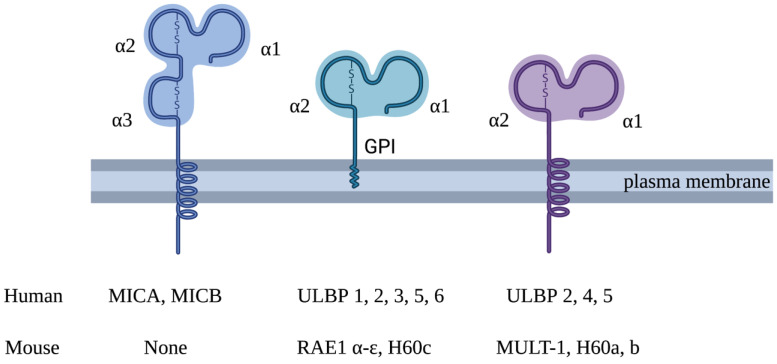
Figure 1
Figure 1
Structure of human and mouse NKG2D ligands. Human NKG2D ligands comprise MICA, MICB and ULBP1–6. MICA and MICB have three extracellular domains (α1, α2 and α3) and a transmembrane domain. Unlike the MIC family, ULBP family members lack an α3 domain and only have MHC class 1-like α1 and α2 extracellular domains. ULBP1, -3 and -6 (and the MICA*008 allelic variant) are anchored to the plasma membrane via a glycosylphosphatidylinositol (GPI) motif at the C-terminus. ULBP4 consists of a transmembrane domain and is expressed as a transmembrane protein. ULBP2 and -5 can be expressed in either conformation. NKG2D ligands in mice include Rae-1 a–e, H60 a–c and MULT-1. There are no mouse equivalents of human MICA or MICB. Rae-1 a–e and H60 c are expressed as GPI-anchored proteins, and MULT-1 and H60 a and b are expressed as transmembrane proteins. They all have MHC class 1-like α1 and α2 extracellular domains.
Figure 2
Figure 2
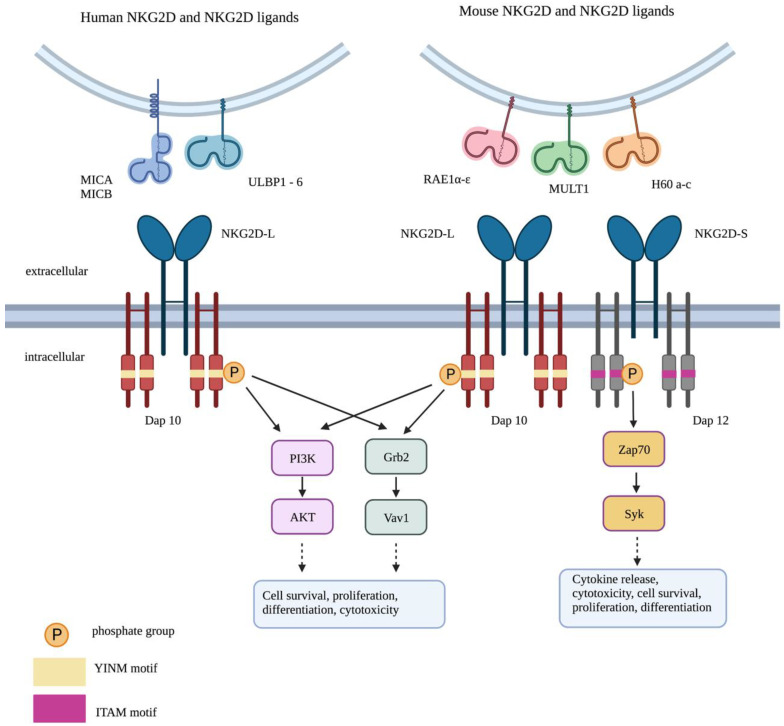
Signalling by the NKG2D system. Long (L) and short (S) isoforms of NKG2D receptors are found in the mouse, allowing interaction with DAP10 alone or both DAP10 and DAP12. By contrast, only the long isoform of NKG2D is found in human cells, allowing association with DAP10 alone. Phosphorylation of the YINM motif within DAP10 triggers the activation of two key pathways: PI3K/AKT and Grb2/Vav1. This leads to cell survival, proliferation, differentiation and cytotoxicity. Phosphorylation of the immune tyrosine activation motif (ITAM) in DAP12 activates ZAP70/Syk signalling. This results in cytokine release, cytotoxic granule secretion, cell survival, proliferation and differentiation.

References

    1. Lanier L.L. NKG2D Receptor and Its Ligands in Host Defense. Cancer Immunol. Res. 2015;3:575–582. doi: 10.1158/2326-6066.CIR-15-0098. - DOI - PMC - PubMed
    1. Groh V., Bruhl A., El-Gabalawy H., Nelson J.L., Spies T. Stimulation of T cell autoreactivity by anomalous expression of NKG2D and its MIC ligands in rheumatoid arthritis. Proc. Natl. Acad. Sci. USA. 2003;100:9452–9457. doi: 10.1073/pnas.1632807100. - DOI - PMC - PubMed
    1. Groh V., Smythe K., Dai Z., Spies T. Fas-ligand-mediated paracrine T cell regulation by the receptor NKG2D in tumor immunity. Nat. Immunol. 2006;7:755–762. doi: 10.1038/ni1350. - DOI - PubMed
    1. Brown G.D., Willment J.A., Whitehead L. C-type lectins in immunity and homeostasis. Nat. Rev. Immunol. 2018;18:374–389. doi: 10.1038/s41577-018-0004-8. - DOI - PubMed
    1. Wensveen F.M., Jelencic V., Polic B. NKG2D: A Master Regulator of Immune Cell Responsiveness. Front. Immunol. 2018;9:441. doi: 10.3389/fimmu.2018.00441. - DOI - PMC - PubMed

LinkOut - more resources