Review
. 2023 Aug 11;12(8):1119.
doi: 10.3390/biology12081119.

Stress Factors as Possible Regulators of Pluripotent Stem Cell Survival and Differentiation

Affiliations
Review

Stress Factors as Possible Regulators of Pluripotent Stem Cell Survival and Differentiation

Toqa Darwish et al. Biology (Basel). .

Abstract

In recent years, extensive research efforts have been directed toward pluripotent stem cells, primarily due to their remarkable capacity for pluripotency. This unique attribute empowers these cells to undergo self-renewal and differentiate into various cell types originating from the ectoderm, mesoderm, and endoderm germ layers. The delicate balance and precise regulation of self-renewal and differentiation are essential for the survival and functionality of these cells. Notably, exposure to specific environmental stressors can activate numerous transcription factors, initiating a diverse array of stress response pathways. These pathways play pivotal roles in regulating gene expression and protein synthesis, ultimately aiming to preserve cell survival and maintain cellular functions. Reactive oxygen species, heat shock, hypoxia, osmotic stress, DNA damage, endoplasmic reticulum stress, and mechanical stress are among the examples of such stressors. In this review, we comprehensively discuss the impact of environmental stressors on the growth of embryonic cells. Furthermore, we provide a summary of the distinct stress response pathways triggered when pluripotent stem cells are exposed to different environmental stressors. Additionally, we highlight recent discoveries regarding the role of such stressors in the generation, differentiation, and self-renewal of induced pluripotent stem cells.

Keywords: cell survival; differentiation; embryonic stem cells; induced pluripotent stem cells; stress response.


Conflict of interest statement

The authors declare no conflict of interest.

Figures

Figure 2
Figure 2
Oxidative stress mechanism [19,20,21,22]. PIK3: phosphatidylinositol 3 kinase, MAPKs: mitogen activated protein kinases, ERKs: extracellular signal-regulated kinases, PCK: protein kinase C, NRF2: nuclear factor elytroid-derived factor 2, Keap1: kelch ECH-associating protein 1, Maf: Musculoaponeurotic Fibrosarcoma Oncogene proteins, Bach1: Basic Leucine Zipper Transcription Factor 1, AREs: antioxidant response elements, HO1: heme oxygenase-1, NQO1: NADPH quinone oxidoreductase, GSTA2: Glutathione S-transferase A2, CO: carbon monoxide.
Figure 3
Figure 3
Heat shock stress response mechanism [27,28,29,30]. Hsp90: heat shock protein 90, HSF1: heat shock transcription factor 1, CaMKII: calcium/calmodulin-dependent protein kinase II, CK2: casein kinase II, Hsp27: heat shock protein 27, Hsp70: heat shock protein 70, MRP1: multidrug resistance protein 1, IL-6: interleukin 6.
Figure 4
Figure 4
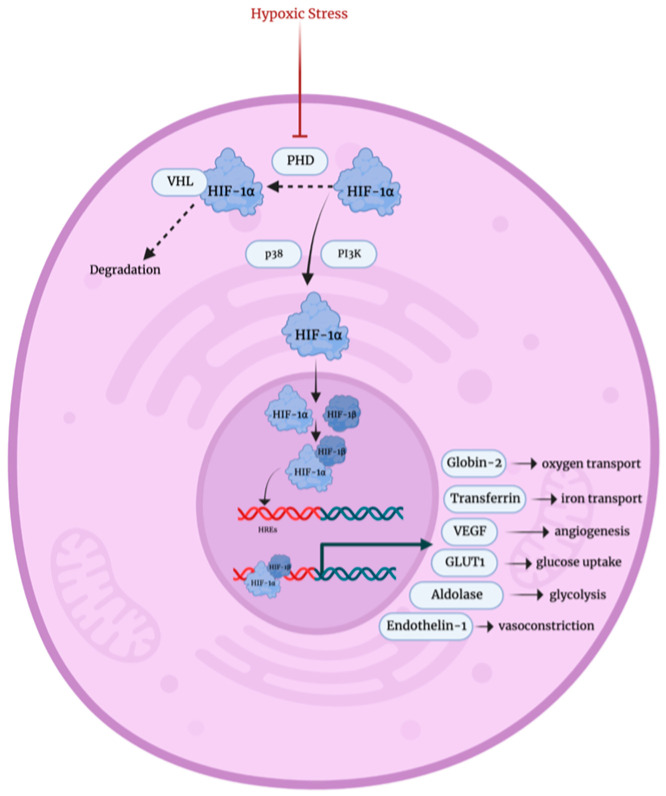
Hypoxic stress response mechanism [35,36,37,38,39,40,41]. PHD: prolyl hydroxylases, HIF-1α: hypoxia-inducible factor alpha subunit, VHL: von Hippel–Lindua tumor suppressor protein, PI3K: phosphatidylinositol 3 kinase, HIF-1β: hypoxia-inducible factor beta subunit, HREs: hypoxia response elements, VEGF: vascular endothelial growth factor, GLUT1: glucose transporter 1.
Figure 5
Figure 5
Osmotic stress response mechanism [42,43,44,45,46]. Rac1: Ras-related C3 botulinum toxin substrate 1, ATM kinase: ataxia-telangiectasia mutated kinase, PKA: protein kinase A, TonEBP: tonicity element binding protein, AP-1: activating protein-1, UTA-1: urea transporter A1, BGT-1: betaine GABA transporter, ALDOA: aldolase A, Hsp70: heat shock protein 70.
Figure 6
Figure 6
DNA damage p53 mediated stress response mechanism [55,56,57]. ATM: ataxia-telangiectasia mutated, JNK: jun N-terminal kinase, Chk1 and Chk2: checkpoint kinases 1 and 2, Mdm2: murine double minute 2, MAPKs: mitogen-activated protein kinases, CKs: casein kinases, CDKN1A: cyclin dependent kinase inhibitor 1A, GADD45A: growth arrest and DNA damage inducible alpha, XPC: xeroderma pigmentosum, Bax: Bcl-2-associated X protein, Bcl-L: B-cell lymphoma-extra large.
Figure 7
Figure 7
Endoplasmic reticulum stress response mechanism [59,60,61,62]. Bip: binding immunoglobulin protein, PERK: PRKR-like endoplasmic reticulum kinase, IRE1a: inositol requiring enzyme 1 alpha, ATF6: activating transcription factor 6, eIF2: eukaryotic translation initiation factor 2, XBP1: X-box binding protein 1, S1p and S2p: site 1 and 2 proteases, CHOP: C/EBP homologous protein.
Figure 1
Figure 1
Stress response mechanisms and their associated protein sensors, transcription factors and target genes. TF: transcription factors, ER: endoplasmic reticulum.

References

    1. González F., Boué S., Izpisúa Belmonte J.C. Methods for making induced pluripotent stem cells: Reprogramming à la carte. Nat. Rev. Genet. 2011;12:231–242. doi: 10.1038/nrg2937. - DOI - PubMed
    1. Karagiannis P., Takahashi K., Saito M., Yoshida Y., Okita K., Watanabe A., Inoue H., Yamashita J.K., Todani M., Nakagawa M., et al. Induced Pluripotent Stem Cells and Their Use in Human Models of Disease and Development. Physiol. Rev. 2019;99:79–114. doi: 10.1152/physrev.00039.2017. - DOI - PubMed
    1. Takahashi K., Yamanaka S. Induction of pluripotent stem cells from mouse embryonic and adult fibroblast cultures by defined factors. Cell. 2006;126:663–676. doi: 10.1016/j.cell.2006.07.024. - DOI - PubMed
    1. Simmons S.O., Fan C.Y., Ramabhadran R. Cellular stress response pathway system as a sentinel ensemble in toxicological screening. Toxicol. Sci. 2009;111:202–225. doi: 10.1093/toxsci/kfp140. - DOI - PubMed
    1. Tower J. Stress and stem cells. Wiley Interdiscip. Rev. Dev. Biol. 2012;1:789–802. doi: 10.1002/wdev.56. - DOI - PMC - PubMed

LinkOut - more resources