


Facing the Shadow Pandemic: Correlation and Trend Analyses of Violence Reports from Women to the Italian National Anti-Violence Number during 2021
- PMID: 37628470
- PMCID: PMC10454491
- DOI: 10.3390/healthcare11162272
Facing the Shadow Pandemic: Correlation and Trend Analyses of Violence Reports from Women to the Italian National Anti-Violence Number during 2021
Abstract
Objectives: To help to tackle gender-based violence against women in the aftermath of COVID-19 or other potential crisis situations, as recommended by the European Institute for Gender Equality, the present study aims to investigate the relationship between calls to the National Anti-violence Number (NAN) and the socio-sanitary pandemic factors during 2021, a period in which the scenario changed due to containment measures that gradually allowed women to emerge from the condition of isolation. In addition, the present work aims to identify significant changes in the number of calls to NAN during the progression of the pandemic in 2021.
Methods: Using Italian Civil Protection Department data on the socio-sanitary pandemic factors (defined by daily number of cases, swabs, deaths, hospitalizations, dismissions, intensive care unit hospitalizations, people isolated at home, and quarantine after 15 and 30 days) and NAN data. Correlation analyses, a joinpoint regression analysis, and Granger causality tests were performed.
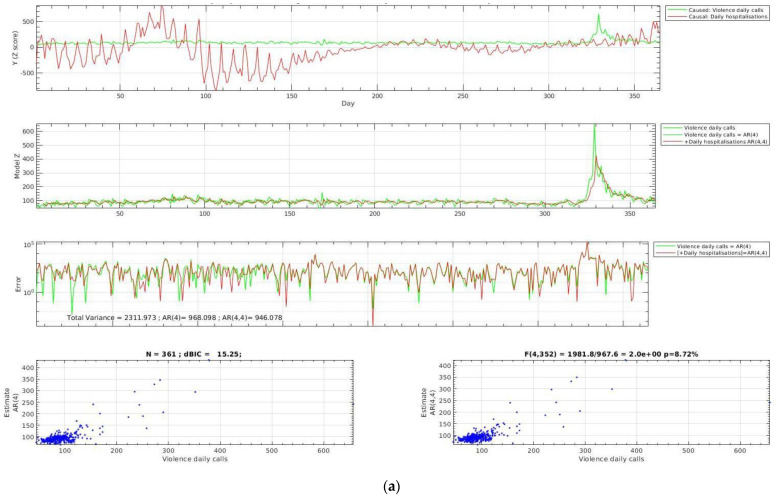
Results: The number of calls correlated with the daily number of cases, swabs, deaths, hospitalizations, dismissions, intensive care unit hospitalizations, and quarantine after 15 and 30 days. The identified joinpoints showed significant changes in the number of daily anti-violence calls during the year. Furthermore, we found evidence of a significant causality between daily hospitalizations, daily home quarantined, daily dismissed patients, and calls to NAN.
Conclusions: The results underline the influence of containment measures on the increased access to NAN, suggesting the need for a greater implementation of social and psychological support services in other potential crisis situations.
Keywords: COVID-19 pandemic; battered women; interpersonal violence; mental health; quarantine.
Conflict of interest statement
The authors declare no conflict of interest.
Figures


References
-
- UN . Declaration on the Elimination of Violence against Women. UN Women; New York, NY, USA: 1993.
-
- Decker M.R., Peitzmeier S., Olumide A., Acharya R., Ojengbede O., Covarrubias L., Gao E., Cheng Y., Delany-Moretlwe S., Brahmbhatt H. Prevalence and Health Impact of Intimate Partner Violence and Non-Partner Sexual Violence Among Female Adolescents Aged 15–19 Years in Vulnerable Urban Environments: A Multi-Country Study. J. Adolesc. Health. 2014;55:S58–S67. doi: 10.1016/j.jadohealth.2014.08.022. - DOI - PubMed
-
- Sullivan T., Thompson K., Wright R., Gross G., Spady D. Social Problems: Divergent Perspectives. Wiley; New York, NY, USA: 1980.
-
- Rubington E., Weinberg M.S. The Study of Social Problems. 5th ed. Oxford University Press; New York, NY, USA: 1995.
-
- Barbieri D., Cazorla A.G., Thil L., Mollard B., Ochmann J., Peciukonis V. Gender Equality Index 2021: Health. [(accessed on 15 June 2023)]. Available online: https://eige.europa.eu/publications/gender-equality-index-2021-report/ge....
LinkOut - more resources
Full Text Sources
