


The Non-Paced 3-Minute Sit-to-Stand Test: Feasibility and Clinical Relevance for Pulmonary Rehabilitation Assessment
- PMID: 37628511
- PMCID: PMC10454867
- DOI: 10.3390/healthcare11162312
The Non-Paced 3-Minute Sit-to-Stand Test: Feasibility and Clinical Relevance for Pulmonary Rehabilitation Assessment
Abstract
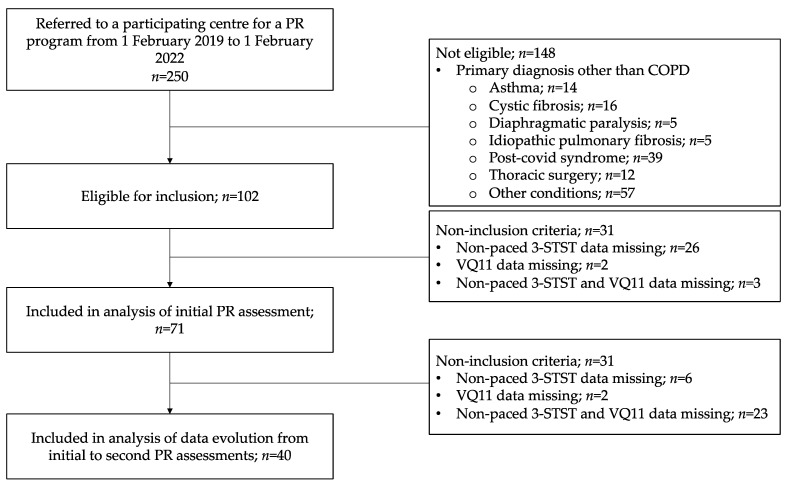
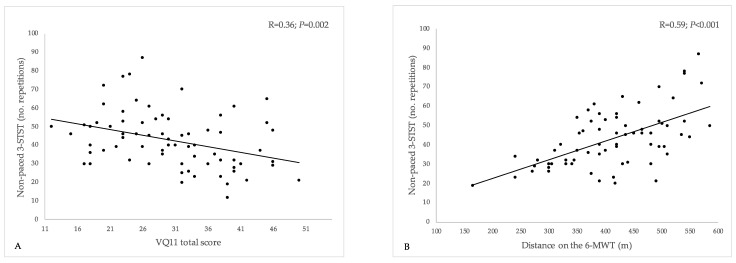
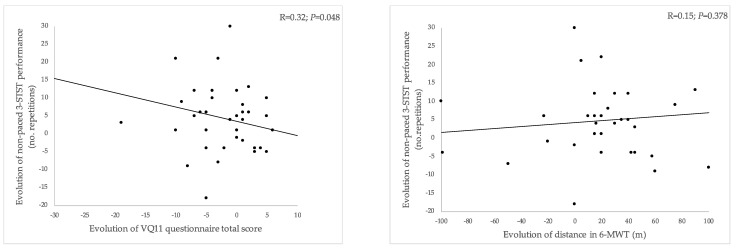
Pulmonary rehabilitation (PR) improves health-related quality-of-life (HRQoL) in individuals with chronic obstructive pulmonary disease (COPD), notably by increasing exercise tolerance. Easy-to-implement sit-to-stand tests can facilitate the assessment of exercise tolerance in routine practice. This retrospective study conducted in a real-life setting was designed to describe the non-paced 3-min sit-to-stand test (3-STST) and to evaluate its relationship with HRQoL (VQ11 questionnaire) to identify the determinants of 3-STST performance and to analyze the evolution of 3-STST performance and HRQoL over the course of a community-based PR program. Seventy-one COPD patients (age 69 ± 10 years old; 51% with GOLD spirometric stages III-IV) were included. Mean ± SD 3-STST performance at the initial PR assessment was 43 ± 15 repetitions. This performance was significantly associated with HRQoL and other indicators of clinical severity (lung function, dyspnea, and functional capacities). During the multivariate analysis, younger age, exertional dyspnea with mMRC ≤ 1, and better HRQoL were significantly associated with better 3-STST performance. From the initial to second PR assessment, changes in 3-STST performance were significantly associated with changes in HRQoL. This study provides evidence that the non-paced 3-STST is feasible and might be clinically relevant in the assessment of patients with COPD referred for community-based PR. This test deserves to be prospectively validated.
Keywords: chronic obstructive pulmonary disease; exercise training; health-related quality-of-life; pulmonary rehabilitation; sit-to-stand test.
Conflict of interest statement
MD reports personal fees from Air Liquide Medical Systems, Breas Medical AB, GSK, and ResMed SAS and non-financial support from L3 Medical, ISIS Medical, and SOS Oxygene outside of the submitted work. PH reports grants from Fondation Bordeaux Université with funding from FGLMR/Avad and non-financial support from Chiesi outside of the submitted work. LG received grants or contracts from AADAIRC outside of the submitted work; payment of honoraria for lectures, presentations, speakers’ bureaus, manuscript writing, or educational events from SOS Oxygene, ASTEN Santé, CHIESI, SANOFI, ASTRA ZENECA, ASV Santé, and ALMS outside of the submitted work; support for attending meetings and/or travel from SOS Oxygen, ALIZE, VIVISOL, and ASTEN Santé outside of the submitted work; and participation on a data safety monitoring board or advisory board for RESMED, ALMS, and VIVISOL outside of the submitted work. The other authors have no conflict of interest to disclose.
Figures
References
-
- Hill K., de Brandt J. Exercise prescription for people with stable COPD as part of a pulmonary rehabilitation programme. In: Holland A.E., Corso S.D., Spruit M.A., editors. Pulmonary Rehabilitation. European Respiratory Society; Sheffield, UK: 2021. pp. 53–66.
-
- Radtke T., Crook S., Kaltsakas G., Louvaris Z., Berton D., Urquhart D.S., Kampouras A., Rabinovich R.A., Verges S., Kontopidis D., et al. ERS statement on standardisation of cardiopulmonary exercise testing in chronic lung diseases. Eur. Respir. Rev. 2019;28:180101. doi: 10.1183/16000617.0101-2018. - DOI - PMC - PubMed
-
- Maltais F., Decramer M., Casaburi R., Barreiro E., Burelle Y., Debigaré R., Dekhuijzen P.N.R., Franssen F., Gayan-Ramirez G., Gea J., et al. An Official American Thoracic Society/European Respiratory Society Statement: Update on Limb Muscle Dysfunction in Chronic Obstructive Pulmonary Disease. Am. J. Respir. Crit. Care Med. 2014;189:e15–e62. doi: 10.1164/rccm.201402-0373ST. - DOI - PMC - PubMed
LinkOut - more resources
Full Text Sources
Research Materials
