Review
. 2023 Aug 11;24(16):12681.
doi: 10.3390/ijms241612681.

Locoregional Therapies and Remodeling of Tumor Microenvironment in Pancreatic Cancer

Affiliations
Review

Locoregional Therapies and Remodeling of Tumor Microenvironment in Pancreatic Cancer

Maria Caterina De Grandis et al. Int J Mol Sci. .

Abstract

Despite the advances made in treatment, the prognosis of pancreatic ductal adenocarcinoma (PDAC) remains dismal, even in the locoregional and locally advanced stages, with high relapse rates after surgery. PDAC exhibits a chemoresistant and immunosuppressive phenotype, and the tumor microenvironment (TME) surrounding cancer cells actively participates in creating a stromal barrier to chemotherapy and an immunosuppressive environment. Recently, there has been an increasing use of interventional radiology techniques for the treatment of PDAC, although they do not represent a standard of care and are not included in clinical guidelines. Local approaches such as radiation therapy, hyperthermia, microwave or radiofrequency ablation, irreversible electroporation and high-intensity focused ultrasound exert their action on the tumor tissue, altering the composition and structure of TME and potentially enhancing the action of chemotherapy. Moreover, their action can increase antigen release and presentation with T-cell activation and reduction tumor-induced immune suppression. This review summarizes the current evidence on locoregional therapies in PDAC and their effect on remodeling TME to make it more susceptible to the action of antitumor agents.

Keywords: ablation therapies; locoregional treatments; pancreatic cancer; radiotherapy; tumor microenvironment.


Conflict of interest statement

The authors declare no conflict of interest.

Figures
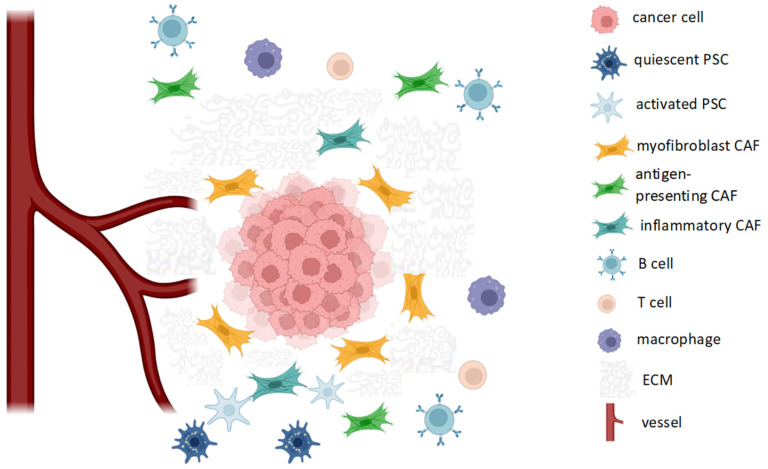
Figure 1
Figure 1
Schematic cellular composition of tumor microenvironment (TME) in PDAC. Tumor fibrosis is sustained by the action of pancreatic stellate cells (PSCs), which are activated from quiescent PSCs, as well as myofibroblast cancer-associated fibroblasts (CAFs). CAFs also play immunomodulatory roles (inflammatory and antigen-presenting CAFs). The immune-cell infiltrate is heterogeneous and includes B, T cells and tumor-associated macrophages. ECM: extracellular matrix.
Figure 2
Figure 2
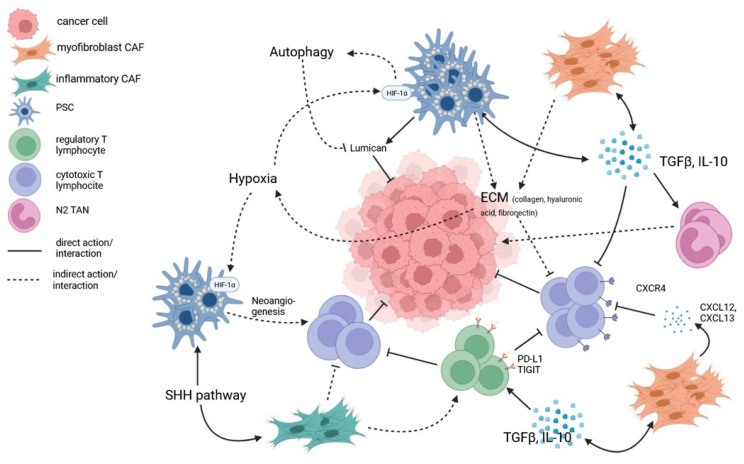
Schematization of key molecular interactions in PDAC microenvironment. Pancreatic stellate cells (PSCs) and cancer-associated fibroblasts (CAFs) secrete immunosuppressive cytokines (IL-10, TGFβ), furthering their proliferation through positive feedback, polarizing tumor-associated neutrophiles (TANs) towards their pro-tumorigenic N2 phenotype and inhibiting cytotoxic T lymphocytes (CTLs) function. Additionally, the deposition of extracellular matrix (ECM) and the overproduction of adhesion molecules ligands (CXCL12, CXCL13) impede normal lymphocytes motility, promoting immune evasion. Abundancy of ECM, moreover, facilitates hypoxia, which activates the HIF-1α pathway. This, on one hand, induces autophagy in cancer-inhibiting cell populations, but, on the other hand, promotes neoangiogenesis and CTLs infiltration.
Figure 3
Figure 3
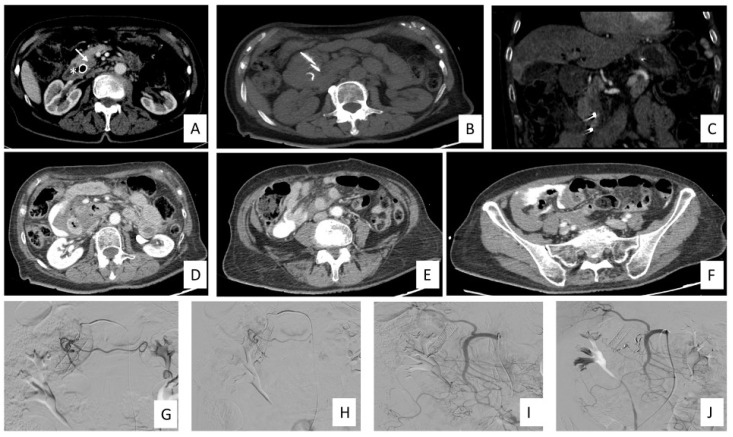
IRE for LAPC treatment timeline and complication management in a 76-year-old female patient. (A) CECT in arterial phase demonstrates the presence of the LAPC in the head of the pancreas (white arrows) and biliary stent (asterisk) prior to IRE treatment. (B) Axial view of noncontrast scan shows two needle electrodes in situ. (C) Coronal view in arterial phase shows the two electrodes in situ. (DF) CECT scan immediately post procedure shows the presence of intraabdominal hematic fluid and extravasation of contrast media without any visible source of bleeding. (GJ) Angiography of celiac trunk, SMA, GDA, right renal artery and phlebography of the inferior vena cava and right renal vein did not demonstrate any source of bleeding. A preventive endovascular embolization of GDA and PDA were made using 3, 4 and 5 mm micro coils. Abbreviations: contrast-enhanced CT (CECT), irreversible electroporation (IRE), gastroduodenal artery (GDA), locally advanced pancreatic cancer (LAPC), pancreatic duodenal artery (PDA), superior mesenteric artery (SMA).

References

    1. Sung H., Ferlay J., Siegel R.L., Laversanne M., Soerjomataram I., Jemal A., Bray F. Global Cancer Statistics 2020: GLOBOCAN Estimates of Incidence and Mortality Worldwide for 36 Cancers in 185 Countries. CA Cancer J. Clin. 2021;71:209–249. doi: 10.3322/caac.21660. - DOI - PubMed
    1. Cai J., Chen H., Lu M., Zhang Y., Lu B., You L., Zhang T., Dai M., Zhao Y. Advances in the epidemiology of pancreatic cancer: Trends, risk factors, screening, and prognosis. Cancer Lett. 2021;520:1–11. doi: 10.1016/j.canlet.2021.06.027. - DOI - PubMed
    1. Rahib L., Smith B.D., Aizenberg R., Rosenzweig A.B., Fleshman J.M., Matrisian L.M. Projecting cancer incidence and deaths to 2030: The unexpected burden of thyroid, liver, and pancreas cancers in the United States. Cancer Res. 2014;74:2913–2921. doi: 10.1158/0008-5472.CAN-14-0155. - DOI - PubMed
    1. Shinde R.S., Bhandare M., Chaudhari V., Shrikhande S.V. Cutting-edge strategies for borderline resectable pancreatic cancer. Ann. Gastroenterol. Surg. 2019;3:368–372. doi: 10.1002/ags3.12254. - DOI - PMC - PubMed
    1. Conroy T., Desseigne F., Ychou M., Bouché O., Guimbaud R., Bécouarn Y., Adenis A., Raoul J.-L., Gourgou-Bourgade S., De La Fouchardière C., et al. FOLFIRINOX versus Gemcitabine for Metastatic Pancreatic Cancer. N. Engl. J. Med. 2011;364:1817–1825. doi: 10.1056/NEJMoa1011923. - DOI - PubMed

MeSH terms