


Interleukin-13 (IL-13)-A Pleiotropic Cytokine Involved in Wound Healing and Fibrosis
- PMID: 37629063
- PMCID: PMC10454844
- DOI: 10.3390/ijms241612884
Interleukin-13 (IL-13)-A Pleiotropic Cytokine Involved in Wound Healing and Fibrosis
Abstract
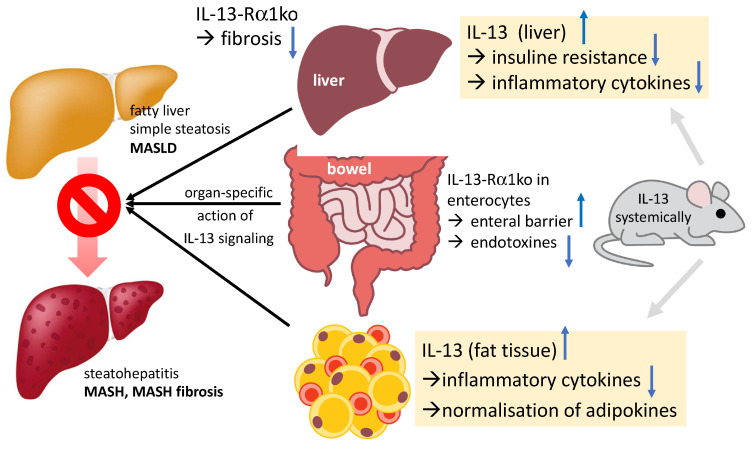
The liver, as a central metabolic organ, is systemically linked to metabolic-inflammatory diseases. In the pathogenesis of the metabolic syndrome, inflammatory and metabolic interactions between the intestine, liver, and adipose tissue lead to the progression of hepatic steatosis to metabolic-dysfunction-associated steatohepatitis (MASH) and consecutive MASH-induced fibrosis. Clinical and animal studies revealed that IL-13 might be protective in the development of MASH through both the preservation of metabolic functions and Th2-polarized inflammation in the liver and the adipose tissue. In contrast, IL-13-associated loss of mucosal gut barrier function and IL-13-associated enhanced hepatic fibrosis may contribute to the progression of MASH. However, there are only a few publications on the effect of IL-13 on metabolic diseases and possible therapies to influence them. In this review article, different aspects of IL-13-associated effects on the liver and metabolic liver diseases, which are partly contradictory, are summarized and discussed on the basis of the recent literature.
Keywords: IL-13; MASH; MASLD; NAFLD; NASH; fibrosis; liver; metabolism.
Conflict of interest statement
The author declares no conflict of interest.
Figures
References
-
- Rinella M.E., Lazarus J.V., Ratziu V., Francque S.M., Sanyal A.J., Kanwal F., Romero D., Abdelmalek M.F., Anstee Q.M., Arab J.P., et al. A multi-society Delphi consensus statement on new fatty liver disease nomenclature. J. Hepatol. 2023:101133. doi: 10.1016/j.jhep.2023.06.003. - DOI
-
- Perez-Carreras M., Casis-Herce B., Rivera R., Fernandez I., Martinez-Montiel P., Villena V. Non-alcoholic fatty liver disease in patients with intestinal, pulmonary or skin diseases: Inflammatory cross-talk that needs a multidisciplinary approach. World J. Gastroenterol. 2021;27:7113–7124. doi: 10.3748/wjg.v27.i41.7113. - DOI - PMC - PubMed
Publication types
MeSH terms
Substances
Grants and funding
LinkOut - more resources
Full Text Sources
Medical
