


Acute Kidney Injury and Sepsis after Cardiac Surgery: The Roles of Tissue Inhibitor Metalloproteinase-2, Insulin-like Growth Factor Binding Protein-7, and Mid-Regional Pro-Adrenomedullin
- PMID: 37629236
- PMCID: PMC10455441
- DOI: 10.3390/jcm12165193
Acute Kidney Injury and Sepsis after Cardiac Surgery: The Roles of Tissue Inhibitor Metalloproteinase-2, Insulin-like Growth Factor Binding Protein-7, and Mid-Regional Pro-Adrenomedullin
Abstract
Background: Identifying a panel of markers detecting kidney injury before the glomerular filtration rate reduction is a challenge to improving the diagnosis and management of acute kidney injury (AKI) in septic patients. This study evaluated the roles of tissue inhibitor metal proteinase-2, insulin growth factor binding protein-7 (TIMP2*IGFBP7), and mid-regional pro-adrenomedullin (MR-proADM) in patients with AKI.
Patients and methods: This study was prospectively conducted in an intensive care unit (ICU) enrolling 230 patients who underwent cardiac surgery. Biomarkers were evaluated before and after 4 h of the cardiac surgery.
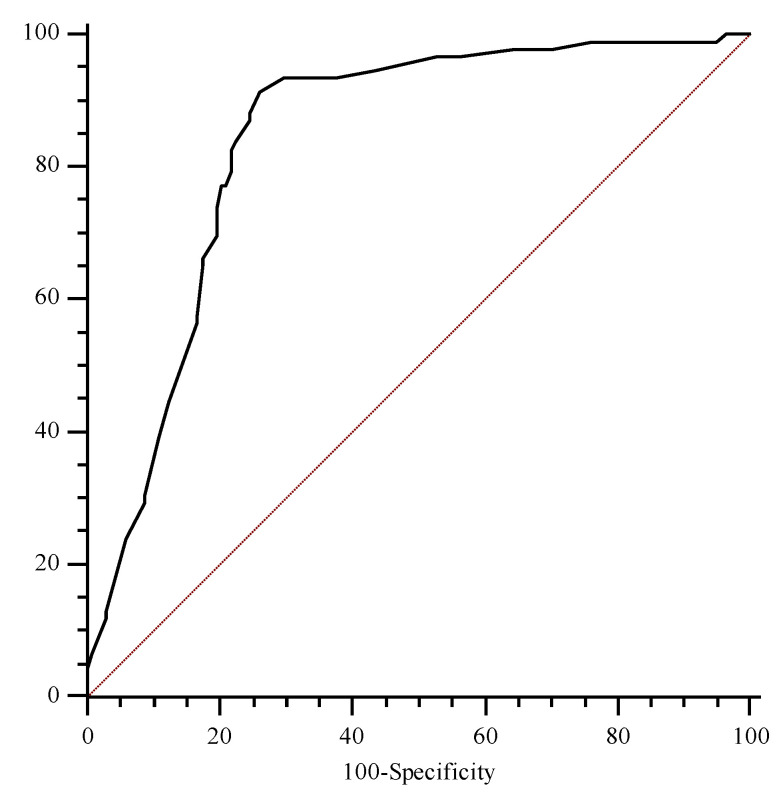
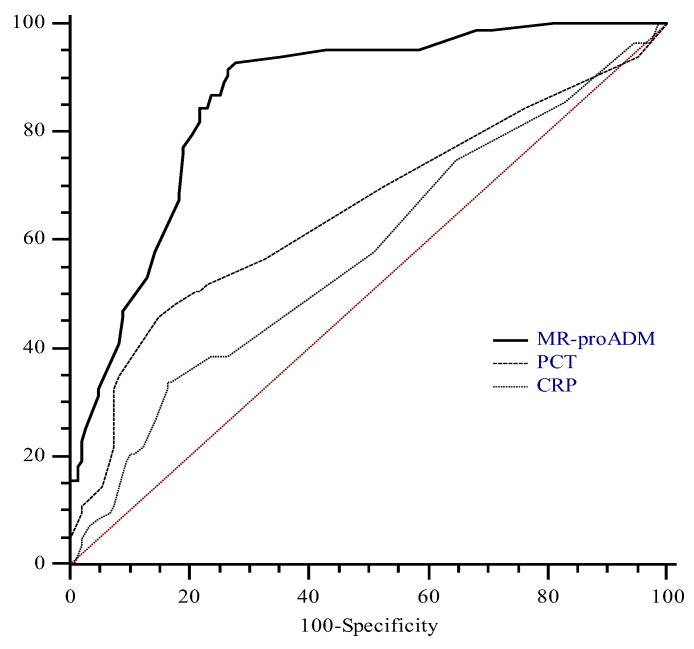
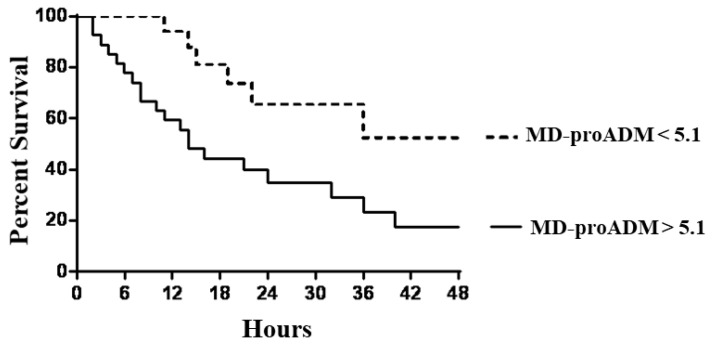
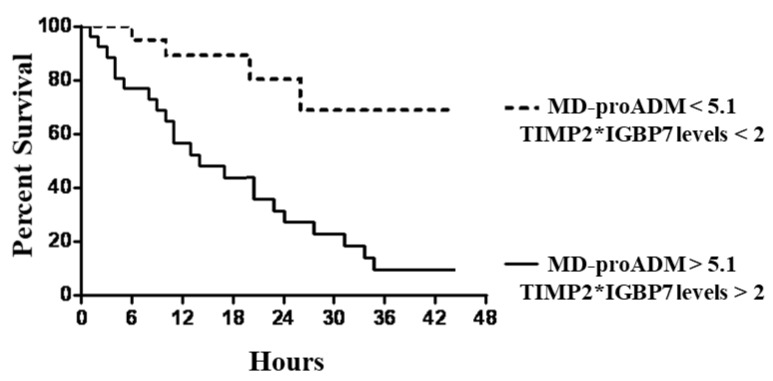
Results: Whereas urine and creatinine alterations appeared at 23.2 (12.7-36.5) hours after cardiac surgery, urinary TIMP2*IGBP7 levels were higher at 4 h in AKI patients (1.1 ± 0.4 mg/L vs. 0.08 ± 0.02 mg/L; p < 0.001). Its concentration > 2 mg/L increases AKI risk within the following 24 h, clearly identifying the population at high risk of renal replacement therapy (RRT). In patients with sepsis, MR-proADM levels were 2.3 nmol/L (0.7-7.8 nmol/L), with the highest values observed in septic shock patients (5.6 nmol/L (3.2-18 nmol/L)) and a better diagnostic profile than procalcitonin and C-reactive protein to identify septic patients. MR-proADM values > 5.1 nmol/L and urine TIMP2*IGBP7 levels > 2 mg/L showed a significantly faster progression to RRT, with a mean follow-up time of 1.1 days.
Conclusions: TIMP2*IGBP7 and MR-proADM precociously diagnose AKI in septic patients after cardiac surgery, giving prognostic information for RRT requirement.
Keywords: TIMP2*IGBP7; acute kidney injury; mid-regional pro-adrenomedullin; sepsis.
Conflict of interest statement
The authors declare no conflict of interest.
Figures
References
-
- Uchino S., Kellum J.A., Bellomo R., Doig G.S., Morimatsu H., Morgera S., Schetz M., Tan I., Bouman C., Macedo E., et al. Acute renal failure in critically ill patients: A multinational, multicenter study. JAMA. 2005;294:813–818. - PubMed
-
- Lacquaniti A., Caccamo C., Salis P., Chirico V., Buemi A., Cernaro V., Noto A., Pettinato G., Santoro D., Bertani T., et al. Delayed graft function and chronic allograft nephropathy: Diagnostic and prognostic role of neutrophil gelatinase-associated lipocalin. Biomarkers. 2016;21:371–378. - PubMed
-
- Murray P.T., Mehta R.L., Shaw A., Ronco C., Endre Z., Kellum J.A., Chawla L.S., Cruz D., Ince C., Okusa M.D. ADQI 10 workgroup Potential use of biomarkers in acute kidney injury: Report and summary of recommendations from the 10th Acute Dialysis Quality Initiative consensus conference. Kidney Int. 2020;180:513–521. - PMC - PubMed
LinkOut - more resources
Full Text Sources
Research Materials
Miscellaneous
