


The Potential of the Nose-to-Brain Delivery of PACAP for the Treatment of Neuronal Disease
- PMID: 37631246
- PMCID: PMC10459484
- DOI: 10.3390/pharmaceutics15082032
The Potential of the Nose-to-Brain Delivery of PACAP for the Treatment of Neuronal Disease
Abstract
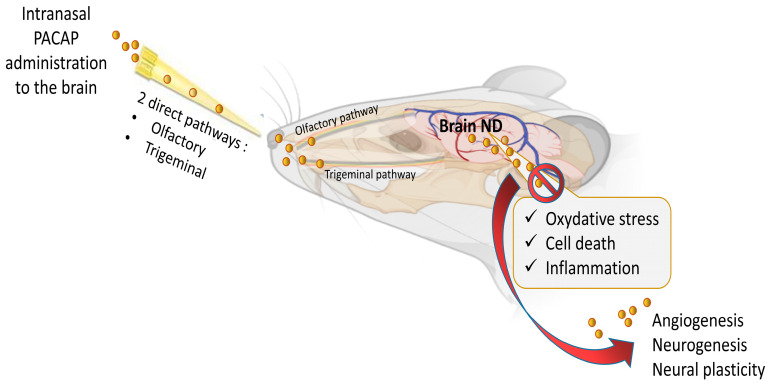
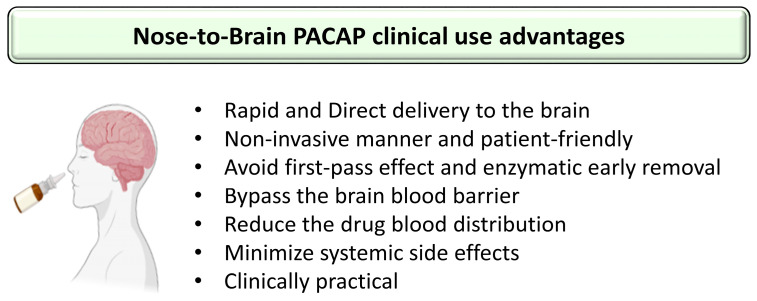
Research on the neuroprotective effect of pituitary adenylate cyclase-activating polypeptide (PACAP) and its use as a therapeutic agent has grown over the past 30 years. Both in vitro and in vivo experiments have shown that PACAP exerts a strong neuroprotective effect in many central and peripheral neuronal diseases. Various delivery routes have been employed from intravenous (IV) injections to intracerebroventricular (ICV) administration, leading either to systemic or topical delivery of the peptide. Over the last decade, a growing interest in the use of intranasal (IN) administration of PACAP and other therapeutic agents has emerged as an alternative delivery route to target the brain. The aim of this review is to summarize the findings on the neuroprotective effect of PACAP and to discuss how the IN administration of PACAP could contribute to target the effects of this pleiotropic peptide.
Keywords: apoptosis; cerebral plasticity; inflammation; intranasal delivery route; neuronal diseases; neuroprotection; pituitary adenylate cyclase-activating polypeptide; redox state.
Conflict of interest statement
The authors declare no conflict of interest.
Figures


References
-
- Miyata A., Arimura A., Dahl R.R., Minamino N., Uehara A., Jiang L., Culler M.D., Coy D.H. Isolation of a novel 38 residue-hypothalamic polypeptide which stimulates adenylate cyclase in pituitary cells. Biochem. Biophys. Res. Commun. 1989;164:567–574. doi: 10.1016/0006-291X(89)91757-9. - DOI - PubMed
-
- Vaudry D., Falluel-Morel A., Bourgault S., Basille M., Burel D., Wurtz O., Fournier A., Chow B.K., Hashimoto H., Galas L., et al. Pituitary adenylate cyclase-activating polypeptide and its receptors: 20 years after the discovery. Pharmacol. Rev. 2009;61:283–357. doi: 10.1124/pr.109.001370. - DOI - PubMed
Publication types
LinkOut - more resources
Full Text Sources
Miscellaneous
