


Performances of Polymer-Dispersed Liquid Crystal Films for Smart Glass Applications
- PMID: 37631477
- PMCID: PMC10458097
- DOI: 10.3390/polym15163420
Performances of Polymer-Dispersed Liquid Crystal Films for Smart Glass Applications
Abstract
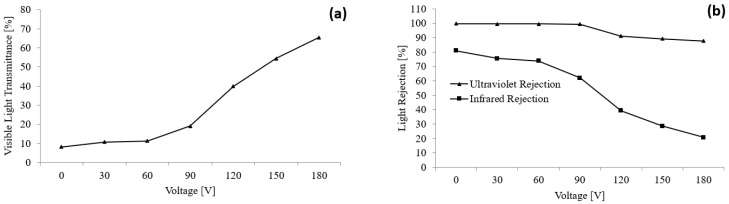
Polymer-dispersed liquid crystal (PDLC) film is an active smart film penetrating the market due to its unique functionalities. These functional characteristics include switchable tint capabilities, which shield building residents from the sun's harmful ultraviolet (UV) rays, improve energy-saving features, and produce higher cost-efficiency. Although PDLC films are promising in several applications, there is still ambiguity on the performance of PDLC films. Particularly, the sizing effects' (such as film thickness and area) correlation with visible light transmission (VLT), ultraviolet rejection (UVR), infrared rejection (IRR), light intensity, current consumption, and apparent power consumption is not well understood. Therefore, this study investigated the sizing effects of PDLC films, including the thickness effect on VLT, UVR, IRR, light intensity, and area influence on current and apparent power consumptions. The varying applied voltage effect on the light transmittance of the PDLC film was also effectively demonstrated. A 0.1 mm PDLC film was successfully presented as a cost-efficient film with optimal parameters. Consequently, this study paves the way for a clearer understanding of PDLC films (behavior and sizing effects) in implementing economic PDLC films for large-scale adoption in commercial and residential premises.
Keywords: apparent power consumption; current consumption; infrared rejection; polymer-dispersed liquid crystals; ultraviolet rejection; visible light transmittance.
Conflict of interest statement
The authors declare no conflict of interest.
Figures


References
-
- Lamontagne B., Fong N.R., Song I.-H., Ma P., Barrios P., Poitras D. Review of Microshutters for Switchable Glass. J. Micro/Nanolithogr. MEMS MOEMS. 2019;18:040901. doi: 10.1117/1.JMM.18.4.040901. - DOI
-
- Jabbar M.M., Zaki S.M. Smart-Glass Glazing Using Arduino and Android Application. Int. J. Interact. Mob. Technol. 2021;15:54. doi: 10.3991/ijim.v15i05.19411. - DOI
-
- Nihalani S., Joshi U., Meeruty A. Materials Science Forum. Volume 969. Trans Tech Publications; Stafa-Zurich, Switzerland: 2019. Smart Materials for Sustainable and Smart Infrastructure; pp. 278–283.
-
- Al-Emran M., Malik S.I., Al-Kabi M.N. Toward Social Internet of Things (SIoT): Enabling Technologies, Architectures and Applications. Springer; Cham, Switzerland: 2020. A Survey of Internet of Things (IoT) in Education: Opportunities and Challenges; pp. 197–209.
-
- Hakemi H. Polymer-Dispersed Liquid Crystal Technology Industrial Evolution and Current Market Situation. Liq. Cryst. Today. 2017;26:70–73. doi: 10.1080/1358314X.2017.1359143. - DOI
Grants and funding
LinkOut - more resources
Full Text Sources
