


A Systematic Literature Review on Cyber Threat Intelligence for Organizational Cybersecurity Resilience
- PMID: 37631808
- PMCID: PMC10459806
- DOI: 10.3390/s23167273
A Systematic Literature Review on Cyber Threat Intelligence for Organizational Cybersecurity Resilience
Abstract
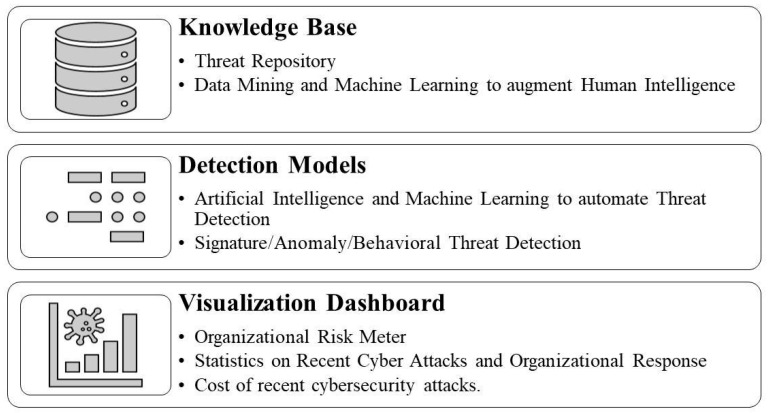
Cybersecurity is a significant concern for businesses worldwide, as cybercriminals target business data and system resources. Cyber threat intelligence (CTI) enhances organizational cybersecurity resilience by obtaining, processing, evaluating, and disseminating information about potential risks and opportunities inside the cyber domain. This research investigates how companies can employ CTI to improve their precautionary measures against security breaches. The study follows a systematic review methodology, including selecting primary studies based on specific criteria and quality valuation of the selected papers. As a result, a comprehensive framework is proposed for implementing CTI in organizations. The proposed framework is comprised of a knowledge base, detection models, and visualization dashboards. The detection model layer consists of behavior-based, signature-based, and anomaly-based detection. In contrast, the knowledge base layer contains information resources on possible threats, vulnerabilities, and dangers to key assets. The visualization dashboard layer provides an overview of key metrics related to cyber threats, such as an organizational risk meter, the number of attacks detected, types of attacks, and their severity level. This relevant systematic study also provides insight for future studies, such as how organizations can tailor their approach to their needs and resources to facilitate more effective collaboration between stakeholders while navigating legal/regulatory constraints related to information sharing.
Keywords: business organizations; cyber threat intelligence; cybersecurity; mitigation.
Conflict of interest statement
The authors declare no conflict of interest.
Figures
References
-
- Lenka A., Goswami M., Singh H., Baskaran H. Effective Cybersecurity Operations for Enterprise-Wide Systems. IGI Global; Hershey, PA, USA: 2023. Cybersecurity Disclosure and Corporate Reputation: Rising Popularity of Cybersecurity in the Business World; pp. 169–183.
-
- Kotsias J., Ahmad A., Scheepers R. Adopting and integrating cyber-threat intelligence in a commercial organisation. Eur. J. Inf. Syst. 2023;32:35–51. doi: 10.1080/0960085X.2022.2088414. - DOI
-
- Gately H. Doctoral Dissertation. Macquarie University; Sydney, Australia: 2023. Russian Organised Crime and Ransomware as a Service: State Cultivated Cybercrime.
-
- Abu M.S., Selamat S.R., Ariffin A., Yusof R. CTI–issue and challenges. Indones. J. Electr. Eng. Comput. Sci. 2018;10:371–379.
-
- Webb J., Maynard S., Ahmad A., Shanks G. Information security risk management: An intelligence-driven approach. Australas. J. Inf. Syst. 2014;18:391–404. doi: 10.3127/ajis.v18i3.1096. - DOI
Publication types
Grants and funding
LinkOut - more resources
Full Text Sources
Research Materials
