Review
. 2023 Jul 25;11(8):1278.
doi: 10.3390/vaccines11081278.

Plant Virus Nanoparticles Combat Cancer

Affiliations
Review

Plant Virus Nanoparticles Combat Cancer

Mehdi Shahgolzari et al. Vaccines (Basel). .

Abstract

Plant virus nanoparticles (PVNPs) have garnered considerable interest as a promising nanotechnology approach to combat cancer. Owing to their biocompatibility, stability, and adjustable surface functionality, PVNPs hold tremendous potential for both therapeutic and imaging applications. The versatility of PVNPs is evident from their ability to be tailored to transport a range of therapeutic agents, including chemotherapy drugs, siRNA, and immunomodulators, thereby facilitating targeted delivery to the tumor microenvironment (TME). Furthermore, PVNPs may be customized with targeting ligands to selectively bind to cancer cell receptors, reducing off-target effects. Additionally, PVNPs possess immunogenic properties and can be engineered to exhibit tumor-associated antigens, thereby stimulating anti-tumor immune responses. In conclusion, the potential of PVNPs as a versatile platform for fighting cancer is immense, and further research is required to fully explore their potential and translate them into clinical applications.

Keywords: delivery; nanoparticles; plant virus-like particles; vaccines.


Conflict of interest statement

The authors declare no conflict of interest.

Figures
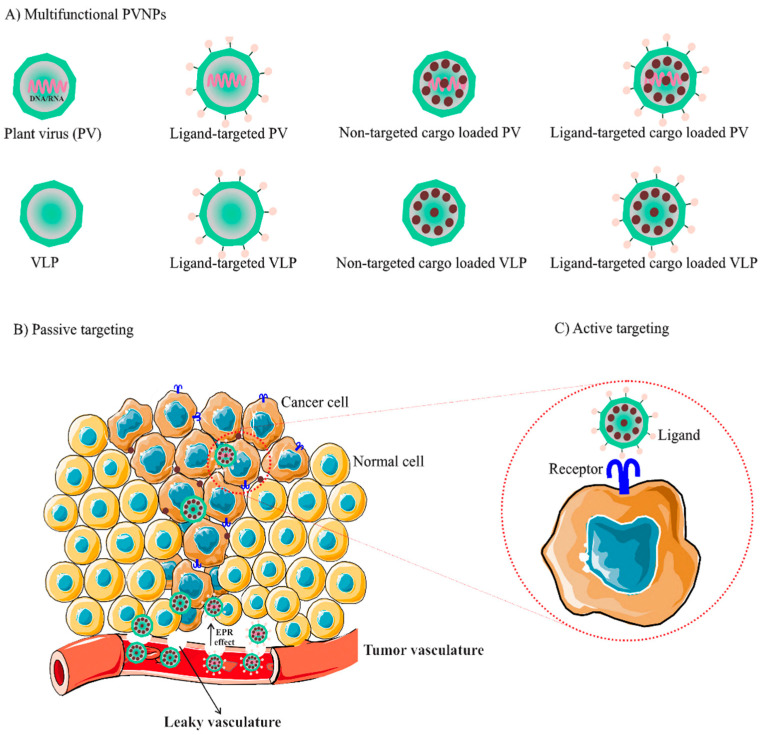
Figure 1
Figure 1
(A) The variety of nanoparticle formulations based on plant viruses, (B) These formulations of plant virus-based nanoparticles (PVNPs) have the ability to concentrate drug and imaging agents through passive-targeting delivery reliant on the enhanced permeability and retention (EPR) outcome in tumors, (C) Active targeting can be achieved by attaching ligands specific to the biomarkers present on cancer cells to the surface of PVNPs, allowing for the specific targeting of cancer cells [61].
Figure 2
Figure 2
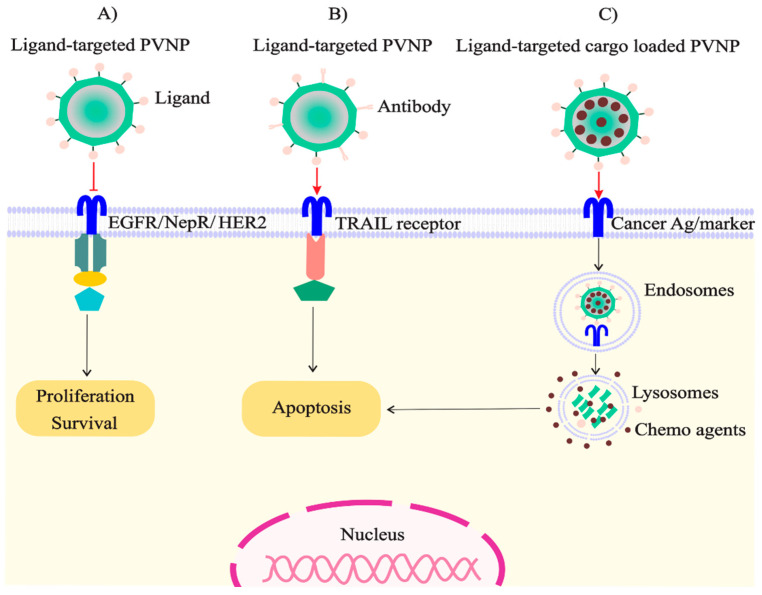
Mechanisms through which plant virus nanoparticles may effectively target cancer cells. The presentation of specific ligands on plant virus nanoparticles has been investigated for the purpose of (A) impeding the survival and proliferation pathways, (B) instigating the apoptotic pathways, and (C) loading and distributing therapeutic agents [61].
Figure 3
Figure 3
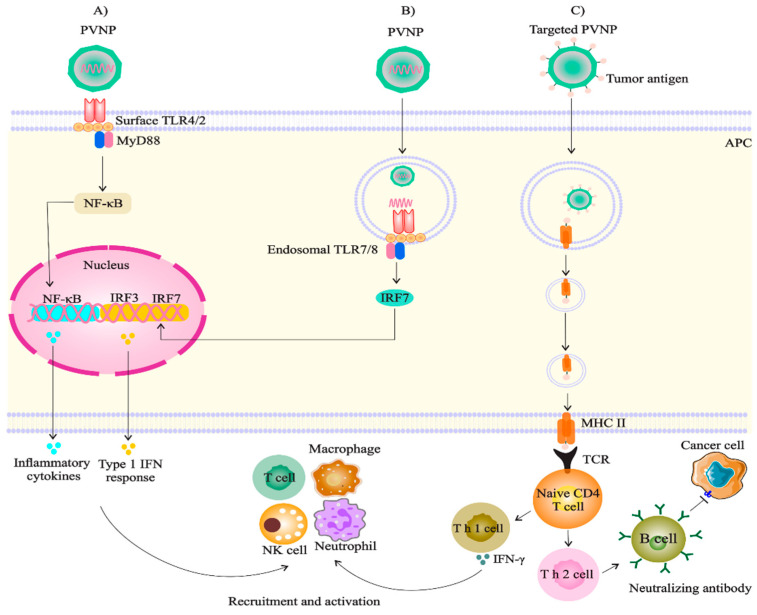
Mechanisms by which plant virus nanoparticles can target immune cells. Plant virus nanoparticles can act as ligands for (A) surface and (B) endosomal PRRs on innate immune cells, or (C) loading and delivery of cancer antigens, therefore active cellular and humoral immune responses against tumor [61].

References

    1. Zhang L., Gu F., Chan J., Wang A., Langer R., Farokhzad O. Nanoparticles in medicine: Therapeutic applications and developments. Clin. Pharmacol. Ther. 2008;83:761–769. doi: 10.1038/sj.clpt.6100400. - DOI - PubMed
    1. Park M.-R., Kwon S.-J., Choi H.-S., Hemenway C.L., Kim K.-H. Mutations that alter a repeated ACCA element located at the 5′ end of the Potato virus X genome affect RNA accumulation. Virology. 2008;378:133–141. doi: 10.1016/j.virol.2008.05.004. - DOI - PubMed
    1. Paviolo C., Stoddart P.R. Gold nanoparticles for modulating neuronal behavior. Nanomaterials. 2017;7:92. doi: 10.3390/nano7040092. - DOI - PMC - PubMed
    1. Moreira A.F., Dias D.R., Correia I.J. Stimuli-responsive mesoporous silica nanoparticles for cancer therapy: A review. Microporous Mesoporous Mater. 2016;236:141–157. doi: 10.1016/j.micromeso.2016.08.038. - DOI
    1. Shah S., Famta P., Tiwari V., Kotha A.K., Kashikar R., Chougule M.B., Chung Y.H., Steinmetz N.F., Uddin M., Singh S.B., et al. Instigation of the epoch of nanovaccines in cancer immunotherapy. WIREs Nanomed. Nanobiotechnol. 2023;15:e1870. doi: 10.1002/wnan.1870. - DOI - PMC - PubMed

LinkOut - more resources