


To Refer or Not to Refer in Teledermoscopy: Retrospective Study
- PMID: 37632902
- PMCID: PMC10334922
- DOI: 10.2196/40888
To Refer or Not to Refer in Teledermoscopy: Retrospective Study
Abstract
Background: Challenges remain for general practitioners (GPs) in diagnosing (pre)malignant and benign skin lesions. Teledermoscopy (TDsc) supports GPs in diagnosing these skin lesions guided by teledermatologists' (TDs) diagnosis and advice and prevents unnecessary referrals to dermatology care. However, the impact of the availability of TDsc on GPs' self-reported referral decisions to dermatology care before and after the TDsc consultation is unknown.
Objective: The objective of this study is to assess and compare the initial self-reported referral decisions of GPs before TDsc versus their final self-reported referral decisions after TDsc for skin lesions diagnosed by the TD as (pre)malignant or benign.
Methods: TDsc consultations requested by GPs in daily practice between July 2015 and June 2020 with a TD assessment and diagnosis were extracted from a nationwide Dutch telemedicine database. Based on GP self-administered questions, the GPs' referral decisions before and their final referral decision after TDsc consultation were assessed for (pre)malignant and benign TD diagnoses.
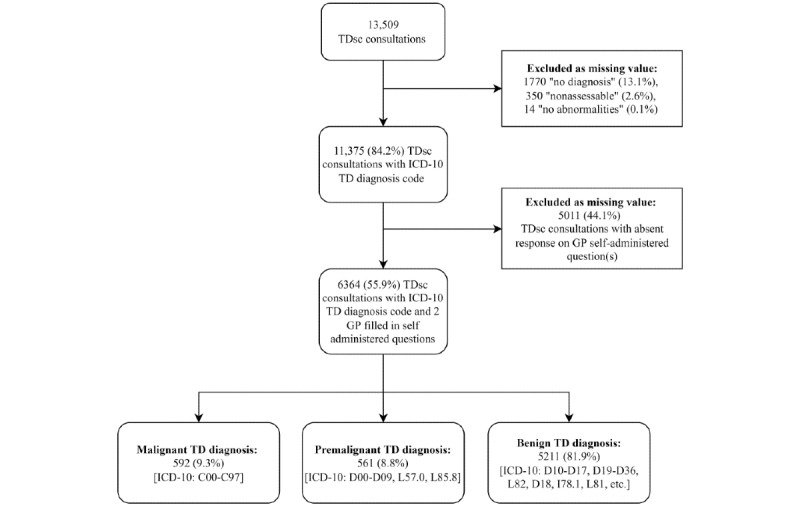
Results: GP self-administered questions and TD diagnoses were evaluated for 6364 TDsc consultations (9.3% malignant, 8.8% premalignant, and 81.9% benign skin lesions). In half of the TDsc consultations, GPs adjusted their initial referral decision after TD advice and TD diagnosis. Initially, GPs did not have the intention to refer 67 (56.8%) of 118 patients with a malignant TD diagnosis and 26 (16.0%) of 162 patients with a premalignant TD diagnosis but then decided to refer these patients after the TDsc consultation. Furthermore, GPs adjusted their decision from referral to nonreferral for 2534 (74.9%) benign skin lesions (including 676 seborrheic keratosis and 131 vascular lesions).
Conclusions: GPs adjusted their referral decision in 52% (n=3306) of the TDsc consultations after the TD assessment. The availability of TDsc is thus of added value and assists GPs in their (non)referral for patients with skin lesions to dermatology care. TDsc resulted in referrals of patients with (pre)malignant skin lesions that GPs would not have referred directly to the dermatologist. TDsc also led to a reduction of unnecessary referrals of patients with low complex benign skin lesions (eg, seborrheic keratosis and vascular lesions).
Keywords: GP; dermatologist; dermatology; dermoscopy; diagnose; diagnosis; diagnostic; family doctor; family physician; general practice; general practitioner; interprofessional; lesion; physician communication; refer; referral; skin; specialist; teledermoscopy; telehealth; telemedicine; triage; unnecessary referrals.
©Esmée Tensen, Femke van Sinderen, Marcel W Bekkenk, Monique W Jaspers, Linda W Peute. Originally published in JMIR Dermatology (http://derma.jmir.org), 23.09.2022.
Conflict of interest statement
Conflicts of Interest: ET and FvS are PhD researchers at the Amsterdam University Medical Center (UMC) and employed by Ksyos.
Figures
References
-
- van Rijsingen MCJ, Hanssen SCA, Groenewoud JMM, van der Wilt GJ, Gerritsen MP. Referrals by general practitioners for suspicious skin lesions: the urgency of training. Acta Derm Venereol. 2014 Mar;94(2):138–141. doi: 10.2340/00015555-1752. https://www.medicaljournals.se/acta/content/abstract/10.2340/00015555-1752 - DOI - PubMed
-
- Koelink CJL, Kollen BJ, Groenhof F, van der Meer K, van der Heide WK. Skin lesions suspected of malignancy: an increasing burden on general practice. BMC Fam Pract. 2014 Feb 12;15:29. doi: 10.1186/1471-2296-15-29. https://bmcfampract.biomedcentral.com/articles/10.1186/1471-2296-15-29 1471-2296-15-29 - DOI - PMC - PubMed
-
- Börve A, Dahlén Gyllencreutz J, Terstappen K, Johansson Backman E, Aldenbratt A, Danielsson M, Gillstedt M, Sandberg C, Paoli J. Smartphone teledermoscopy referrals: a novel process for improved triage of skin cancer patients. Acta Derm Venereol. 2015 Feb;95(2):186–190. doi: 10.2340/00015555-1906. http://www.medicaljournals.se/acta/content/?doi=10.2340/00015555-1906 - DOI - PubMed
LinkOut - more resources
Full Text Sources
