


Prompt treatment-seeking behaviour varies within communities among guardians of children with malaria-related fever in Malawi
- PMID: 37633902
- PMCID: PMC10463323
- DOI: 10.1186/s12936-023-04680-6
Prompt treatment-seeking behaviour varies within communities among guardians of children with malaria-related fever in Malawi
Abstract
Background: In Malawi, malaria is responsible for 40% of hospital deaths. Prompt diagnosis and effective treatment within 24 h of fever onset is critical to prevent progression from uncomplicated to severe disease and to reduce transmission.
Methods: As part of the large evaluation of the malaria vaccine implementation programme (MVIP), this study analysed survey data to investigate whether prompt treatment-seeking behaviour is clustered at community-level according to socio-economic demographics.
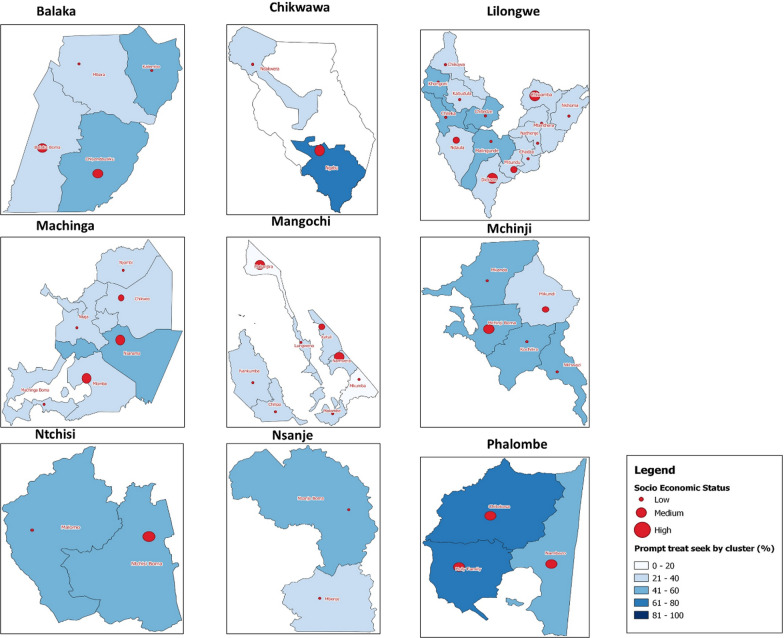
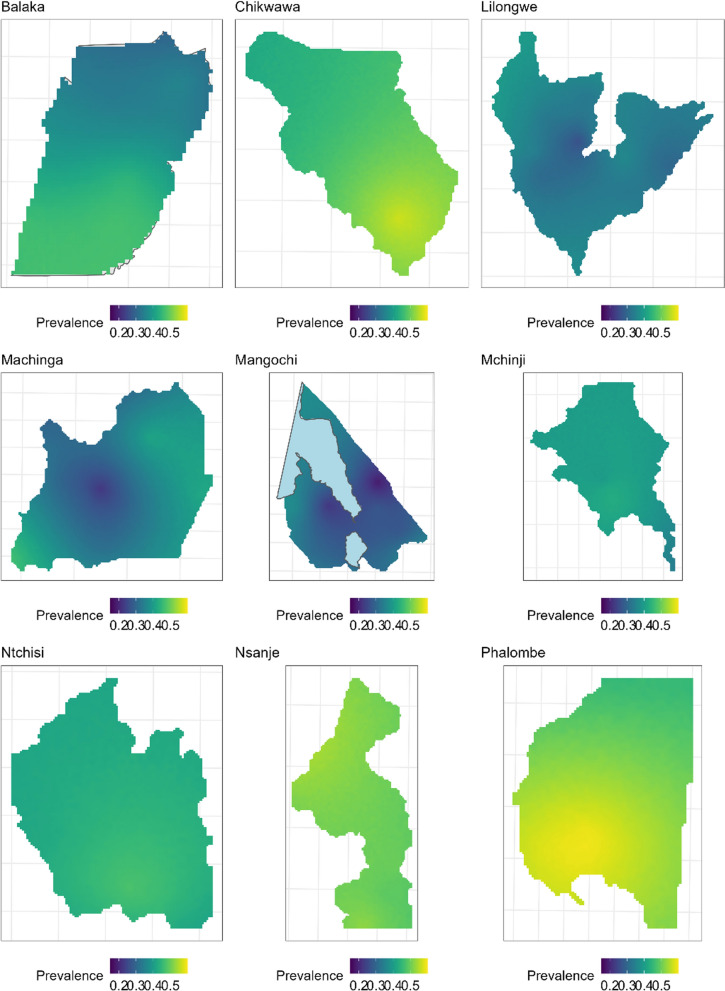
Results: From 4563 households included in the survey, 4856 children aged 5-48 months were enrolled. Out of 4732 children with documented gender, 52.2% were female and 47.8% male. Among the 4856 children, 33.8% reported fever in the two weeks prior to the survey. Fever prevalence was high in communities with low socio-economic status (SES) (38.3% [95% CI: 33.7-43.5%]) and low in areas with high SES (29.8% [95% CI: 25.6-34.2%]). Among children with fever, 648 (39.5%) sought treatment promptly i.e., within 24 h from onset of fever symptoms. Children were more likely to be taken for prompt treatment among guardians with secondary education compared to those without formal education (aOR:1.37, 95% CI: 1.11-3.03); in communities with high compared to low SES [aOR: 2.78, 95% CI: 1.27-6.07]. Children were less likely to be taken for prompt treatment if were in communities far beyond 5 km to health facility than within 5 km [aOR: 0.44, 95% CI: 0.21-0.92].
Conclusion: The high heterogeneity in prevalence of fever and levels of prompt treatment-seeking behaviour underscore the need to promote community-level malaria control interventions (such as use of long-lasting insecticide-treated nets (LLINs), indoor residual spraying (IRS), intermittent preventive therapy (IPT), presumptive treatment and education). Programmes aimed at improving treatment-seeking behaviour should consider targeting communities with low SES and those far from health facility.
Keywords: Fever; Malaria; Malawi; Prompt treatment-seeking.
© 2023. BioMed Central Ltd., part of Springer Nature.
Conflict of interest statement
The authors declare that they have no competing interests.
Figures

References
-
- WHO. World Malaria Report 2021. Geneva, World Health Organization, 2021.
-
- National Malaria Control Programme-NMCP/Malawi ICF International. Malawi Malaria Indicator Survey 2017. National Malaria Control Programme. Malawi Ministry of Health, Lilongwe, 2018.
-
- Tarimo DS, Lyimo EO, Moshiro C. Accuracy of fever and fraction of fevers attributable to malaria among under-fives under reduced malaria infection prevalence in district. Malar Chemother Control Elimin. 2014;3:1.
-
- WHO Global Malaria Programme . Global technical strategy for malaria 2016–2030. Geneva: World Health Organization; 2015.
MeSH terms
Substances
Grants and funding
LinkOut - more resources
Full Text Sources
Medical
Research Materials
