


Deforestation within breeding ranges may still drive population trends of migratory forest birds in the East Asian Flyway
- PMID: 37635179
- PMCID: PMC10460791
- DOI: 10.1038/s41598-023-40626-3
Deforestation within breeding ranges may still drive population trends of migratory forest birds in the East Asian Flyway
Abstract
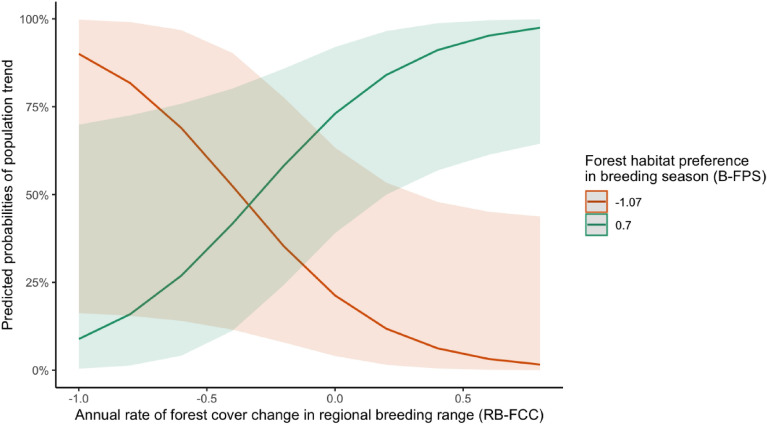
The East Asian Flyway (EAF) is the most species diverse of global flyways, with deforestation in its migratory landbird's non-breeding range suspected to be the main driver of population decline. Yet range-wide habitat loss impact assessments on EAF migratory landbirds are scarce, and seasonal variation in habitat preference of migratory species further increases the complexity for conservation strategies. In this study, we reviewed population trends of migratory forest breeding birds in the EAF along with their seasonal habitat preference from the literature and assessed the impact of forest cover change in species' breeding and non-breeding ranges on population trends. We found that 41.3% of the bird species with trend data available are declining, and most have higher forest preference in the breeding season. Despite 93.4% of the species experienced deforestation throughout their annual cycle, forest cover change in the non-breeding range was not identified as the main driver of population trend. However, forest cover change in species' regional breeding range interacts positively with the degree of breeding season forest preference in predicting population trends. We therefore stress that regional breeding habitat protection may still be important while following the call for cross-border collaboration to fill the information gap for flyway conservation.
© 2023. Springer Nature Limited.
Conflict of interest statement
The authors declare no competing interests.
Figures

References
-
- IPBES. Summary for policymakers of the global assessment report on biodiversity and ecosystem services of the Intergovernmental Science-Policy Platform on Biodiversity and Ecosystem Services. IPBES secretariat, Bonn, Germany. 10.5281/zenodo.3553579 (2019).
-
- Runge CA, Martin TG, Possingham HP, Willis SG, Fuller RA. Conserving mobile species. Front. Ecol. Environ. 2014;12:395–402. doi: 10.1890/130237. - DOI
Publication types
MeSH terms
LinkOut - more resources
Full Text Sources
Miscellaneous
