


Prognostic value of peritoneal scar-like tissue in patients with peritoneal metastases of ovarian origin presenting for curative-intent cytoreductive surgery
- PMID: 37635209
- PMCID: PMC10463384
- DOI: 10.1186/s12957-023-03153-z
Prognostic value of peritoneal scar-like tissue in patients with peritoneal metastases of ovarian origin presenting for curative-intent cytoreductive surgery
Abstract
Background: Complete cytoreductive surgery (CRS), remain the gold standard in the treatment of peritoneal metastases of ovarian cancer (PMOC). Given the increasing rate of neoadjuvant chemotherapy in patients with high PCI, prior abdominal surgeries, inflammation and fibrotic changes, the benefit of removing any "peritoneal scar-like tissues" (PST) during CRS, hasn't been thoroughly investigated. Our objective in this retrospective cohort was to identify the proportion of malignant cells positivity in PST of patients with PMOC, undergoing curative-intent CRS ± HIPEC.
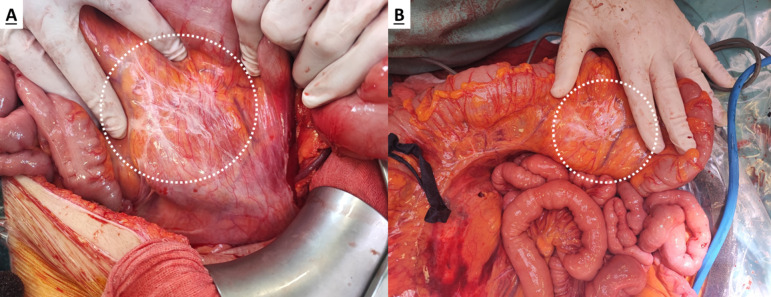
Methods: This is a retrospective study, conducted at our comprehensive cancer center, including patients with PMOC, presenting for curative-intent CRS. During CRS, benign-looking peritoneal lesions, lacking the typical hard nodular, aggressive, and invasive morphology, were systematically resected or electro fulgurated. PSTs were analyzed for the presence of tumoral cells by our pathologist. Correlations between the presence of PST and their positivity, and the different patients' variables, were studied.
Results: In 51% of patients, PST harbored malignant cells. Those were associated with poorly differentiated serous tumors, a high PCI (> 8) and a worse DFS: 17 months in the positive PST group versus 29 months in the negative PST group (p = 0.05), on univariate analysis. Multivariate analysis revealed that PCI > 8 and poorly differentiated primary tumor histology were correlated with a worse DFS, and that higher PCI and advanced FIGO were correlated with a worse OS.
Conclusion: Benign-looking PST harbors malignancy in 51% of cases. The benefit of their systematic resection and their prognostic value should be further investigated in larger cohorts.
Keywords: Cytoreductive surgery; Ovarian cancer; Peritoneal carcinomatosis; Peritoneal fibroses; Prognostic factors.
© 2023. BioMed Central Ltd., part of Springer Nature.
Conflict of interest statement
The authors declare no competing interests.
Figures
References
-
- Lockley M, Brockbank E, Fitzpatrick A. Chemotherapy response score: development and validation of a system to quantify histopathologic response to neoadjuvant chemotherapy in tubo-ovarian High-Grade Serous Carcinoma Gynaecological pathology book View project Cochrane review view project Asma Faruqi Barts health NHS trust. Article J Clinic Oncol. Published online 2015. 10.1200/JCO.2014.60.5212. - PubMed
-
- Du BA, Reuss A, Pujade-Lauraine E, Harter P, Ray-Coquard I, Pfisterer J. Role of surgical outcome as prognostic factor in advanced epithelial ovarian cancer: a combined exploratory analysis of 3 prospectively randomized phase 3 multicenter trials: by the arbeitsgemeinschaft gynaekologische onkologie studiengruppe ovarialkarzinom (AGO-OVAR) and the groupe d’Investigateurs nationaux pour les etudes des cancers de l’Ovaire (GINECO) Cancer. 2009;115(6):1234–1244. doi: 10.1002/CNCR.24149. - DOI - PubMed
-
- Vergote I, et al. Neoadjuvant chemotherapy or primary surgery in stage IIIC or IV ovarian cancer. N Engl J Med. 2010;363(10):943–53. - PubMed
MeSH terms
LinkOut - more resources
Full Text Sources
Medical
Miscellaneous
