Review
. 2023 Jul;18(4):100834.
doi: 10.1016/j.ajps.2023.100834. Epub 2023 Aug 1.

Advances in the development of amorphous solid dispersions: The role of polymeric carriers

Affiliations
Review

Advances in the development of amorphous solid dispersions: The role of polymeric carriers

Jie Zhang et al. Asian J Pharm Sci. 2023 Jul.

Abstract

Amorphous solid dispersion (ASD) is one of the most effective approaches for delivering poorly soluble drugs. In ASDs, polymeric materials serve as the carriers in which the drugs are dispersed at the molecular level. To prepare the solid dispersions, there are many polymers with various physicochemical and thermochemical characteristics available for use in ASD formulations. Polymer selection is of great importance because it influences the stability, solubility and dissolution rates, manufacturing process, and bioavailability of the ASD. This review article provides a comprehensive overview of ASDs from the perspectives of physicochemical characteristics of polymers, formulation designs and preparation methods. Furthermore, considerations of safety and regulatory requirements along with the studies recommended for characterizing and evaluating polymeric carriers are briefly discussed.

Keywords: Amorphous solid dispersions; Bioavailbility; Dissolution; Molecular interactions; Polymeric carriers; Stability.


Conflict of interest statement

The authors declare that there is no conflicts of interest.

Figures

Image, graphical abstract
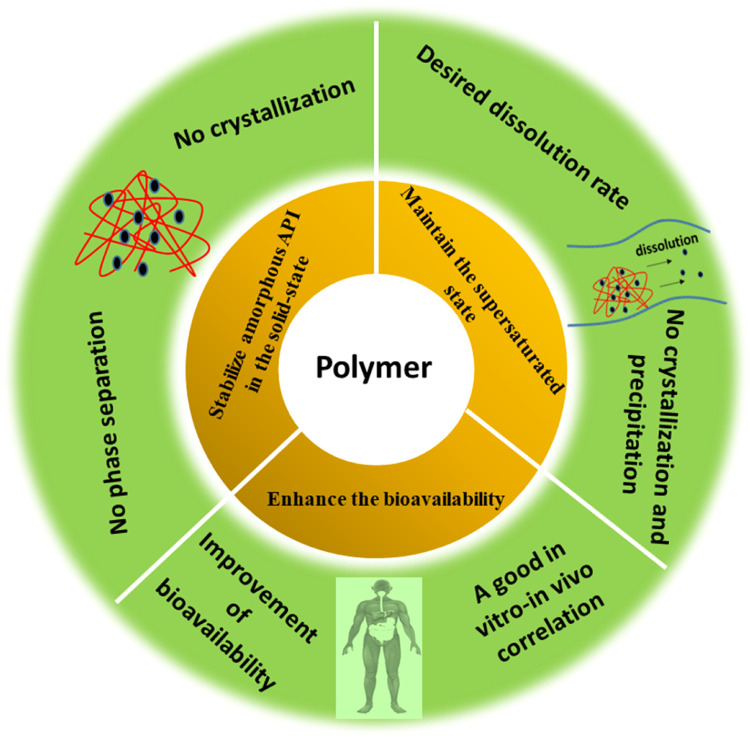
Graphical abstract
Fig 1
Fig. 1
Classification of polymeric carriers based on their chemical structures.
Fig 2
Fig. 2
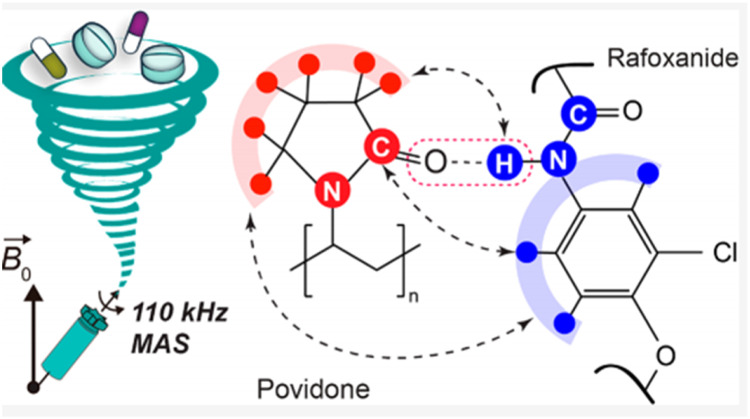
The hydrogen bonding interactions in rafoxanide-PVP ASDs. Adapted from with the permission.
Fig 3
Fig. 3
Two hydrogen-bonded patterns formed between POSA and HPMCAS . Adapted from with the permission.
Fig 4
Fig. 4
13C SSNMR spectra of Eudragit E (EGE), Naproxen (NAP)−EGE with different ratio ASDs, and crystalline NAP. Adapted from with the permission.
Fig 5
Fig. 5
Schematic illustration of the polymer characteristics needed for ASD formation.
Fig 6
Fig. 6
A typical temperature-composition phase diagram for an ASD.
Fig 7
Fig. 7
A schematic model for the ionic interactions between clofazimine and PAA. Adapted from [114]with the permission.
Fig 8
Fig. 8
The α-relaxation and β-relaxation times for different systems vs temperature (a). Crystallization for different systems vs time at 82 °C (b). Adapted from with the permission.
Fig 9
Fig. 9
The impacts of different polymers on the nucleation rate (J) and growth rate (u) of fluconazole Form II. Adapted from with the permission.
Fig 10
Fig. 10
Graphical illustration of the spring and parachute effect. Adapted from with the permission.
Fig 11
Fig. 11
Schematic representation of the impacts of polymers on balancing solid-state stabilities and dissolution rates of lumefantrine ASDs . Adapted from with the permission.
Fig 12
Fig. 12
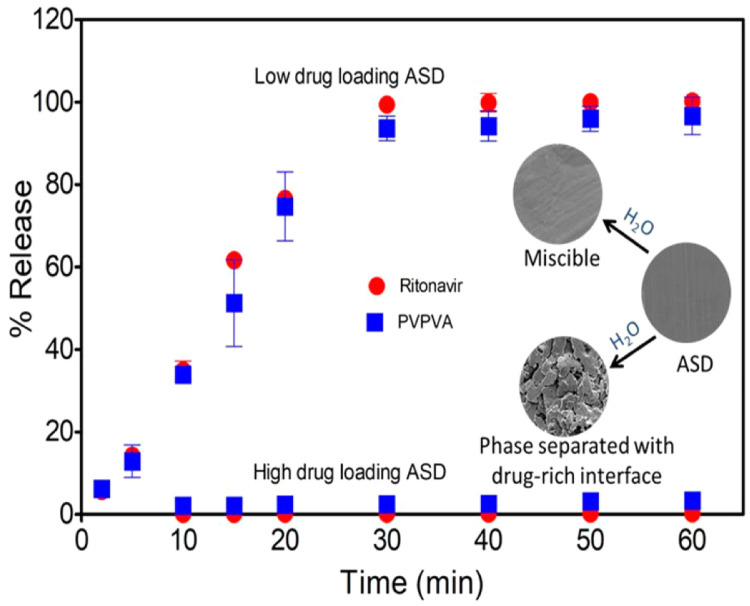
Percentages of RTV and PVPVA release from ASDs with different drug loadings . Adapted from with the permission.
Fig 13
Fig. 13
The contact angles of water on IMC, IMC-ASD tablets. Adapted from with the permission.
Fig 14
Fig. 14
Gel layers formation and dry cores within tablets after exposure to a dissolution medium for approximately 10 min; (A) 40% neat PVPVA; (B) 40% PVPVA-drug 80:20; (C) 40% neat HPMC and (D) 40% HPMC-drug 80:20 . Adapted from with the permission.
Fig 15
Fig. 15
Schematic for the relationships between drug-polymer interactions and the LoCs for ASDs . Adapted from [201]with the permission.
Fig 16
Fig. 16
Schematic for the dissolution and crystallization for bicalutamide/PVPVA ASDs (a) without residual crystallinity and (b) with residual crystallinity. Adapted from [209]with the permission.
Fig 17
Fig. 17
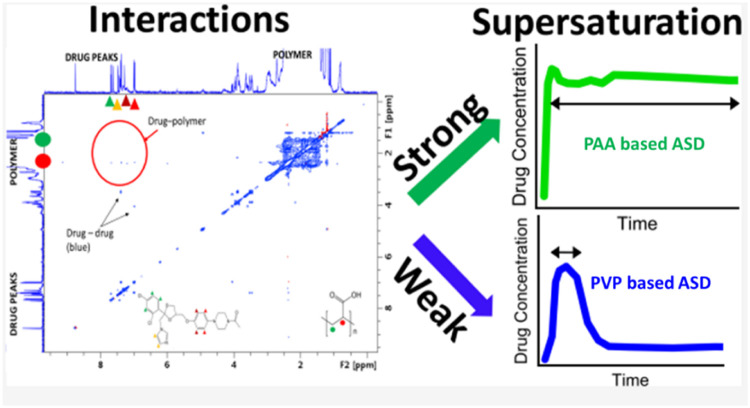
Schematic illustration of the interactions between ketoconazole and PAA, which were confirmed by two-dimensional 1H NOESY and the dissolution of KTZ ASDs formulated with PAA and PVP. Adapted from with the permission.
Fig 18
Fig. 18
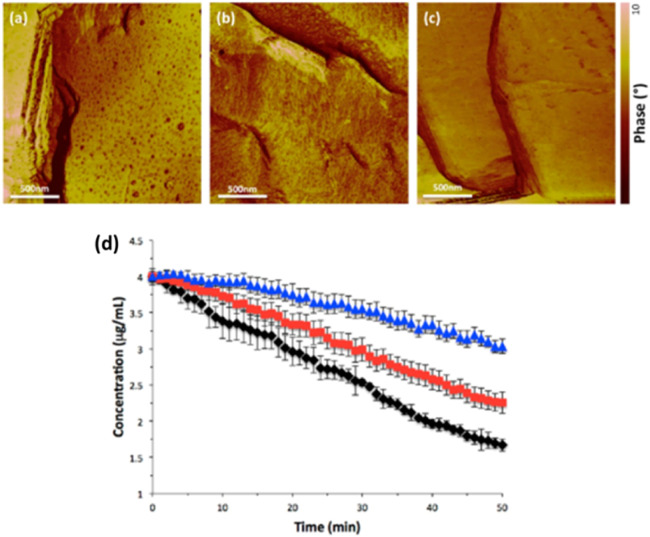
AFM images for HPMCAS adsorbed to felodipine (a) at pH 3, (b) pH 6.8, and (c) no HPMCAS adsorbed. (d) desupersaturation in the absence of HPMCAS (◆) and in the presence of HPMCAS at pH 3 (■) and pH 6.8 (▲) . Adapted from with the permission.
Fig 19
Fig. 19
Schematic illustration of IBP-rich nanodroplets stabilized by HPMC in supersaturated solution. Adapted from with the permission.
Fig 20
Fig. 20
Schematic illustration of the impacts of SLS on dissolution and bioavailability of PSZ/HPMCAS ASDs. Adapted from with the permission.
Fig 21
Fig. 21
Detailed considerations for ASD formulation development.

References

    1. Newman A., Zografi G. What we need to know about solid-state isothermal crystallization of organic molecules from the amorphous state below the glass transition temperature. Mol Pharm. 2020;17:1761–1777. - PubMed
    1. Pandi P., Bulusu R., Kommineni N., Khan W., Singh M. Amorphous solid dispersions: an update for preparation, characterization, mechanism on bioavailability, stability, regulatory considerations and marketed products. Int J Pharm. 2020;586 - PMC - PubMed
    1. Qi S., Craig D. Recent developments in micro- and nanofabrication techniques for the preparation of amorphous pharmaceutical dosage forms. Adv Drug Deliv Rev. 2016;100:67–84. - PubMed
    1. Singh A., Van den Mooter G. Spray drying formulation of amorphous solid dispersions. Adv Drug Deliv Rev. 2016;100:27–50. - PubMed
    1. Iyer R., Petrovska Jovanovska V., Berginc K., Jaklic M., Fabiani F., Harlacher C., et al. Amorphous solid dispersions (ASDs): the influence of material properties, manufacturing processes and analytical technologies in drug product development. Pharmaceutics. 2021;13:1682. - PMC - PubMed

LinkOut - more resources