


Epistaxis Treatment Options: Literature Review
- PMID: 37636777
- PMCID: PMC10447774
- DOI: 10.1007/s12070-023-03824-z
Epistaxis Treatment Options: Literature Review
Abstract
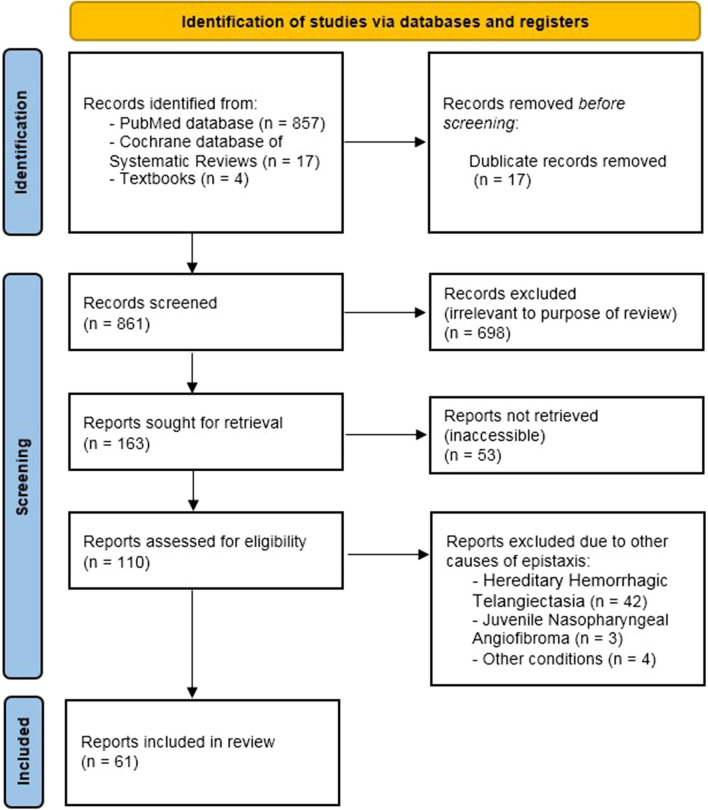
Epistaxis means bleeding from nostrils, nasal cavity or nasopharynx. To summarize the available epistaxis treatment options. Methods: 61 articles published in the last 20 years were included. Duplicate records, irrelevant and inaccessible ones were excluded. Epistaxis can be treated with first aid measures such as external pressure and ice packing and applying topical agents, e.g. oxymetazoline that stops 65-75% of nosebleeds in A&E. Also, with electrocautery which is more effective and has fewer recurrences (14.5% vs. 35.1%) than chemical cauterization and applying tranexamic acid that promotes hemostasis in 78% of patients, versus 35% and 31% respectively in patients treated with oxymetazoline and nasal packing. Furthermore, nasal packing can be applied with non-absorbable materials, e.g. petroleum jelly, BIPP gauze, PVA nasal tampons (Merocel), Foley catheter, balloons (Rapid-Rhino), absorbable materials, e.g. nasal tampon (Nasopore), and with newer hemostatic materials which are more effective and with fewer complications, e.g. hemostatic gauzes (Surgicel), thrombin matrix (Floseal), gelatin sponge (Spongostan) and fibrin glue. Moreover, epistaxis can be achieved with endoscopic ligation of arteries, mainly SPA, which is more effective than conventional nasal packing (97% vs. 62%), and with endoscopic cauterization which is more effective than ligation. Finally, for intractable cases embolization can be applied using gelatin sponge, foam, PVA and coils with 80% success rate and comparable efficacy and complications to surgical methods. Epistaxis can be dealt with various methods depending on patient's history and available resources. Newer hemostatic agents in combination with endoscopic methods have advantages over traditional methods.
Keywords: Embolization; Epistaxis; Ligation; Nasal packing; Treatment.
© Association of Otolaryngologists of India 2023. Springer Nature or its licensor (e.g. a society or other partner) holds exclusive rights to this article under a publishing agreement with the author(s) or other rightsholder(s); author self-archiving of the accepted manuscript version of this article is solely governed by the terms of such publishing agreement and applicable law.
Conflict of interest statement
Conflict of interestAll the authors that they have no conflict of interst.
Figures
References
-
- Kucik CJ, Clenney T. Management of epistaxis. Am Fam Physician. 2005;71(2):305–311. - PubMed
-
- Svider P, Arianpour K, Mutchnick S. Management of epistaxis in children and adolescents: avoiding a chaotic approach. Pediatr Clin North Am. 2018;65(3):607–621. - PubMed
-
- Khan M, Conroy K, Ubayasiri K, Constable J, Smith ME, Williams RJ, et al. Initial assessment in the management of adult epistaxis: systematic review. J Laryngol Otol. 2017;131(12):1035–1055. - PubMed
-
- Hajimaghsoudi M, Largani HA, Baradaranfar MH, Aghabagheri M, Jafari MA, Saeedi M. A novel method for epistaxis management: randomized clinical trial comparing nose clip with manual compression. Am J Emerg Med. 2018;36(1):149–150. - PubMed
-
- Béquignon E, Teissier N, Gauthier A, Brugel L, De Kermadec H, Coste A, et al. Emergency Department care of childhood epistaxis. Emerg Med J. 2017;34(8):543–548. - PubMed
LinkOut - more resources
Full Text Sources
Miscellaneous