Exogenous glutathione maintains the postharvest quality of mango fruit by modulating the ascorbate-glutathione cycle
- PMID: 37637166
- PMCID: PMC10452625
- DOI: 10.7717/peerj.15902
Exogenous glutathione maintains the postharvest quality of mango fruit by modulating the ascorbate-glutathione cycle
Abstract
Background: Mango fruit is prone to decay after harvest and premature senescence, which significantly lowers its quality and commercial value.
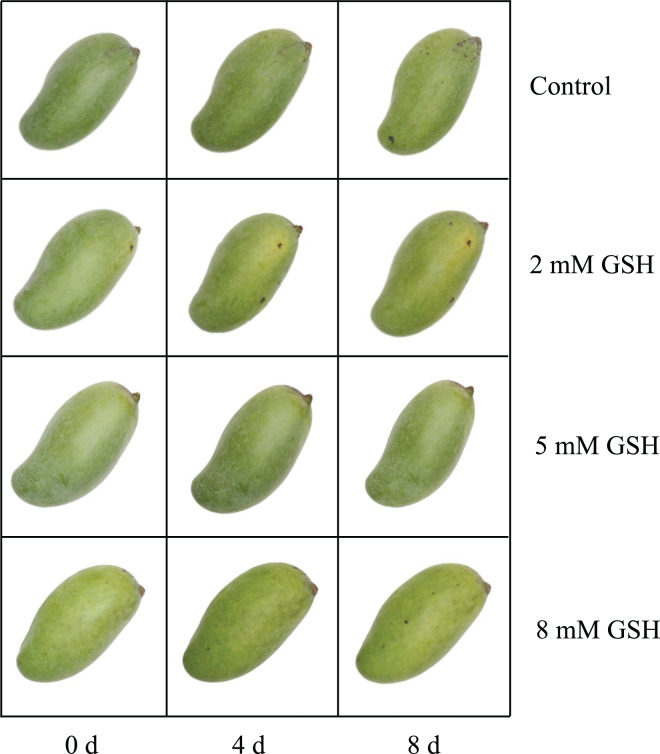
Methods: The mango fruit (Mangifera indica L.cv. Guixiang) was treated with 0 (control), 2, 5, and 8 mM of reduced glutathione (GSH) after harvest. The fruit was stored at 25 ± 1 °C for 12 days to observe the changes in the antioxidant capacity and postharvest quality.
Results: Compared with the control, the 5 mM GSH treatment significantly decreased the weight loss by 44.0% and 24.4%, total soluble solids content by 25.1% and 4.5%, and soluble sugar content by 19.0% and 27.0%. Conversely, the 5 mM GSH treatment increased the firmness by 25.9% and 30.7% on days 4 and 8, respectively, and the titratable acidity content by 115.1% on day 8. Additionally, the 5 mM GSH treatment decreased the malondialdehyde and hydrogen peroxide contents and improved the antioxidant capacity of mango fruit by increasing the superoxide dismutase and peroxidase activities and upregulating the expression of the encoding genes. Meanwhile, the higher levels of monodehydroascorbate reductase, dehydroascorbate reductase, and glutathione reductase enzyme activities and gene expressions accelerated the AsA-GSH cycle, thereby increasing the accumulation of AsA and GSH and maintaining the redox balance.
Conclusions: Overall, the experimental results suggest that 5 mM GSH maintains high antioxidant capacity and postharvest quality of mangoes and can use as an effective preservation technique for postharvest mangoes.
Keywords: Antioxidant; Fruit quality; Glutathione; Mango; Reactive oxygen species.
© 2023 Zhou et al.
Conflict of interest statement
The authors declare that they have no competing interests.
Figures


References
-
- Bartoli CG, Buet A, Gergoff Grozeff G, Galatro A, Simontacchi M. Ascorbate-glutathione cycle and abiotic stress tolerance in plants. In: Hossain MA, Munné-Bosch S, Burritt DJ, Diaz-Vivancos P, Fujita M, Lorence A, editors. Ascorbic Acid in Plant Growth, Development and Stress Tolerance. Cham: Springer International Publishing; 2017. pp. 177–200.
-
- Cakmak I, Strbac D, Marschner H. Activities of hydrogen peroxide-scavenging enzymes in germinating wheat seeds. Journal of Experimental Botany. 1993;44(1):127–132. doi: 10.1093/jxb/44.1.127. - DOI
-
- Costa H, Gallego SM, Tomaro ML. Effect of UV-B radiation on antioxidant defense system in sunflower cotyledons. Plant Science. 2002;162(6):939–945. doi: 10.1016/S0168-9452(02)00051-1. - DOI
Publication types
MeSH terms
Substances
LinkOut - more resources
Full Text Sources
Medical