


Short-term effects of national smoking cessation service on smoking-related disease prevalence and healthcare costs: Experience from the National Health Insurance Service Smoking Cessation Intervention Program in Korea
- PMID: 37637229
- PMCID: PMC10448735
- DOI: 10.18332/tid/169654
Short-term effects of national smoking cessation service on smoking-related disease prevalence and healthcare costs: Experience from the National Health Insurance Service Smoking Cessation Intervention Program in Korea
Abstract
Introduction: We measured the short-term clinical and economic impacts of the National Health Insurance Service (NHIS) smoking cessation program, which subsidizes the cost of pharmacotherapy and medical consultations, by comparing the changes in prevalence and healthcare costs of smoking-related diseases among cessation service users, non-users, and never smokers.
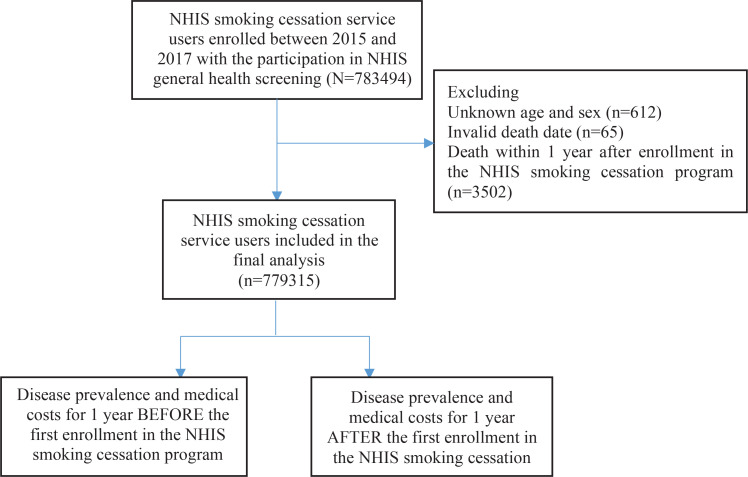
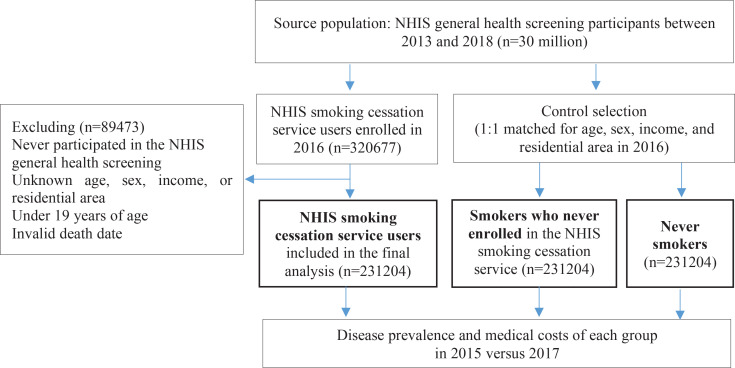
Methods: Smokers who used the cessation service from 2015 to 2017 were included (n=779315). We used claims data from the NHIS, a mandatory, single-payer insurance covering the entire Korean population, to determine the number of patients with selected diseases, their healthcare utilization, and medical costs, and compared these amounts in the one year before and after enrollment. For further comparison, we also estimated disease prevalence and medical costs in matched controls by age, sex, income, and residential area, including never smokers and smokers who never used the cessation program.
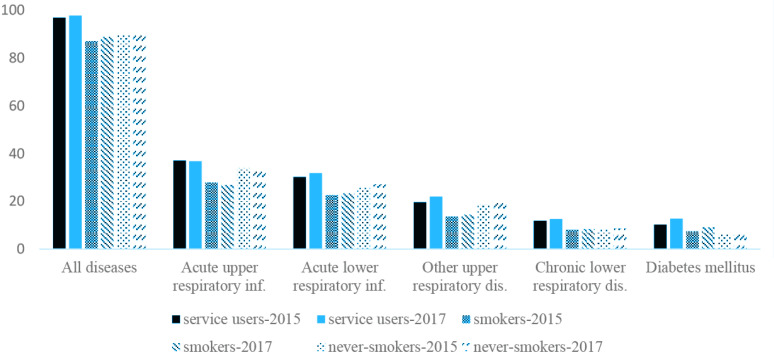
Results: Across all 15 selected diseases, the number of patients, days spent in the hospital, and medical costs for 1 year were consistently higher after service enrollment than before. This pattern was observed for both men and women. Notably, decreased prevalence and medical costs for pneumonia were observed among individuals aged <50 years. Healthcare utilization for any kind of disease for 1 year was 97.7%, 91.1%, and 88.8% among cessation service users, never smokers, and smokers who did not use the cessation service, respectively. The disease-specific prevalence was also highest and increased more in the cessation service users compared with the control groups.
Conclusions: Cessation service users were more likely to seek healthcare. Increased healthcare utilization in the first year after cessation service use may have resulted from smoking-related conditions that led individuals to attempt smoking cessation.
Keywords: Korea; benefit; cessation; cost; smoking.
© 2023 Oh J.K. et al.
Conflict of interest statement
The authors have each completed and submitted an ICMJE form for disclosure of potential conflicts of interest. The authors declare that they have no competing interests, financial or otherwise, related to the current work. All authors declare that since the initial planning of the work, financial support was provided by the Korean Ministry of Health and Welfare (11-1352000-002705-01) and NRF-2020R1A2C2012295.
Figures
Similar articles
-
The effects of smoking habit change on the risk of depression-Analysis of data from the Korean National Health Insurance Service.J Affect Disord. 2022 Apr 1;302:293-301. doi: 10.1016/j.jad.2022.01.095. Epub 2022 Jan 24. J Affect Disord. 2022. PMID: 35085672
-
Estimating the public economic consequences of introducing varenicline smoking cessation therapy in South Korea using a fiscal analytic framework.J Med Econ. 2018 Jun;21(6):571-576. doi: 10.1080/13696998.2018.1434183. Epub 2018 Feb 13. J Med Econ. 2018. PMID: 29376747
-
Healthcare costs around the time of smoking cessation.Am J Prev Med. 2012 Jun;42(6):596-601. doi: 10.1016/j.amepre.2012.02.019. Am J Prev Med. 2012. PMID: 22608375 Free PMC article. Clinical Trial.
-
Varenicline: a pharmacoeconomic review of its use as an aid to smoking cessation.Pharmacoeconomics. 2010;28(3):231-54. doi: 10.2165/11204380-000000000-00000. Pharmacoeconomics. 2010. PMID: 20108995 Review.
-
Motivational support intervention to reduce smoking and increase physical activity in smokers not ready to quit: the TARS RCT.Health Technol Assess. 2023 Mar;27(4):1-277. doi: 10.3310/KLTG1447. Health Technol Assess. 2023. PMID: 37022933 Free PMC article.
Cited by
-
Switching from Cigarettes to Heated Tobacco Products in Japan-Potential Impact on Health Outcomes and Associated Health Care Costs.Healthcare (Basel). 2024 Sep 27;12(19):1937. doi: 10.3390/healthcare12191937. Healthcare (Basel). 2024. PMID: 39408118 Free PMC article.
-
Global, Regional, and National Burden of Smoking-Related Diseases and Associations With Health Workforce Distribution, 1990-2021: Analysis From the Global Burden of Disease Study 2021.Int J Public Health. 2025 Jul 2;70:1608217. doi: 10.3389/ijph.2025.1608217. eCollection 2025. Int J Public Health. 2025. PMID: 40671918 Free PMC article.
References
-
- Clinical Practice Guideline Treating Tobacco Use and Dependence 2008 Update Panel, Liaisons, and Staff A clinical practice guideline for treating tobacco use and dependence: 2008 update. A U.S. Public Health Service report. Am J Prev Med. 2008;35(2):158–176. doi: 10.1016/j.amepre.2008.04.009. - DOI - PMC - PubMed
-
- National Center for Chronic Disease Prevention and Health Promotion (US) Office on Smoking and Health . The Health Consequences of Smoking—50 Years of Progress: A Report of the Surgeon General. Centers for Disease Control and Prevention (US); 2014. - PubMed
-
- Twardella D, Küpper-Nybelen J, Rothenbacher D, Hahmann H, Wüsten B, Brenner H. Short-term benefit of smoking cessation in patients with coronary heart disease: estimates based on self-reported smoking data and serum cotinine measurements. Eur Heart J. 2004;25(23):2101–2108. doi: 10.1016/j.ehj.2004.08.017. - DOI - PubMed
LinkOut - more resources
Full Text Sources