Review
. 2023 Jul 26;9(8):1525-1537.
doi: 10.1021/acscentsci.3c00304. eCollection 2023 Aug 23.

Robotic Modules for the Programmable Chemputation of Molecules and Materials

Affiliations
Review

Robotic Modules for the Programmable Chemputation of Molecules and Materials

Daniel Salley et al. ACS Cent Sci. .

Abstract

Before leveraging big data methods like machine learning and artificial intelligence (AI) in chemistry, there is an imperative need for an affordable, universal digitization standard. This mirrors the foundational requisites of the digital revolution, which demanded standard architectures with precise specifications. Recently, we have developed automated platforms tailored for chemical AI-driven exploration, including the synthesis of molecules, materials, nanomaterials, and formulations. Our focus has been on designing and constructing affordable standard hardware and software modules that serve as a blueprint for chemistry digitization across varied fields. Our platforms can be categorized into four types based on their applications: (i) discovery systems for the exploration of chemical space and novel reactivity, (ii) systems for the synthesis and manufacture of fine chemicals, (iii) platforms for formulation discovery and exploration, and (iv) systems for materials discovery and synthesis. We also highlight the convergent evolution of these platforms through shared hardware, firmware, and software alongside the creation of a unique programming language for chemical and material systems. This programming approach is essential for reliable synthesis, designing experiments, discovery, optimization, and establishing new collaboration standards. Furthermore, it is crucial for verifying literature findings, enhancing experimental outcome reliability, and fostering collaboration and sharing of unsuccessful experiments across different research labs.


Conflict of interest statement

The authors declare no competing financial interest.

Figures
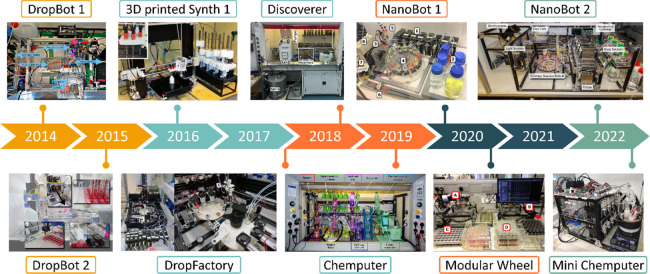
Figure 1
Figure 1
Platform evolution timeline for the most representative platforms developed within the group for discovery, multistep organic/inorganic synthesis, and formulations.
Figure 2
Figure 2
Finder platforms. (a) Three flow reactor platforms used for reaction discovery composed of an ESI-MS and a flow FTIR for analysis, and syringe pumps for liquid handling. (b) Optimization pathway using a reaction selection index (RSI). (c) Inorganic finder platform used for an autonomous discovery of inorganic moieties. The platform is composed of an ESI-MS for analysis and syringe pumps for liquid handling. (d) Helical coordination complexes discovered in a 6D parameter search space.
Figure 3
Figure 3
Reactivity prediction finder platforms. (a) Automated platform for reaction prediction comprised by an ESI-MS, NMR, and AT-IR for analysis and syringe pumps for liquid handling. (b) Optimization pathway using the reaction selection index (RSI). (b) Vector representation of chemical reactions used for determining if the mixture was reactive or nonreactive. (c) Photoreactor finder platform composed of an ESI-MS and NMR for analysis and syringe pumps for liquid handling. (d) A closed-loop approach for chemical space exploration where after every reaction and NMR and MS spectra are collected, processed, and used to formulate the next experiment to be performed automatically.
Figure 4
Figure 4
Multistep organic synthesis systems. (a) Reactobot platform: a 3D printer architecture along with in-house built syringe pumps to print reactionware vessels and dispense reactants simultaneously used for the synthesis of ibuprofen. (b) Chemputer platform: an organic synthesis system used for the preparation of diphenhydramine hydrochloride, rufinamide, and sildenafil. (c) C3PU platform: A miniaturized chemputer implementing reactionware systems used for the synthesis of small organic molecules, oligopeptides, and oligonucleotides. (d–f) Software implementation evolution that came along with the platforms, starting with a simple process control software to execute individual steps (d), going through to a programming language that involves higher level execution steps along with a graphical representation of the physical instances of the platform and connectivity (e), and finalizing with XDL, a platform independent programming description language (f).
Figure 5
Figure 5
Droplet platforms. (a) Dropbot 1: first droplet robotic, developed from the Rep-Rap 3D printer architecture. (i) Top view of the preparation and moving axis assemblies, (ii) mobile syringe unit preparing droplet mixtures in a well plate, (iii) multiple syringes producing droplets in a Petri dish above a camera setup. (b) 3D printed droplet flow platform. (c) DropFactory system composed of a dual Geneva wheel setup. (i) Droplet material dispensing assembly, (ii) light isolated recording, (iii) drying fan positions, (iv) cleaning station, and (v) assembly for extracting material from the production reservoir to produce droplets on the experimental station. (d) Graphical scheme of Dropfactory showing the action performed at each of the 8 positions of both Geneva wheels.
Figure 6
Figure 6
Modular system for parallel syntheses of inorganic materials. (a) Scheme of networked robotic systems used for collaborative synthesis platforms. (b) Nanomaterials optimization platform using a genetic algorithm to target UV signals composed of a 15 vial Geneva wheel with individual stirring and sample extraction assemblies, syringe pumps for liquid handling, and a UV–vis flow setup for analysis. (c) Modular wheel platform (MWP) for high throughput syntheses and exploration of polyoxometalates. (d) The platform is composed of a Z motion and dual Z motion for syringe assemblies as well as an XZ/YZ motion setup. These modules can be used to adapt tubing, probes, dispensing needles, overhead stirring, and electrodes in the automated workflow. (e) Advanced MWP used for the closed-loop multistep nanomaterial synthesis with in-line spectroscopy. The platform includes a pH control, sample extraction, and reaction to reaction seeding assemblies, along with high performance UV–vis, IR and Raman spectrometers for analysis, and syringe pumps for liquid handling.
Figure 7
Figure 7
Abstraction of the unit operations for the chemical processes (center) shown applied to a robot arm system (left) and a chemputer system (right).
Figure 8
Figure 8
Process optimization from the procedure described in the abstract unit operations to be optimized (top) to the design of experiments campaign (middle) which is then implemented on the hardware (bottom).

References

    1. Baker M. Is There a Reproducibility Crisis?. Nature 2016, 533, 452–454. 10.1038/533452a. - DOI - PubMed
    1. Merrifield R. B. Automated Synthesis of Peptides. Science 1965, 150, 178. 10.1126/science.150.3693.178. - DOI - PubMed
    1. Plante O. J.; Palmacci E. R.; Seeberger P. H. Automated solid-phase synthesis of oligosaccharides. Science 2001, 291, 1523–1527. 10.1126/science.1057324. - DOI - PubMed
    1. Caruthers M. H. Gene Synthesis Machines - DNA Chemistry and Its Uses. Science 1985, 230, 281–285. 10.1126/science.3863253. - DOI - PubMed
    1. Blanc F.; et al. Dynamic Nuclear Polarization NMR Spectroscopy Allows High-Throughput Characterization of Microporous Organic Polymers. J. Am. Chem. Soc. 2013, 135, 15290–15293. 10.1021/ja408074v. - DOI - PubMed