


Perceptions of antimicrobial stewardship: identifying drivers and barriers across various professions in Canada utilizing a one health approach
- PMID: 37637830
- PMCID: PMC10456999
- DOI: 10.3389/fpubh.2023.1222149
Perceptions of antimicrobial stewardship: identifying drivers and barriers across various professions in Canada utilizing a one health approach
Abstract
Introduction: As antimicrobial resistance (AMR) represents a substantial threat to the efficacy of available antimicrobial options, it is important to understand how to implement effective and practical mitigation efforts, including antimicrobial stewardship (AMS), across human, animal, and environmental sectors.
Methods: A mixed-methods questionnaire was distributed virtually to attendees of the virtual One Health Antimicrobial Stewardship Conference (March 10-12, 2021) and their professional networks. Respondents (n = 81) were largely from the veterinary (75%) or human (19%) health sectors. Qualitative data were analyzed in NVivo using template analysis whereas quantitative data were analyzed in STATA using Kruskall-Wallis tests. The questionnaire asked respondents about their perceptions of AMS, as well as the perceived barriers and drivers of AMS efforts.
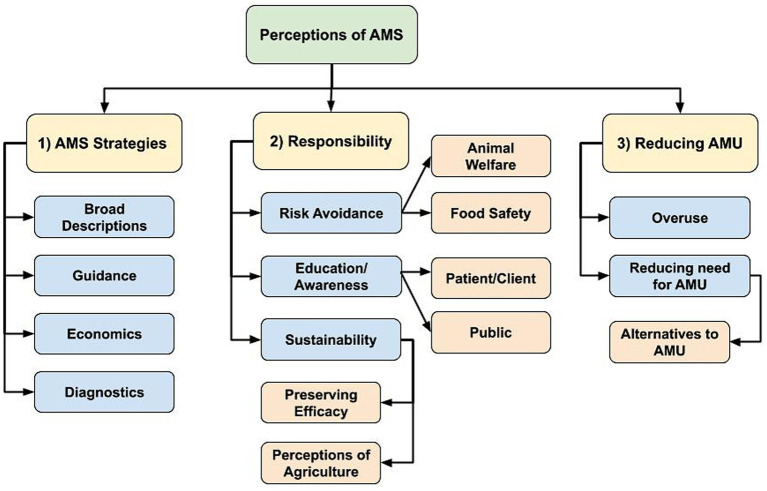
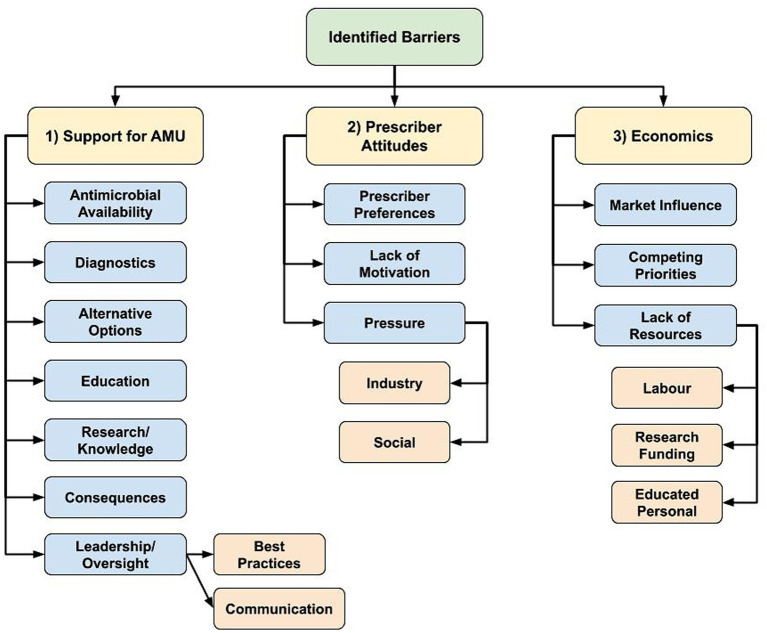
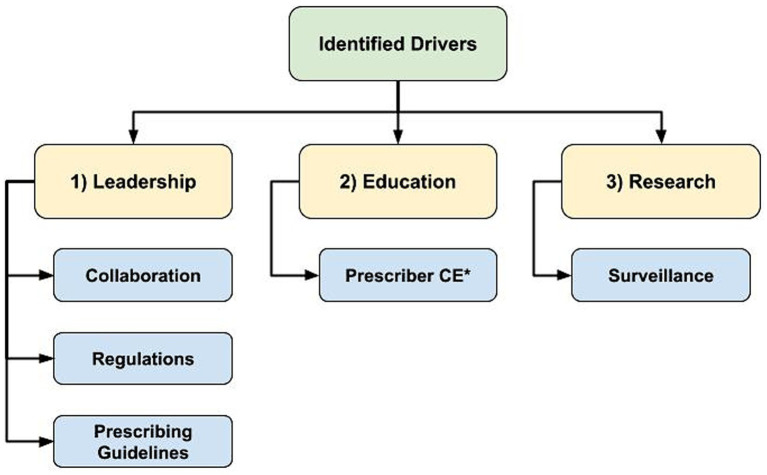
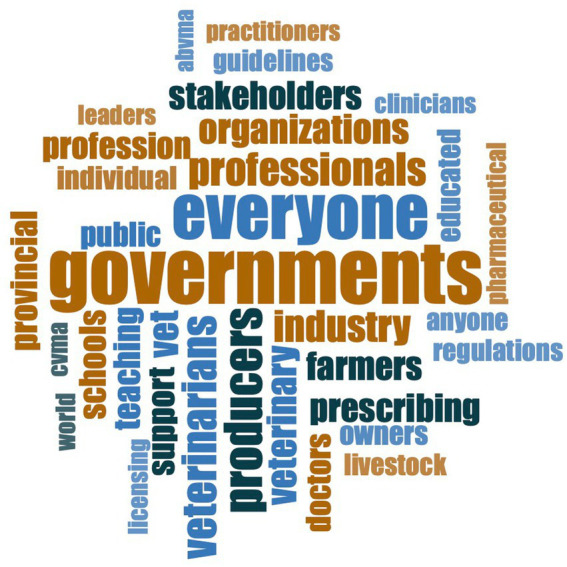
Results: Perceptions of what AMS meant to the respondents personally and their profession as a whole were grouped into 3 main themes: 1) AMS strategies or considerations in antimicrobial prescribing and use; 2) responsibility to maintain health and preserve antimicrobial effectiveness; and 3) reducing antimicrobial use (AMU) as a goal of AMS efforts. Identified AMS barriers had 3 main themes: 1) lack of various prescribing and AMU support mechanisms; 2) shift in prescriber attitudes to drive change; and 3) stronger economic considerations to support shifting prescribing practices. Drivers of AMS had the following themes: 1) leadership to guide change; 2) education to support optimizing AMU; and 3) research to identify best practices and opportunities for action. Across all questions, 2 cross-cutting themes emerged: 1) a One Health understanding of AMS; and 2) blame placed on others for a lack of AMS success.
Conclusion: Overall, sector-specific, but particularly cross-sectoral AMS drivers and barriers were identified, highlighting the importance of a One Health approach in AMR research and mitigation.
Keywords: Canada; antimicrobial resistance; antimicrobial stewardship; drivers and barriers; one health.
Copyright © 2023 McCubbin, de Jong, Smid, Ida, Bodaneze, Anholt, Larose, Otto and Barkema.
Conflict of interest statement
The authors declare that the research was conducted in the absence of any commercial or financial relationships that could be construed as a potential conflict of interest.
Figures
References
-
- Council of Canadian Academies . (2019). When antibiotics fail: the expert panel on the potential socio-economic impacts of antimicrobial resistance in Canada. Available at: https://cca-reports.ca/wp-content/uploads/2018/10/When-Antibiotics-Fail-... (Accessed July 12, 2023).
-
- World Health Organization . (2015). Global action plan on antimicrobial resistance. Available at: https://apps.who.int/iris/bitstream/handle/10665/193736/9789241509763_en... (Accessed July 15, 2023).
-
- Wall B.A., Mateus A., Marshall L., Pfeiffer D.U. (2016). Drivers, dynamics and epidemiology of antimicrobial resistance in animal production. Available at: http://www.fao.org/3/i6209e/i6209e.pdf (Accessed July 13, 2023).
-
- Tang KL, Caffrey NP, Nóbrega DB, Cork SC, Ronksley PE, Barkema HW, et al. Restricting the use of antibiotics in food-producing animals and its associations with antibiotic resistance in food-producing animals and human beings: a systematic review and meta-analysis. Lancet Planet Health. (2017) 1:e316–27. doi: 10.1016/S2542-5196(17)30141-9, PMID: - DOI - PMC - PubMed
Publication types
MeSH terms
LinkOut - more resources
Full Text Sources
Research Materials
