. 2023 Nov 14;7(21):6710-6716.
doi: 10.1182/bloodadvances.2023010665.

Inflammatory reactions mimic residual or recurrent lymphoma on [18F]FDG-PET/CT after CD19-directed CAR T-cell therapy

Affiliations

Inflammatory reactions mimic residual or recurrent lymphoma on [18F]FDG-PET/CT after CD19-directed CAR T-cell therapy

Janneke W de Boer et al. Blood Adv. .
No abstract available


Conflict of interest statement

Conflict-of-interest disclosure: P.G.N.J.M. received research funding from AstraZeneca and served on the advisory board of GlaxoSmithKline. M.J. received honoraria from Kite/Gilead and Bristol Myers Squibb/Celgene; serves in an advisory role for Janssen; and received research funding from Novartis. M.W.M.v.d.P. received honoraria from Kite/Gilead and Takeda. A.D. received research funding from Takeda. A.G.H.N. discloses conflicts of interest all outside the submitted work with IBA, Philips, Mirada, RaySearch, Siemens, Elekta, Leonie, and Genentech. M.J.K. received honoraria from Bristol Myers Squibb, Celgene, Kite/Gilead, Miltenyi Biotech, Adicet Bio, Novartis, and Roche; received research funding from Kite/Gilead, Roche, Takeda, and Celgene; has an advisory role in Bristol Myers Squibb, Celgene, Kite/Gilead, Miltenyi Biotech, Adicet Bio, Novartis, and Roche; and received travel support from Kite/Gilead, Miltenyi Biotech, Novartis, and Roche. T.v.M. received research funding from Kite/Gilead, Celgene/Bristol Myers Squibb, Genentech, and Siemens, and has served on advisory boards of Kite/Gilead, Celgene/Bristol Myers Squibb, Jansen, and Lilly. The remaining authors declare no competing financial interests.

Figures

Figure 1.
Figure 1.
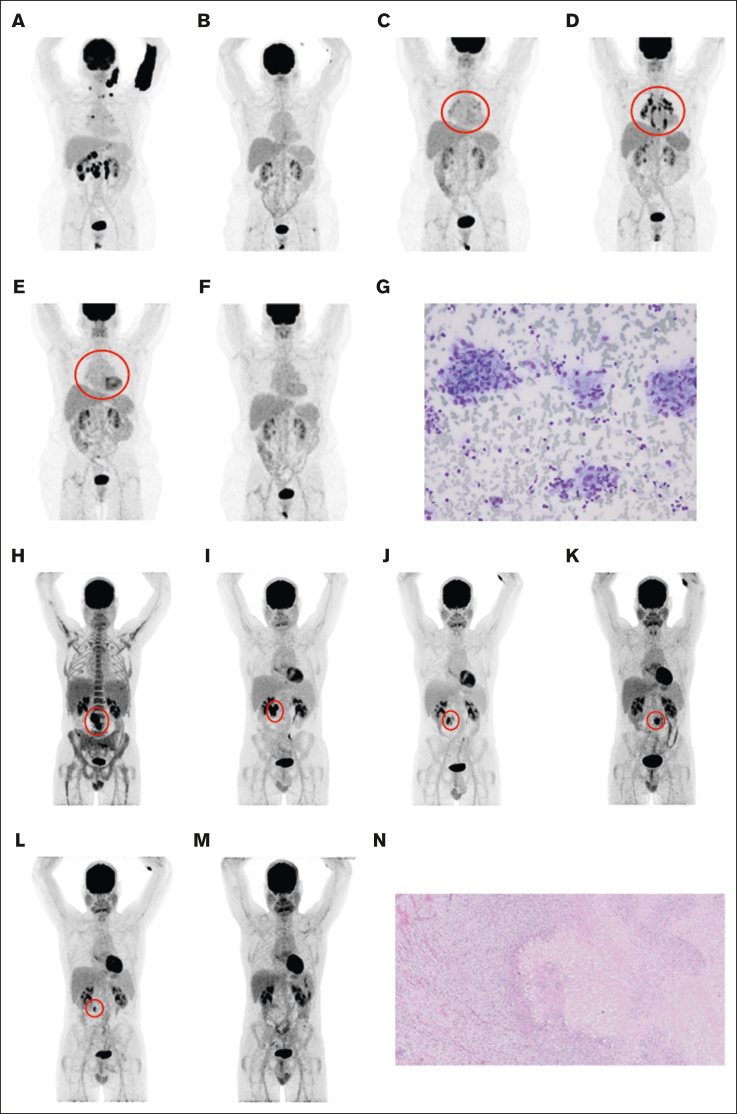
Representative case of an SLR and an HR. A 66-year-old patient diagnosed with transformed follicular lymphoma, with an SLR after CAR-T therapy. No therapy was given during the bridging phase. (A) [18F]FDG-PET/CT maximum intensity projection (MIP) overview before CAR-T infusion shows widespread localizations of lymphoma and extravasation of contrast. The [18F]FDG-PET/CT at 1 (B), 3, and 6 months after infusion showed disappearance or normalization in size and metabolic activity of the previously described lymphoma localizations, consistent with a metabolic complete response. (C) The routine [18F]FDG-PET/CT 9 months after infusion revealed new symmetric bilateral hilar and mediastinal lymphadenopathy with increased [18F]FDG uptake, without suspicion of recurrent disease at the other original localizations. Biopsy of 1 of the [18F]FDG-avid lymph nodes revealed nonnecrotic granulomatous changes, so follow-up was chosen. (D) On the [18F]FDG-PET/CT 12 months after infusion, the hilar and mediastinal lymphadenopathy persisted and the intensity increased. Again, biopsy of [18F]FDG-avid lymph nodes was performed, which again showed tissue with reactive changes consisting of nonnecrotic granulomas. Tuberculosis was ruled out via polymerase chain reaction and culture. Because our patient was doing fine and the radiological pattern and pathology findings were consistent with an SLR, we considered this the working diagnosis, and no treatment was administered. Fifteen (E), 18, and 24 (F) months after infusion of CAR-Ts, lymphadenopathy spontaneously disappeared. To date, this patient is in remission of lymphoma. (G) Histopathological results from [18F]FDG-avid lymph nodes after CAR-T infusion showed reactive changes consisting of nonnecrotic granulomas, without evidence of lymphoma (Giemsa stain, scale 200x). (H) A 47-year-old patient diagnosed with DLBCL stage IV with a HR after CAR-T therapy. [18F]FDG-PET/CT MIP overview at screening for CAR-T therapy shows a movable mesenterial lymphoma lesion. (I) Partial regression of the lesion after radiotherapy during the bridging phase. (J) At response evaluation, 28 days after infusion, a region with high [18F]FDG uptake is visible at original tumor localization. (K) Compared with [18F]FDG-PET/CT at 28 days after infusion, the residual high [18F]FDG uptake region increased. A biopsy was performed, and histopathological examination showed an HR with no lymphoma. (L) Partial regression of [18F]FDG uptake at the 9-month evaluation. (M) Complete regression of the HR 12 months after CAR-T infusion. (N) Histopathological results from the biopsy at 3 months showed a necrotic center of lymphoma cells surrounded by sheets of foamy histiocytes (Hematoxylin and eosin staining, scale 50x).

References

    1. Locke FL, Ghobadi A, Jacobson CA, et al. Long-term safety and activity of axicabtagene ciloleucel in refractory large B-cell lymphoma (ZUMA-1): a single-arm, multicentre, phase 1-2 trial. Lancet Oncol. 2019;20(1):31–42. - PMC - PubMed
    1. Abramson JS, Palomba ML, Gordon LI, et al. Lisocabtagene maraleucel for patients with relapsed or refractory large B-cell lymphomas (TRANSCEND NHL 001): a multicentre seamless design study. Lancet. 2020;396(10254):839–852. - PubMed
    1. Schuster SJ, Bishop MR, Tam CS, et al. JULIET Investigators Tisagenlecleucel in adult relapsed or refractory diffuse large B-cell lymphoma. N Engl J Med. 2019;380(1):45–56. - PubMed
    1. Wang M, Munoz J, Goy A, et al. KTE-X19 CAR T-cell therapy in relapsed or refractory mantle-cell lymphoma. N Engl J Med. 2020;382(14):1331–1342. - PMC - PubMed
    1. Ruff A, Ballard HJ, Pantel AR, et al. 18F-fluorodeoxyglucose positron emission tomography/computed tomography following chimeric antigen receptor T-cell therapy in large B-cell lymphoma. Mol Imaging Biol. 2021;23(6):818–826. - PMC - PubMed

Publication types

MeSH terms